 Lynden Siding
 Bellingham's Exterior Climate: A Tougher Job Than It Looks
Bellingham sits right on the water, and that changes what a house actually has to survive year to year. Homes closer to the bay deal with a steady drift of salt-laden air that finds its way into seams, fasteners, and any exposed wood trim. Combine that with the marine layer's near-constant humidity and Whatcom County's long, wet winters, and you get an exterior that rarely gets a real chance to fully dry out between storms. Add the region's shaded lots and mature tree cover, and moss and algae become a near year-round tenant on roofs, siding, and anything north-facing.
None of this is unusual for the area — it's just the trade-off of living somewhere this green and this close to Puget Sound. But it does mean the exterior materials and workmanship on a Bellingham home need to be chosen with those specific stresses in mind, not generic "Pacific Northwest weather" assumptions. A product or installation detail that holds up fine in a drier inland climate can fail years sooner here.
What Salt Air Actually Does
Salt exposure accelerates corrosion on exposed metal fasteners, flashing, and hardware. It also tends to hold moisture against surfaces longer than plain rainfall does, which matters most at the joints and edges of any siding system — the places where water intrusion actually starts.
Why Moss Season Runs So Long Here
Whatcom County's mix of rainfall, humidity, and shade means moss and algae growth isn't a seasonal nuisance — it's closer to a permanent condition on shaded or north-facing walls and rooflines. Left unaddressed, that growth holds moisture against the siding surface and, on the wrong material, can accelerate rot, paint failure, or substrate breakdown.
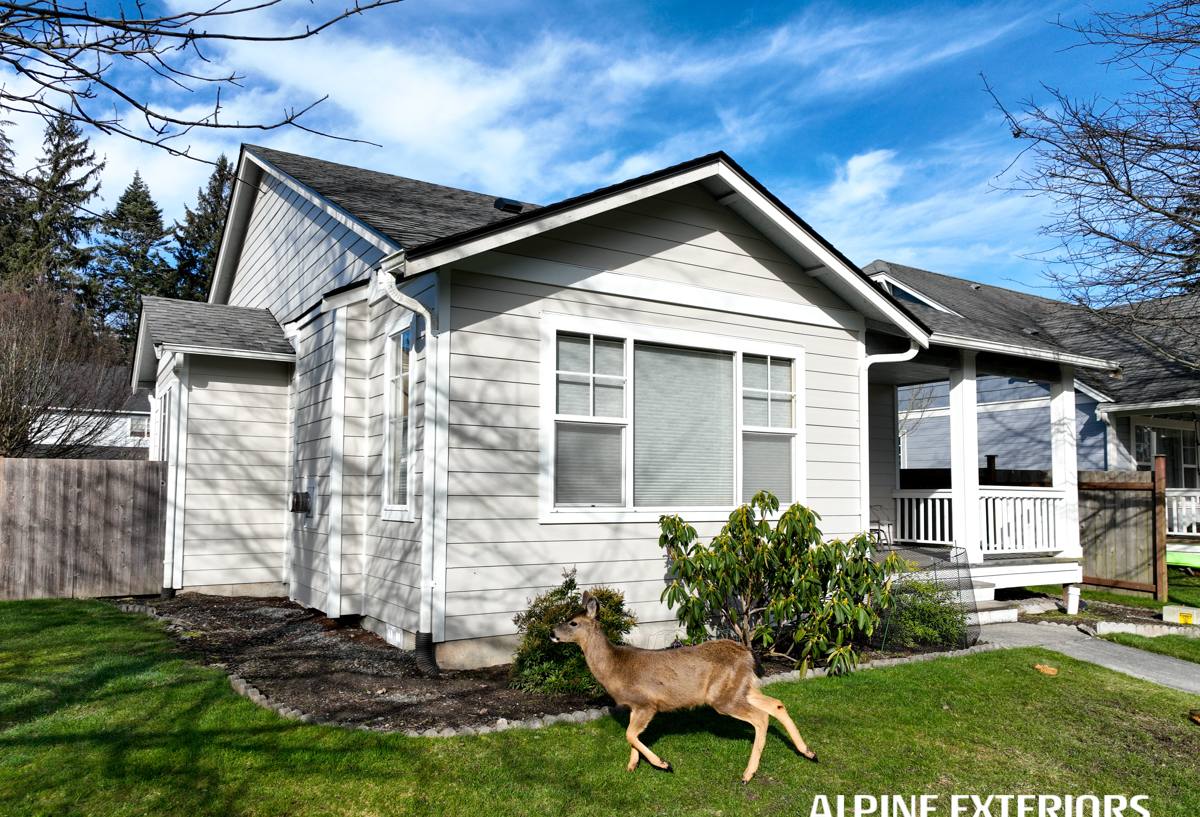
Why We Install James Hardie Fiber Cement — and Only James Hardie
We're a Lynden-based crew, and we made a deliberate call a long time ago to standardize on James Hardie fiber cement siding for every job we do, including here in Bellingham. We don't install vinyl, LP SmartSide, Cemplank, Allura, primed spruce, or cedar. That's not a marketing angle — it's a decision built around what actually holds up to this specific climate over decades, not just years.
Fiber cement is non-combustible and dimensionally stable, meaning it doesn't expand, contract, warp, or absorb moisture the way wood-based or wood-composite products do. In a climate where a wall can stay damp for days at a stretch during a January storm system, that stability matters more than it does in a drier region. James Hardie's ColorPlus finish is also factory-applied and baked on under controlled conditions, which gives it a more consistent, durable bond than field-applied paint — a real advantage when a house is exposed to salt air and heavy UV cycling between wet spells.
Climate-Engineered Product Lines
James Hardie manufactures different HZ (HardieZone) product formulations for different climate zones across the country. Western Washington, including Whatcom County, falls into a wetter, cooler zone, and the product line we install is engineered around that moisture exposure specifically — not a one-size-fits-all national spec. That's part of why we don't treat siding selection as interchangeable between regions.
What We're Choosing Not to Install, and Why
Vinyl siding is inexpensive and low-maintenance in the sense that it doesn't need painting, but it's a thinner, more flexible product that can warp under sustained heat or impact, and its seams and appearance don't hold up the way a fiber cement lap or panel system does over a 20-30 year horizon. LP SmartSide, primed spruce, and cedar are wood-based products; even with modern treatments, wood-based siding is inherently more sensitive to sustained moisture exposure and requires more diligent maintenance to avoid rot at seams, corners, and fastener points — exactly the failure points that a long moss season and salt air work hardest on. Cemplank and Allura are also fiber cement products, but we've standardized on James Hardie specifically for its factory finish process, documented performance history, and warranty structure. We install one product because we can stand behind it fully, not because it's the cheapest thing on the truck.
What a Local Lynden Crew Actually Brings to a Bellingham Job
Lynden is a short drive from Bellingham, and that proximity matters more than it might sound like on paper. A local crew can respond quickly if a weather window closes mid-project, get back out for a warranty check without treating it as a special trip, and build a schedule that accounts for how fast conditions change here rather than working off a generic install timeline.
We've also worked enough homes across Whatcom County to know how lot shading, tree cover, and proximity to the water tend to affect a given property before we ever get on a ladder. That's the kind of context that shapes where we pay extra attention during install — flashing details at trim and window returns, fastener spacing, and butt joint sealing are all places where a rushed or inexperienced crew leaves a house vulnerable to this specific climate.
How the Siding Process Works
1. Assessment and Estimate
We walk the exterior, look at existing siding condition, moisture damage, trim, and flashing, and talk through what's actually needed versus what can wait. This is also when we talk through James Hardie product lines, profiles, and colors that fit the home.
2. Tear-Off and Substrate Check
Old siding comes off and we inspect the sheathing underneath for rot or water damage before anything new goes up. Covering a compromised substrate just locks a problem behind a new wall.
3. Weather Barrier and Flashing
A correctly lapped weather-resistive barrier and properly integrated flashing at every window, door, and penetration is where most long-term siding failures actually start or get prevented. This step gets the same attention as the visible finish work.
4. Installation to Manufacturer Spec
James Hardie's warranty depends on installation following their published specifications — fastener type and spacing, clearances, joint treatment. We install to that spec as a baseline, not an upsell.
5. Final Walkthrough
We go over the finished work with the homeowner before calling the job done.
Beyond Siding: The Rest of the Exterior Envelope
Siding doesn't work in isolation — it's one part of a home's overall weather envelope, along with the roof, windows, and any exterior decking. We handle all four, which matters in a climate like Bellingham's because problems in one area often show up as damage in another. A roof with failing flashing can send water behind siding at the wall line; an aging window can let moisture into the same wall cavity a new siding job just sealed up.
- Roofing — moss and algae management, flashing integrity, and material choices suited to sustained moisture exposure
- Windows — proper flashing integration with new or existing siding to keep water out at the most vulnerable transition points
- Decks — materials and fastening detailed for a wet, shaded climate where standing moisture is the main long-term threat
When we're on-site for a siding job, we're looking at the whole envelope, not just the walls.
What Siding Replacement Costs Depend On
| Factor | Why It Matters in Bellingham |
|---|---|
| Home size and wall complexity | More corners, dormers, and trim details mean more cutting, flashing, and labor time |
| Existing siding removal | Tear-off and disposal of old material adds cost versus a bare-sheathing new build |
| Substrate condition | Rot or water damage found during tear-off requires repair before new siding goes on |
| Siding profile and color | James Hardie offers multiple plank widths, panel styles, and ColorPlus finishes at different price points |
| Trim and accessory work | Corner boards, window trim, and fascia detailing add material and labor beyond the field siding itself |
| Access and site conditions | Sloped lots, tree cover, and tight setbacks common around Bellingham can add setup and staging time |
We give straightforward, itemized estimates so a homeowner can see what's driving the number, rather than a single lump figure.
Seasonal Exterior Maintenance for Bellingham Homes
- Rinse moss and algae growth off siding and roof surfaces before it has a chance to build up, especially on shaded or north-facing walls
- Check caulking and sealant at trim, window, and door joints annually — these are the first points to fail under repeated wet-dry cycling
- Keep gutters clear so water isn't overflowing directly down the siding face during heavy rain events
- Trim back tree branches and vegetation that keep a wall surface shaded and damp longer than necessary
- Walk the exterior after major windstorms to check for loose trim, damaged flashing, or debris impact
- Have flashing and caulking inspected every few years even if nothing looks obviously wrong — small gaps are hard to spot from the ground
Choosing an Exterior Contractor in Whatcom County
Bellingham and the surrounding area have plenty of exterior contractors, and it's worth being deliberate about who gets hired. A few things worth confirming before signing anything:
- Current Washington contractor license and active insurance, verifiable independently rather than taken on faith
- A written, itemized estimate — not a single vague number
- Manufacturer training or certification on the specific siding product being installed
- A clear explanation of the warranty, including what's covered by the manufacturer versus the installer
- Willingness to explain why they recommend a specific product for your home rather than defaulting to whatever they stock
A contractor who can answer those questions clearly, without pressure tactics or vague reassurance, is usually a good sign about how they'll handle the actual job.
Ready to Talk Through Your Bellingham Home
If your siding is showing its age, holding onto moss longer than it should, or you're just planning ahead, we're happy to take a look and walk through honest options — no pressure, no obligation. Reach out through the form below for a free estimate, and we'll talk through what your home actually needs.