 Lynden Siding
 Ferndale's Exterior Climate Challenge
Ferndale sits in a stretch of Whatcom County where the exterior of a house does real work every single day of the year. Proximity to the water brings salt-tinged marine air across roofs and walls. Storms off the Pacific push rain sideways instead of straight down. And the mix of mild temperatures, shade, and near-constant moisture keeps moss and mildew active for most of the calendar, not just a few soggy months. None of these forces are unusual for this part of Washington, but together they put steady, cumulative stress on siding, roofing, windows, and decks. A home built or re-sided without that reality in mind tends to show problems years earlier than one that was.
We work Ferndale as part of our regular Whatcom County service area, alongside Lynden and the surrounding communities. That means the crew showing up at your door has seen how these conditions actually play out on real houses across multiple wet seasons, not just read about them in a spec sheet.
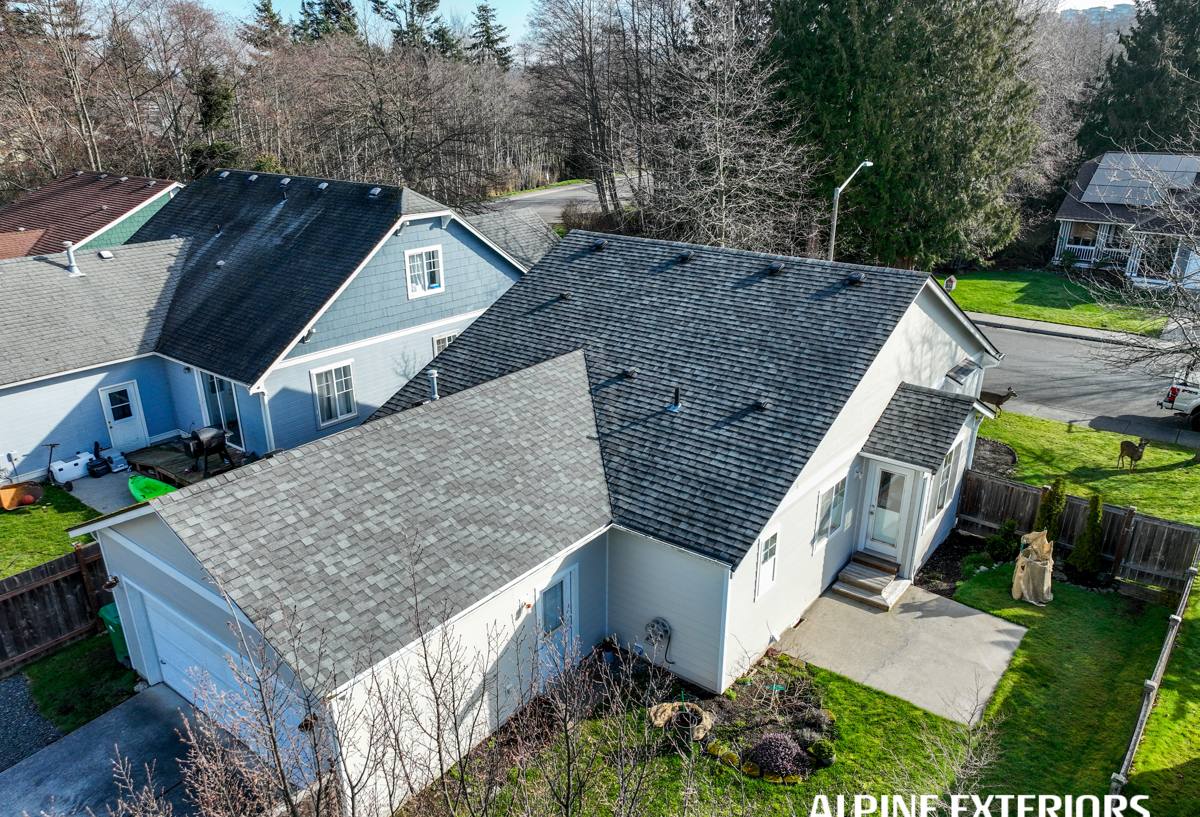
What Salt Air Does to a Home's Exterior
Even homes set back from the immediate shoreline pick up a steady dose of salt-laden air moving through this part of the county. Salt is corrosive. It accelerates the breakdown of exposed fasteners, metal flashing, and lower-grade paint finishes, and it works on every exterior surface at once, not just the ones facing the water. Over time, that means faster rusting at nail heads, quicker fading on painted surfaces, and more frequent touch-up work than a homeowner further inland would need to deal with.
The practical response isn't complicated, but it does require attention to detail: corrosion-resistant fasteners and flashing, finishes engineered to hold color and integrity under salt exposure, and installation practices that don't leave metal components more exposed than they need to be. It's a detail that's easy to skip and easy to regret a few winters later.
Driving Rain and How Wall Assemblies Actually Fail
Annual rainfall totals don't tell the whole story here. What matters more is that rain in this region rarely falls straight down — wind pushes it sideways into lap joints, trim edges, and anywhere a wall assembly has a seam. That's a fundamentally different load than a calm, dry climate puts on a house, and it's why siding and flashing details that work fine elsewhere can still let water in here.
Most serious siding failures we find on tear-offs didn't start as a dramatic leak. They started as a small gap at a trim joint or a poorly lapped seam that let water track behind the siding a little at a time, over multiple seasons, until sheathing or framing was compromised. By the time it's visible from the curb, the damage is usually well established.
Where Wind-Driven Rain Tends to Find Weak Points
- Butt joints and seams where siding courses meet
- Window and door trim, especially top corners where caulking fails first
- Inside corners and areas where two roof planes or wall planes meet
- Deck ledger boards and any point where a deck attaches to the house
- Roof-to-wall transitions, particularly around chimneys and dormers
Moss Season and Why It Never Fully Ends
Mild temperatures, shade from mature trees, and consistent moisture add up to a moss and mildew season that can run most of the year on north-facing or heavily shaded walls and roof sections in Ferndale. Any exterior material that's even slightly porous, or that holds moisture against its surface, becomes a growth surface over time. It typically shows up first in places you don't look at every day — behind shrubs, under eaves, on the shaded side of the house — well before it's obvious from the street.
Moss on a roof is more than cosmetic. It holds moisture against shingles and can work its way under tabs and flashing over time. Moss and mildew on siding do something similar at a smaller scale, keeping a wall surface damp longer than it would otherwise stay. Materials and finishes that shed water quickly and resist organic growth make a measurable difference here.
Siding: Our James Hardie Standard
We install James Hardie fiber cement siding exclusively — not LP SmartSide, not vinyl, not Cemplank, not Allura, not primed spruce or cedar. That's not a default position; it's a standard we settled on after years of seeing which siding materials actually hold up in this specific mix of salt air, wind-driven rain, and moss, and which ones quietly become a maintenance burden.
| Material | How It Handles This Climate | Long-Term Consideration |
|---|---|---|
| James Hardie fiber cement | Non-combustible, dimensionally stable, factory-sealed ColorPlus finish resists moisture and fading | Higher upfront cost, offset by lower repaint and repair frequency |
| Vinyl siding | Sheds rain but can trap moisture behind panels; seams and J-channels are common entry points | Tends to fade, warp, or crack under sustained UV and temperature swings |
| LP SmartSide (engineered wood) | Wood-based core is more sensitive to sustained moisture exposure than fiber cement | Edge and seam sealing must be maintained precisely or moisture intrusion follows |
| Cedar / primed spruce | Natural material, attractive, but combustible and moisture-absorptive | Requires ongoing refinishing and is more susceptible to rot and insect damage here |
Every one of those alternative products has a legitimate place in the broader market, and plenty of homeowners are satisfied with them in the right climate. We made a professional call that in coastal Whatcom County, one fiber cement system we trust completely — installed correctly, every time — beats offering a menu of options that shift maintenance risk onto the homeowner down the road.
What Correct Installation Actually Involves
The material is only half the equation. A Hardie installation performs the way it's engineered to only when fastening patterns, clearances from grade and roofline, joint lapping, and the house wrap and flashing details underneath are all done to spec. We treat those details as seriously as the product choice itself, because a good material with a rushed installation still fails.
Roofing Considerations for Ferndale Homes
A roof that's shedding moss, holding standing water in valleys, or losing granules faster than expected is often the real source of what looks like a siding or interior moisture problem. Because we handle roofing alongside siding, we can trace water intrusion back to its actual origin instead of treating a wall symptom in isolation. In this climate, roof valleys, chimney flashing, and any north-facing or heavily shaded roof plane deserve extra attention during both installation and routine inspection, since those are the areas where moss and trapped moisture build up fastest.
Windows: A Common, Overlooked Leak Point
Window installation quality matters as much here as siding quality does. A window that isn't flashed correctly becomes one of the most common places for wind-driven rain to work its way into a wall assembly, and the resulting damage often shows up on interior trim or siding well before anyone traces it back to the window itself. When we replace windows, we integrate the flashing with the surrounding siding and house wrap as one continuous water-management system rather than treating the window as a standalone product swap.
Decks: Built for Standing Water and Wet Wood Contact
Decks in this climate spend a lot of the year wet, and the ledger board — where the deck attaches to the house — is one of the most consequential moisture points on the entire structure if it's not flashed correctly. Standing water on deck boards, fasteners that corrode from salt exposure, and moss buildup on shaded decking are all routine issues we see on older decks around Ferndale. Proper ledger flashing, corrosion-resistant hardware, and decking materials chosen with this specific moisture load in mind go a long way toward avoiding a callback a few years down the line.
Choosing a Local Exterior Contractor in Whatcom County
Not every contractor working in Whatcom County actually lives with the results of their work here year-round. A crew based locally and working this territory repeatedly sees how a given detail performs across an entire wet season, not just on install day. That shapes real decisions: where to spend extra time on flashing, which wall orientations need the most attention, and which shortcuts simply aren't worth taking in this climate.
Questions Worth Asking Before You Hire
- Which specific siding, roofing, and decking products do they install, and why those specifically?
- Are they licensed and insured to do business in Washington, and can they show current documentation?
- Do they handle siding, roofing, windows, and decks, or will you need to coordinate multiple contractors for one connected exterior problem?
- How do they handle hidden damage discovered once old material comes off?
- Can they explain their material choices in plain terms rather than just handing you a price?
What to Expect from an Estimate
Exact costs for siding, roofing, window, or deck work depend on the specific home — its size, wall and roof complexity, existing substrate condition, and site access. We don't quote off a generic price sheet. A real estimate starts with walking the property, looking at the actual condition of what's there now, and being honest about whether a section needs repair, a full replacement, or nothing at all yet. If your Ferndale home needs new siding, roofing, windows, or deck work — or you just want an honest second opinion on something that's been bothering you — reach out using the form below for a free, no-pressure estimate.