 Lynden Siding
 What Makes ColorPlus Technology Different
Most siding gets its color one of two ways: it's painted on site after installation, or it's painted by the factory before it ever reaches a job site. James Hardie's ColorPlus Technology is the second kind, and the difference is bigger than it sounds. The finish is baked onto the fiber cement in a controlled factory environment, in multiple coats, and cured before the boards are boxed and shipped. There's no wind, no humidity swing, no rushed second coat because rain is coming in an hour.
Field-applied paint depends on the weather the day the crew is out there, the surface prep, and how evenly a brush or sprayer lays down coverage on a house that's already standing. Factory finish removes almost all of that variability. Every board in a run gets the same coating process, which is why ColorPlus siding looks uniform from the first panel to the last, even across a large elevation.
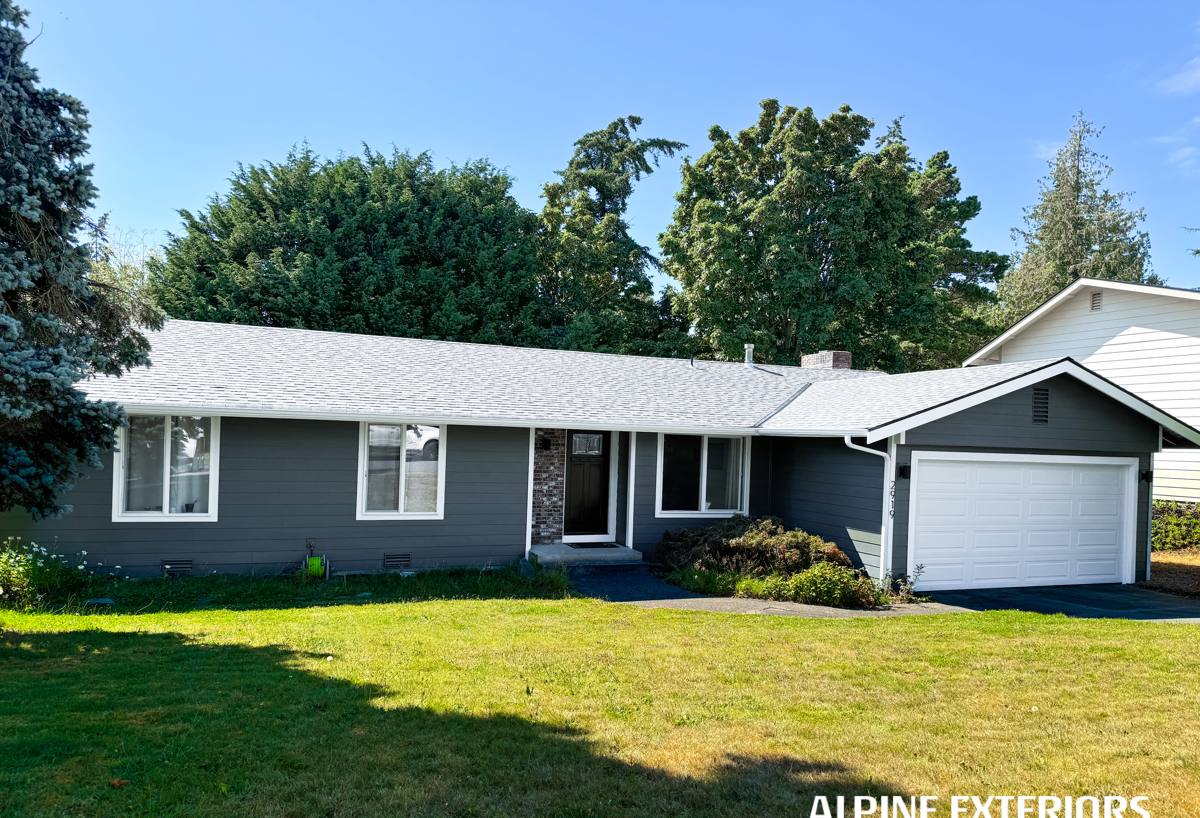
Why the Factory Finish Matters in Whatcom County
Lynden sits inland from Bellingham Bay, but this part of Whatcom County still gets a steady dose of moist, salt-tinged air moving up from Puget Sound and the Strait of Georgia, on top of the driving rain that blows in off the Pacific most of the fall and winter. Add in a moss season that can run five or six months on a shaded or north-facing wall, and you've got siding that's rarely fully dry for long stretches of the year.
That combination is hard on paint. Moisture that gets under a field-applied coat — through a hairline crack, a nail hole, a spot where prep wasn't perfect — can lift and peel it from underneath, sometimes years before you'd expect a repaint. A factory-cured finish bonded directly to the fiber cement substrate resists that kind of moisture intrusion far better, which is a meaningful advantage in a climate that almost never gives siding a real chance to dry out.
The Two ColorPlus Palettes
James Hardie organizes its ColorPlus colors into two collections, and it's worth understanding the difference before you start picking chips.
The Dream Collection
This is the broader, more traditional palette — the whites, warm grays, greiges, and earth tones that make up the bulk of what you see on homes across the Pacific Northwest. These colors are built to work with a wide range of rooflines, stone, and landscaping, which makes them the safer starting point for most projects.
The Statement Collection
This is a smaller set of bolder, more saturated colors — deep blues, greens, and near-blacks — meant to be used more deliberately, often as an accent or on a home where the owner wants the siding itself to be a design statement rather than a backdrop. Availability by product line and profile varies, so confirm early which Statement colors your chosen siding profile actually supports.
Reading Color in Lynden's Light and Landscape
Color reads differently under the Pacific Northwest's mostly overcast sky than it does in a sunnier climate. Cool grays and blues can look flatter and more muted under cloud cover, while warm tones and true whites tend to hold their character better on a gray day. That's worth factoring in here, where clear, direct sun is the exception rather than the rule for a lot of the year.
The backdrop matters too. A lot of homes in and around Lynden sit against a tree line, farmland, or a mix of both, and siding color reads differently against a wall of Douglas fir than it does against open sky or pavement. Before committing, get a large sample — not just a paint chip — and look at it against your actual house, in different light, both wet and dry. A color that looks right at noon on a dry day can shift noticeably at dusk in the rain, and dry-day judgments are the ones that fool people most in a climate like this.
Coordinating Trim, Fascia, and Accents
ColorPlus isn't limited to the field siding. Trim boards, fascia, and soffit material in the same system can be factory-finished too, which is what gives a finished house that clean, consistent look rather than a patchwork of factory color next to field-painted wood trim that will weather on a different timeline.
- Matching trim to siding color creates a quieter, more contemporary look with less visual break at the corners
- A contrasting trim color (often white or a warm neutral) is the more traditional Pacific Northwest approach and tends to hold up well against darker field colors
- Accent colors — on a front door, shutters, or a gable feature — are best pulled from the same undertone family as the field color so the house doesn't end up fighting itself
- Decide on gutter and downspout color at the same time; mismatched metal against a new factory finish is a common afterthought regret
Factory Finish vs. Field-Applied Paint: The Real Cost Difference
The upfront cost difference between factory-finished and field-painted siding is often smaller than homeowners expect, but the cost over the life of the siding is where ColorPlus pulls ahead. Field-painted siding — whether it's fiber cement, primed wood, or another substrate — goes back on a repaint cycle, and each cycle means scaffolding or lifts, labor, and paint, on top of whatever prep is needed if the old coat has started to fail.
| Factor | ColorPlus Factory Finish | Field-Applied Paint |
|---|---|---|
| Typical repaint interval | Often none needed for 15+ years under normal conditions | Commonly every 5-10 years in this climate |
| Application conditions | Controlled factory environment, every board consistent | Dependent on weather and site conditions the day of the job |
| Cost over 20 years | Largely the upfront cost, plus occasional touch-up | Upfront cost plus 2-3 full repaint cycles |
| Color uniformity | Consistent across the entire elevation and any future additions | Can vary batch to batch or with partial repaints |
| Manufacturer finish warranty | Backed by James Hardie against fading, chipping, cracking, and peeling | Warranty (if any) is typically the paint manufacturer's, separate from the siding |
Caring for ColorPlus Siding to Keep the Color True
A factory finish resists moisture and UV far better than field paint, but it isn't maintenance-free, especially in a spot that gets a genuine moss season. Moss, algae, and general grime will settle on any exterior surface here given enough damp, shaded time, and ColorPlus siding is no exception — it just tends to clean up rather than needing to be repainted.
A soft wash with a garden hose and a mild detergent once or twice a year, focused on north-facing walls and areas under overhangs where moss gets a foothold, keeps the color looking like it did on installation day. Avoid high-pressure washing directly at the siding, since it can force water behind joints and trim rather than just cleaning the surface. If a touch-up is ever needed — around a repair or a scratch — Hardie-matched touch-up paint is the right product, not a generic exterior paint that won't match the sheen or hold color the same way over time.
A Practical Checklist for Choosing Your Color
- Pull large physical samples, not just paint chips, and view them against your actual roofline and landscaping
- Look at the sample in overcast light, direct light, and at dusk — Lynden's sky is overcast more often than not
- Check the sample wet as well as dry, since that's the condition your siding will actually be in a good part of the year
- Confirm which collection (Dream or Statement) your chosen siding profile and product line actually offers before falling in love with a specific color
- Decide on trim, fascia, and gutter color as part of the same decision, not as an afterthought
- Ask your contractor to confirm the finish carries the standard ColorPlus warranty coverage for your specific product and region
Making the Final Call
There's no universally "right" color — what works on a farmhouse-style property outside town looks different from what works on a newer build closer to Lynden's downtown grid. The goal is a color that holds its character in this specific climate: through a wet fall, a mossy winter, and enough gray days that the color needs to work without direct sun doing it any favors. A factory-cured finish gives you a real head start on that, since the color you choose is the color that's actually engineered to last here, not just applied and hoped for.
If you're planning a siding project and want to see ColorPlus samples against your own home, we're happy to bring boards out and walk through the options in person. Reach out for a free, no-pressure estimate using the form below.