 Lynden Siding
 One Product, One Standard — Here's Why
Homeowners in Lynden sometimes ask why we don't offer options the way a lot of contractors do. We get it — more choices usually feels like better service. But after years of tear-offs, warranty claims, and callbacks across Whatcom County, we made a decision: we install James Hardie fiber cement siding, and nothing else. Not vinyl, not LP SmartSide, not Cemplank or Allura fiber cement, not primed spruce or cedar lap. This page explains the reasoning, not the marketing.
This isn't about brand loyalty. It's about what actually holds up on a house that sits fifteen miles from Bellingham Bay, gets soaked by driving rain off the Nooksack valley for months at a stretch, and grows moss on anything that stays damp long enough. We'd rather turn down a job than install something we don't trust to perform here.
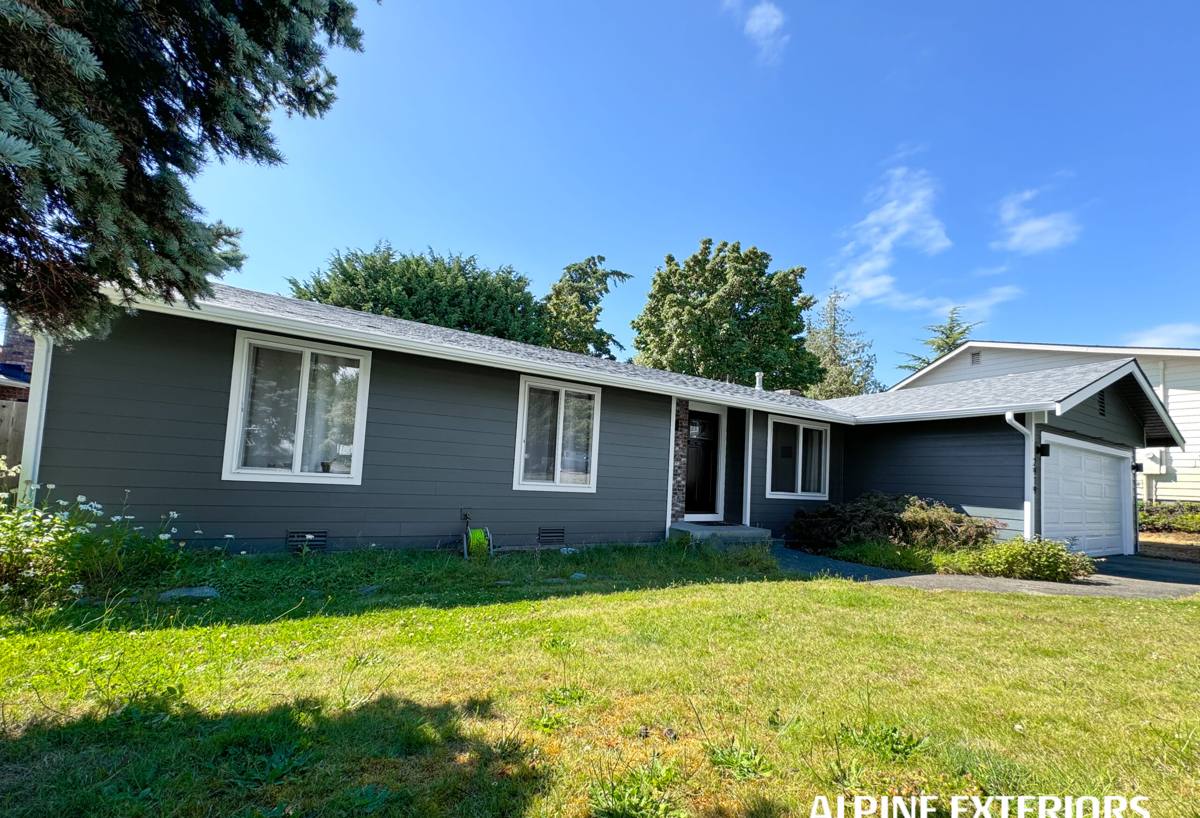
What Lynden's Climate Actually Does to Siding
Whatcom County isn't the wettest place in Washington, but it is one of the more punishing places for exterior building materials, for a specific combination of reasons:
- Salt-influenced air drifts in off the Salish Sea and settles into the lowlands, accelerating corrosion on fasteners and finishes that aren't rated for it.
- Driving rain — wind-driven, not just vertical — pushes water sideways into laps, seams, and butt joints that a dry-climate product was never tested against.
- Extended moss and algae season runs from fall through spring. Anything porous that stays damp becomes a growth surface, and growth surfaces hold more moisture, which starts the cycle over.
- Freeze-thaw swings, while less severe than east of the mountains, still happen enough winters to matter for any product that absorbs water into its core.
None of this is exotic. It's just steady, unglamorous exposure, year after year. Products that look identical on a spec sheet perform very differently once you factor in fifteen or twenty years of this pattern.
Why We Stopped Installing Vinyl
Vinyl siding is inexpensive and easy to install fast, and for a lot of climates it does a reasonable job. In Whatcom County it runs into two specific problems. First, it expands and contracts with temperature swings, and over time that movement opens gaps at seams and corners — exactly where driving rain wants to get in. Second, vinyl doesn't hold paint, so once the color fades (UV exposure here is real even under overcast skies) there's no refresh option short of replacement. We were doing enough vinyl repair and replacement work that we stopped installing it as new construction or re-siding material.
Why We Stopped Installing LP SmartSide
LP SmartSide is engineered wood — strand-based, resin-treated, and genuinely improved over the OSB siding products that gave engineered wood a bad name in the 1990s. It's lighter than fiber cement and easier on a crew's back. The trade-off is that it's still wood at its core. Wood siding performs only as well as its weakest seam, cut edge, or fastener penetration. Every cut end and every place a nail or screw breaks the factory seal is a spot where moisture can start working into the substrate. In a climate with Lynden's rain load and moss pressure, that margin for installation error is smaller than we're comfortable with, especially on details like the field cuts around windows and trim that every job requires no matter who's doing the work.
Why We Stopped Installing Other Fiber Cement Brands
This one surprises people, because Cemplank and Allura are also fiber cement — cellulose, sand, and Portland cement, same basic chemistry as Hardie. The material itself isn't the issue. What's different is the finish system and the warranty structure. James Hardie's ColorPlus finish is baked on in a factory process with a dedicated finish warranty backing it; some competing products are sold primed-only or with a less established factory-finish track record in this region. We also value having one consistent installation spec, one set of climate-engineered product lines (HZ5 for the Pacific Northwest), and one manufacturer relationship for warranty support if something ever needs attention ten or fifteen years down the road. Standardizing lets our crews install the same system, the same way, every time — which is where most siding failures actually come from: inconsistent installation, not bad material.
Why We Stopped Installing Primed Wood and Cedar
Cedar has real appeal — it's a Pacific Northwest tradition, and a lot of older Lynden homes still wear it. But solid wood and primed spruce lap siding require a maintenance commitment that most homeowners underestimate: recoating on a cycle of every few years, vigilant caulking, and prompt attention to any moss or mildew before it takes hold. In a county with this much sustained moisture, that maintenance window shrinks. We were spending more time on wood siding repair and refinishing calls than on new installs, which told us something about how the product actually holds up here versus how it's marketed.
What James Hardie Gets Right for This Region
Non-combustible core
Fiber cement doesn't burn. That matters more each year given wildfire smoke seasons reaching into western Washington, and it's a straightforward, factual advantage over vinyl and wood-based products.
Engineered for wet climates
Hardie's HZ5 product line is specifically formulated for regions with significant moisture exposure, which includes the qualities that matter for Whatcom County: freeze-thaw tolerance and a low-permeability composition that resists moisture intrusion into the panel itself.
Factory-applied ColorPlus finish
Rather than field-painting a raw substrate — which is where a lot of siding failures start, at the cut edges and seams — Hardie's color is baked on in a controlled factory process before the material ever reaches the jobsite. It resists fading and chipping better than field-applied paint, and touch-up product is available for the inevitable ding or scratch.
Warranty backing
Hardie backs its siding with a transferable limited warranty on the substrate and a separate finish warranty on ColorPlus color, which matters if the home changes hands — a real consideration in a growing area like Lynden.
Moss and algae resistance
Fiber cement's dense, non-porous composition doesn't feed organic growth the way wood fiber can, which is a direct answer to the moss pressure this region deals with for half the year.
Comparing the Options Head-to-Head
| Factor | Vinyl | LP SmartSide | Cedar / Primed Wood | James Hardie |
|---|---|---|---|---|
| Core material | PVC plastic | Engineered wood strand | Solid or milled wood | Fiber cement |
| Combustibility | Melts/burns | Combustible | Combustible | Non-combustible |
| Moisture behavior in driving rain | Seam gaps open over time | Vulnerable at cut edges | Absorbs, needs sealing | Low permeability, engineered for wet climates |
| Moss/algae resistance | Moderate | Lower (organic core) | Lower (organic core) | Higher (mineral-based) |
| Finish life | Fades, cannot repaint effectively | Field or factory paint, needs cycles | Needs recoating every few years | Factory ColorPlus finish, long fade resistance |
| Typical maintenance | Low but limited lifespan | Moderate, edge sealing critical | High, ongoing | Low when installed to spec |
This table reflects general product characteristics, not a claim that any competitor's product is defective — plenty of these materials perform adequately in less demanding climates. Our decision is about what we're willing to warranty our own workmanship against, in this specific county.
Correct Installation Matters as Much as the Product
Choosing Hardie doesn't automatically solve everything — installation quality is still the deciding factor in how any siding performs over twenty years. A few things we hold to on every job:
- Proper clearance from grade, roofing, and decking per Hardie's published requirements
- Correct fastener type, spacing, and penetration depth — not just "close enough"
- Weather-resistive barrier and flashing details installed before the first plank goes up
- Caulking and joint treatment at butt seams, corners, and penetrations done to spec, not skipped for speed
- Field-cut edges primed or sealed before installation, since factory finish doesn't extend to a cut edge
A Hardie board installed with shortcuts can fail the same way a lesser product does. We standardized on the material because it gives our crews the best foundation to build a durable installation on top of — but the installation itself is where our name is actually on the line.
Is This the Right Fit for Your Home?
Standardizing on one product means we're not the right contractor for someone who's set on vinyl or cedar for cost or aesthetic reasons — and that's a fair call for a homeowner to make elsewhere. But if you're weighing siding options for a Lynden home and want to understand what actually holds up against Whatcom County's salt air, rain, and moss, we're happy to walk through it honestly, including where Hardie costs more upfront and where that cost shows up in fewer callbacks and repaint cycles down the road.
If you'd like a straightforward look at what your home would need — panel style, HZ5 spec details, and a realistic cost range — reach out for a free, no-pressure estimate using the form below.