 Lynden Siding
 Serving Abbotsford, BC and the Border Region from Lynden
Lynden sits close enough to the international border that a lot of our work naturally reaches homeowners just across the line in Abbotsford, BC, and the surrounding Fraser Valley communities. The building stock and the weather don't stop at the border, and neither do the problems we get called out for. A house in Abbotsford faces the same driving rain, the same long stretch of damp months, and the same moss and mildew pressure that we see on siding jobs throughout Whatcom County.
We treat cross-border service the way we'd treat any service area: with realistic expectations. Coordinating a project that crosses an international line takes a bit more planning around scheduling, material logistics, and permitting than a job three miles from our shop. We're upfront about that during the estimate, and we build it into the timeline rather than surprising anyone later.
What the Climate Actually Does to Exterior Siding Here
The Pacific Northwest border region gets a specific combination of conditions that's harder on siding than most homeowners expect. It isn't one dramatic storm that causes damage — it's the accumulation of small exposures, month after month, year after year.
Driving Rain and Wind-Driven Moisture
Rain here rarely falls straight down. Wind pushes it sideways into wall assemblies, and over time that wind-driven moisture finds every weak seam, every gap in flashing, and every spot where caulking has started to fail. Siding that can't shed water efficiently — or that swells and holds moisture once it gets wet — starts to break down from the inside out, often before any damage is visible from the street.
Salt Air and Airborne Moisture
Proximity to the Salish Sea and Georgia Strait means the air carries more salt and moisture than an inland climate would. That moisture-laden air accelerates corrosion on fasteners and trim, and it keeps exterior surfaces damp longer after a rain event, which sets the stage for the next problem.
A Long Moss and Algae Season
Between the rainfall totals and the moderate temperatures, moss and algae have a long growing window here — often close to nine or ten months out of the year on north-facing walls and shaded elevations. Wood-based and fiber-based siding products that absorb moisture give moss something to root into. Once it's established, it holds even more water against the wall and accelerates whatever decay process was already underway.
Why We Only Install James Hardie Fiber Cement
We made a deliberate decision to stop installing vinyl siding, LP SmartSide, primed spruce, cedar, and other fiber cement brands like Cemplank or Allura. That's not a marketing angle — it's a standard we hold to because of what we've seen play out on homes in exactly this kind of climate.
Vinyl siding is affordable and low-maintenance in the sense that it doesn't need painting, but it's a thin plastic product that can warp in temperature swings, crack on impact in colder snaps, and fade unevenly over the years. It also has visible seams and a look that reads as vinyl no matter how the panel is styled, which matters to homeowners who want their house to look like it's built from real material.
Engineered wood products like LP SmartSide use a wood-strand core with a resin coating. When that coating is compromised — from a nail hole that wasn't sealed, a cut edge left exposed, or years of driving rain finding a seam — the wood core underneath can absorb moisture and swell or delaminate. In a climate with this much sustained rainfall, that's a real risk, not a hypothetical one.
Primed spruce and cedar are honest, traditional materials, but they're organic. They need repainting on a cycle, they're susceptible to rot at end grain and butt joints, and they're a food source for the moss and mildew that thrive here. Keeping them looking good is an ongoing maintenance commitment that a lot of homeowners don't want to sign up for.
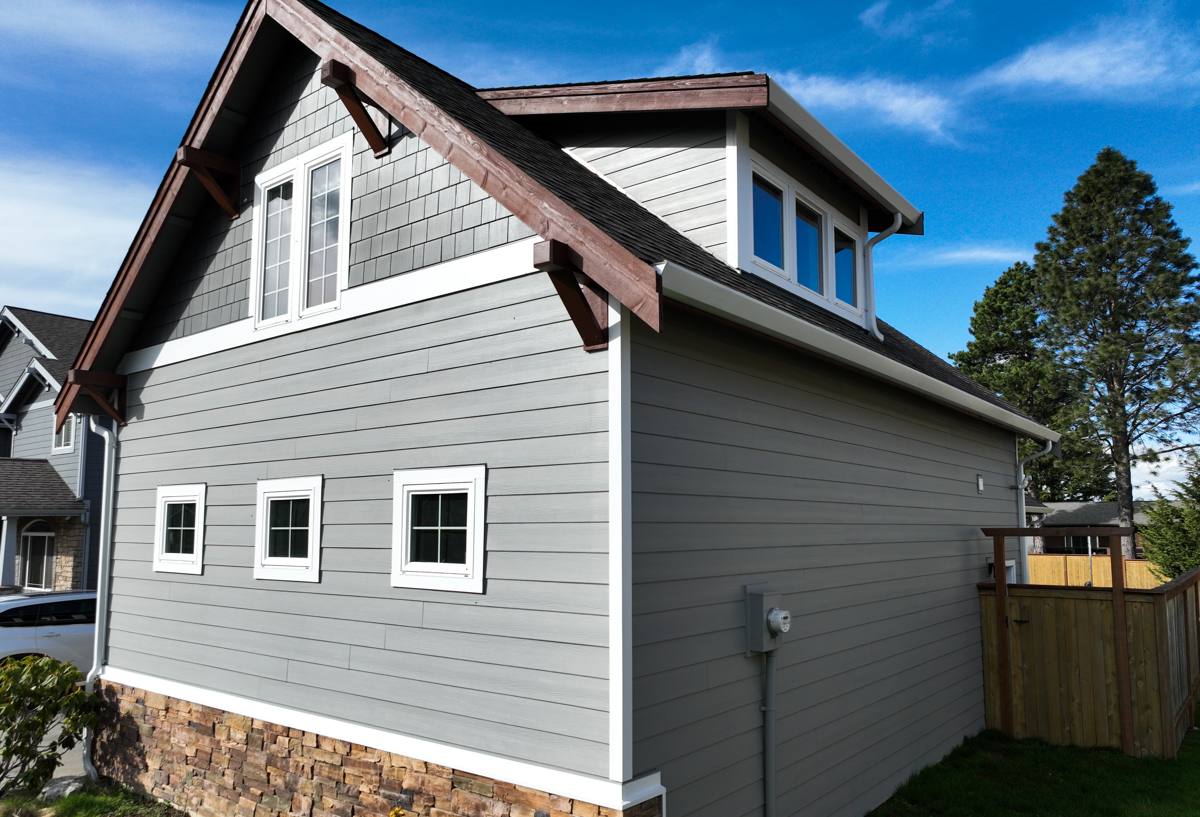
James Hardie fiber cement is cement, sand, and cellulose fiber — it doesn't rot, it isn't a wood product for moss and insects to feed on, and it holds up to repeated wet-dry cycles far better than wood-based alternatives. The ColorPlus factory finish is baked on under controlled conditions, which gives it more consistent coverage and better fade resistance than field-applied paint. Hardie also engineers specific product lines (their HZ5 formulation, for example) for regions with more moisture exposure, which fits this climate better than a one-size-fits-all product.
Comparing Siding Options for a Wet, Mossy Climate
| Material | Moisture Behavior | Moss/Algae Resistance | Maintenance | Typical Lifespan |
|---|---|---|---|---|
| James Hardie Fiber Cement | Does not rot or swell; engineered for wet climates | Non-organic, doesn't feed moss | Occasional wash; no repainting with ColorPlus | 30-50+ years with proper install |
| Vinyl | Doesn't absorb water but can warp/crack with temperature swings | Can still host surface growth in shaded areas | Low, but can't be repainted easily if faded | 20-30 years |
| LP SmartSide / Engineered Wood | Vulnerable at cut edges and compromised seams | Wood core is organic; growth risk if coating fails | Caulk and coating maintenance ongoing | 20-30 years if maintained |
| Cedar / Primed Spruce | Absorbs moisture; prone to rot at joints | High — organic material moss readily colonizes | Repainting/staining on a regular cycle | 15-25 years depending on care |
More Than Siding: Roofing, Windows, and Decks
Siding is only one part of a home's exterior envelope, and treating it in isolation misses the bigger picture. We also handle roofing, window replacement, and deck construction, because a lot of the problems we find on a siding inspection actually start somewhere else on the house.
Roofing
A roof that's shedding granules, has failing flashing, or is holding moss is often the reason water is finding its way behind siding at the top of a wall. We look at roof condition as part of any full exterior evaluation, especially on homes where moss has clearly been established for years.
Windows
Old window flashing and failed seals around window openings are one of the most common places we find hidden water damage during a siding tear-off. Replacing windows at the same time as siding lets us integrate flashing correctly instead of working around an aging window that's already letting moisture in.
Decks
Decks take the same driving rain and moss exposure as siding, plus direct foot traffic and standing water on horizontal surfaces. We build and repair decks with the same attention to drainage and material selection that we apply to the rest of the exterior.
What to Expect From an Exterior Project in This Region
Every project starts with an honest look at the house — not just the siding, but the flashing, the trim, the window seals, and anything else that affects how water moves around the building. For homes in Abbotsford and the surrounding border communities, we factor logistics into the plan up front: crew scheduling, material staging, and any permitting steps specific to the local jurisdiction, since building code and permitting requirements differ across the border.
We don't cut corners on the parts that don't show up in a photo — proper weather-resistive barrier, correctly lapped flashing, and manufacturer-spec fastening. Those details are what determine whether siding lasts 10 years or 40 in a climate this wet.
Signs Your Current Siding May Need Attention
- Visible moss or algae streaking, especially on north-facing or shaded walls
- Soft or spongy spots when you press on wood-based siding
- Paint that's peeling, bubbling, or chalking heavily
- Warped, cracked, or bowed panels
- Gaps opening up at seams, corners, or around trim
- Visible staining or discoloration that keeps returning after cleaning
- Rising energy bills that might point to a compromised exterior envelope
Why a Local Crew Matters for This Kind of Work
Siding failures in this region tend to follow patterns that a crew working somewhere dry and mild simply doesn't encounter as often. Knowing where moss tends to establish first, how far wind-driven rain typically pushes into a wall assembly, and which details fail first in a long wet season comes from doing this work locally, year after year, not from a general installation manual.
That local pattern recognition is exactly why we standardized on one product line instead of installing whatever a homeowner asks for. We'd rather tell a homeowner honestly that a product isn't a good fit for this climate than install it and watch it fail early.
Get an Estimate
If you're in Abbotsford, BC, Lynden, or anywhere in the border region and want an honest look at your siding, roofing, windows, or deck, we're happy to come take a look. There's no pressure and no obligation — just a straightforward assessment of what your home's exterior actually needs and what it would take to fix it right. Use the form below to request a free estimate.