 Lynden Siding
 Maple Falls Sits in a Different Microclimate Than the Valley Floor
Maple Falls is tucked into the forested foothills of Whatcom County, closer to the Mount Baker foothills than to the open farmland around Lynden. That location changes how a house ages. Homes here sit under more tree canopy, at a bit more elevation, and in a spot where clouds coming off the Nooksack River valley tend to hang around longer before they clear out. The result is more days of lingering dampness than you'd find on a house sitting out in open sun a few miles away.
Marine air off the Strait of Georgia still reaches inland through the river valleys and brings a faint salt tinge with it, but the bigger day-to-day story for Maple Falls is shade, rain, and moss. A house wrapped in tree cover dries slower after every rain event, and in Whatcom County that can mean weeks at a time where exterior surfaces never fully dry out between storms. Combine that with driving rain that comes in sideways during winter frontal systems, and you have an exterior environment that punishes any siding product with weak moisture management.
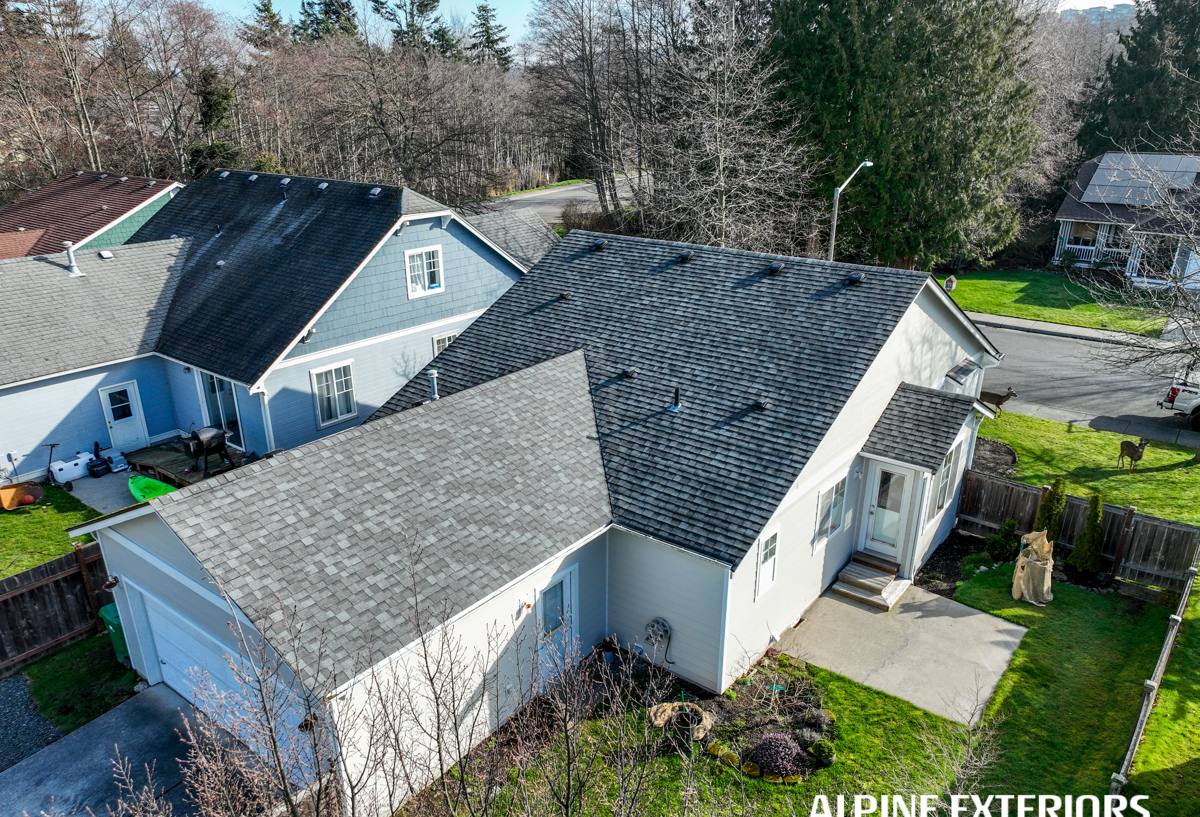
What a Long Moss Season Actually Does to a House
Moss and algae aren't just a cosmetic nuisance. They hold moisture directly against the siding surface, which keeps the substrate underneath wetter, longer, than open air ever would on its own. On products that aren't dimensionally stable or that swell and contract with moisture, that constant damp cycle accelerates paint failure, delamination, and rot at seams and butt joints. On a shaded lot in Maple Falls, north-facing walls and anything under a tree canopy will collect moss faster than the same wall on an open lot in town.
The freeze-thaw factor
Whatcom County foothill areas also see more nights near or below freezing than the valley floor, especially at Maple Falls' elevation. Water that's soaked into a porous or poorly sealed siding material can freeze, expand, and force cracks or separation at joints. Over several winters that compounding damage is what turns small maintenance items into full siding failures.
Wind-driven rain at cut edges and penetrations
Rain that comes in at an angle finds every unsealed cut edge, every fastener hole, and every spot where flashing was skipped or done wrong. This matters more in the foothills, where storms often arrive with more sustained wind than they do by the time they've crossed the flatter valley floor.
Why We Install Only James Hardie Fiber Cement
We made a decision as a company to install one siding system: James Hardie fiber cement. That's not a marketing angle — it's a standard we set because of what we see on service calls across Whatcom County, including plenty of houses in wooded, damp settings like Maple Falls.
- Non-combustible material — fiber cement doesn't feed a fire the way wood-based products can, which matters on wooded lots with limited defensible space.
- Climate-engineered HZ formulations — Hardie's HZ5 product line is engineered for the wetter, cooler Pacific Northwest climate zone rather than a generic national spec.
- ColorPlus factory finish — a baked-on finish applied under controlled conditions holds color and resists moisture intrusion at the surface better than field-applied paint.
- Dimensional stability — fiber cement doesn't swell, cup, or warp with moisture cycling the way wood-based or wood-composite sidings can.
- Transferable warranty backing — a real factor for resale value on a property that may change hands down the road.
None of that means every other siding product is worthless. It means that after years of installing and repairing exterior siding in this climate, we decided we'd rather stand behind one system we trust completely than offer a menu of products with different failure modes.
Why We Don't Install Vinyl, LP SmartSide, or Cedar
Homeowners in Maple Falls often ask what's wrong with the other options, and the honest answer is: nothing is "wrong" with them in every situation, but each comes with trade-offs we're not willing to install and then have to explain later.
| Product | What it does well | Why it's not our standard |
|---|---|---|
| Vinyl siding | Low upfront cost, low maintenance day to day | Can warp or become brittle over time, doesn't hold up as well to sustained impact, seams are more visible |
| LP SmartSide | Engineered wood, easier to install than solid wood | Wood-based core is still moisture-sensitive at cut edges and joints if sealing isn't perfect and maintained |
| Cedar / primed spruce | Natural look many homeowners love | Needs ongoing refinishing, and in a shaded, damp setting like Maple Falls it's the most maintenance-intensive option we install nothing beats |
| Cemplank / Allura | Also fiber cement, generally solid products | We standardized on one manufacturer's system, warranty, and factory finish so we can guarantee our installation to a single spec |
When a product's long-term performance depends heavily on perfect field sealing and consistent maintenance, that's a risk we'd rather not carry on a homeowner's behalf, especially on properties where tree cover keeps things damp most of the year.
How We Approach a Siding Install on a Maple Falls Home
Every property in this area is a little different depending on how much sun it gets, how close the tree line sits to the house, and what the current siding is doing. Our process starts with an honest look at the specific problems your house has, not a generic sales pitch.
- Site and moisture assessment — we look at drainage around the foundation, roof overhangs, gutter performance, and how much shade the walls get through the day.
- Removal and substrate check — once old siding comes off, we inspect the sheathing underneath for rot or hidden moisture damage before anything new goes up.
- Weather-resistive barrier and flashing — proper house wrap, window and door flashing, and rain-screen detailing where called for are what actually keep water out, not the siding material alone.
- Hardie installation to manufacturer spec — correct fastener spacing, gapping, and caulking at joints, following James Hardie's published installation guidelines so the product performs and the warranty stays valid.
- Final inspection and cleanup — we walk the finished job with the homeowner before calling it done.
Skipping steps two through four is exactly how a siding job looks fine for the first year or two and then starts failing at the seams. In a climate like Maple Falls', shortcuts in flashing and moisture barrier work show up faster than they would in a drier region.
We Handle the Whole Exterior, Not Just Siding
Siding, roofing, windows, and decks all interact with each other on a house. A roof that's shedding water onto a wall, a window that's not flashed correctly, or a deck ledger board that's trapping moisture against the house can all undermine siding that was installed perfectly. Because we handle all four, we can look at a Maple Falls property as one system instead of treating siding as an isolated project.
Roofing
Roof condition directly affects siding longevity — overflow, ice damming, and failed flashing at roof-to-wall intersections are common sources of siding damage we find during tear-off.
Windows
Old or poorly flashed windows are one of the most common hidden water entry points behind new siding. We address window flashing as part of a siding project whenever it's compromised.
Decks
Deck ledger connections and stair stringers that tie into the house need to be detailed correctly so they don't become a moisture path into the wall assembly, something that matters even more on a shaded, damp lot.
Why a Local Crew Matters in the Foothills
Maple Falls isn't downtown Lynden. Some properties have longer driveways, more tree cover to work around, and seasonal weather windows that close earlier in the fall than they do closer to the valley floor. A crew that works this area regularly understands how to schedule around that, how to stage material and equipment on a wooded lot, and what kind of moisture and drainage issues tend to show up on foothill properties specifically. That local knowledge is different from what a crew based an hour away, doing one job in the area a year, is going to bring to your project.
Maintaining James Hardie Siding in a Wet, Shaded Climate
Fiber cement is low-maintenance, not no-maintenance. In a moss-prone area like Maple Falls, a little seasonal attention goes a long way toward protecting the investment.
- Rinse siding annually with a garden hose (avoid high-pressure washing directly into joints and seams)
- Keep gutters clear so water doesn't sheet down the wall face
- Trim back tree branches and brush that keep siding in constant shade and dampness
- Inspect caulking at trim and joints every year or two and re-caulk as needed
- Address any moss or algae growth early with a gentle cleaning rather than letting it establish
- Watch for paint or finish issues near ground level, where splash-back moisture is highest
What Affects the Cost of a Siding Project
Every home is different, but these are the main factors that move a project's scope and price up or down. We give straight, itemized estimates rather than vague ranges.
| Factor | Why it matters |
|---|---|
| Existing siding removal | Tear-off adds labor and disposal, and reveals whether sheathing repairs are needed |
| Substrate condition | Rot or moisture damage found underneath old siding needs repair before new siding goes on |
| Home size and complexity | Multiple stories, dormers, and trim detail all add labor time |
| Siding profile and color | Plank width, texture, and ColorPlus color selection affect material cost |
| Site access | Long driveways, steep grades, or dense tree cover common in the foothills can affect staging and labor |
| Window and flashing work | Replacing or re-flashing windows during the same project adds scope but protects the new siding |
If you're in Maple Falls and dealing with siding that's showing its age, or you're planning ahead before the next wet season sets in, we're glad to take a look and give you a straightforward, no-pressure estimate. Fill out the form below and we'll get in touch.