 Lynden Siding
 Two Fiber Cement Products, Two Different Standards
If you've been pricing siding in Whatcom County, you've probably run into more than one brand of fiber cement. Cemplank is one of them, and it's a legitimate product category — fiber cement, not vinyl, not engineered wood. That distinction matters more than most homeowners realize, because fiber cement as a material class handles the Pacific Northwest better than almost anything else on the market. It doesn't rot, it doesn't feed insects, and it holds up to the freeze-thaw swings and driving rain we get between the Nooksack lowlands and the foothills.
So this isn't a story about a "good" product versus a "bad" one. Cemplank and James Hardie are both fiber cement. The differences that matter are in the details — the finish process, the climate engineering, the warranty structure, and the local support behind the product once it's on your wall. We install exclusively James Hardie siding, and we think homeowners deserve to know exactly why before they sign a contract, not after.
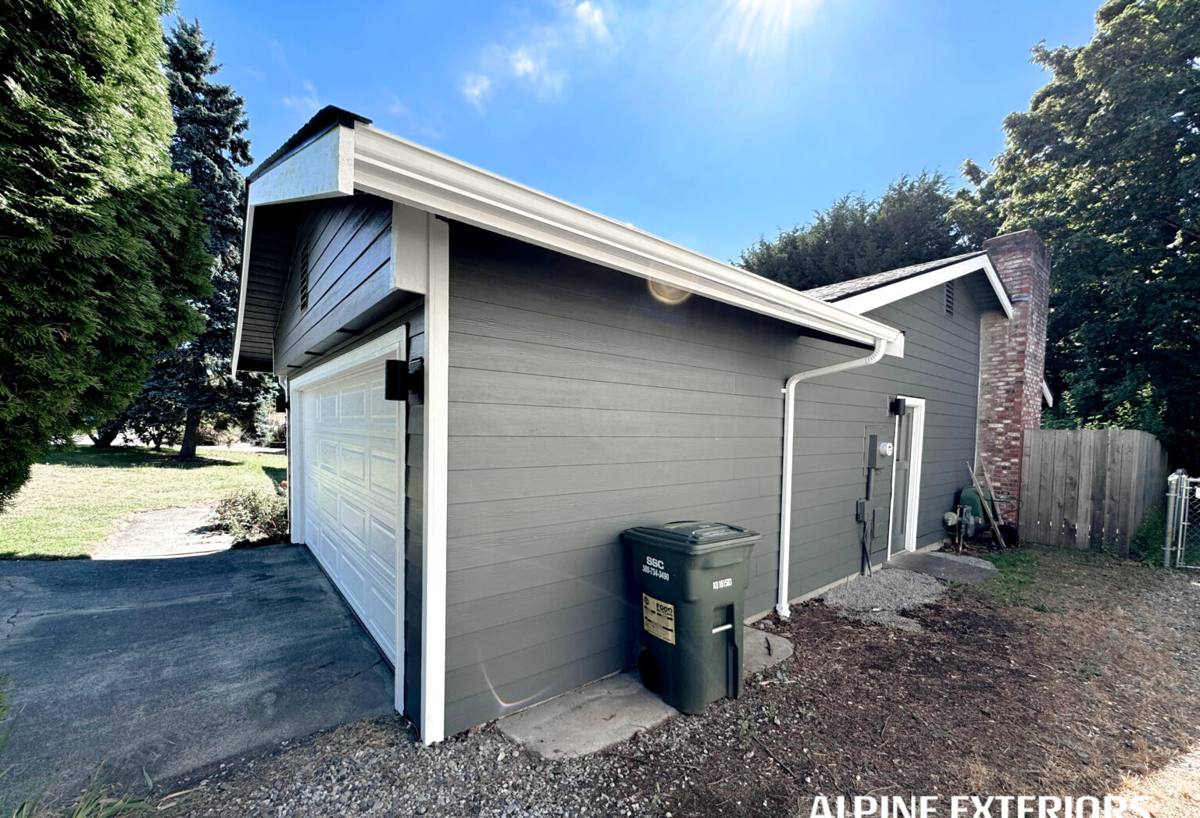
What Cemplank Gets Right
To be fair to Cemplank: it's a real fiber cement product, manufactured to be non-combustible and dimensionally stable, and it costs less installed than Hardie in most markets. For a homeowner on a tight budget who wants to move up from vinyl or aging cedar, it's a defensible choice on paper. We're not going to pretend otherwise, and if a competitor tells you Cemplank is "junk," that's not an honest characterization of the material itself.
Where the gap opens up isn't the base cement board — it's everything built around it.
Factory Finish and Color Consistency
James Hardie's ColorPlus finish is baked onto every plank at the factory in a multi-coat process, and the company backs that finish with matched caulk and touch-up products engineered specifically for it. That matters in a climate like ours: a finish that's cured under controlled factory conditions holds its color and adhesion far better over years of Whatcom County drizzle than a finish applied on a jobsite or through a less rigorous factory process. Cemplank offers primed and some pre-finished options, but the factory-finish program isn't built with the same depth of matched accessories — caulk, trim, and touch-up kits engineered as one system rather than sourced separately.
Over ten or fifteen years, that difference shows up as uneven fading, visible caulk lines, or trim that no longer quite matches the field color. It's not dramatic on day one. It's dramatic on year twelve, when you're trying to explain to a buyer's inspector why the south wall looks different from the north wall.
Climate-Engineered Formulations
James Hardie formulates its siding by climate zone — a wetter, milder coastal formulation for regions like ours versus a formulation built for hot, dry, or hard-freeze climates elsewhere in the country. Whatcom County sits in that wet coastal zone: salt-tinged marine air rolling in off the Salish Sea, a moss season that runs most of the fall through spring, and driving rain that finds every gap in a siding system. A product engineered with that specific moisture exposure in mind is going to perform more predictably here than a generic formulation sold the same way in every region of the country, which is the more common approach among broader fiber cement brands.
Warranty Structure: A Side-by-Side Look
Warranty length isn't just a marketing number — it tells you how much confidence a manufacturer has in its own product holding up without prorated coverage kicking in early. Here's how the two typically compare in structure, not just headline years:
| Factor | Cemplank | James Hardie |
|---|---|---|
| Substrate (board) warranty | Limited warranty on the cement board itself, terms set by the manufacturer and sometimes the distributing dealer | Long-term, non-prorated limited warranty on the plank substrate |
| Factory finish warranty | Varies by finish option chosen; not always bundled as tightly with the board warranty | Separate, dedicated ColorPlus finish warranty covering fade and finish integrity |
| Warranty transferability | Varies by product line and dealer | Transferable to a new homeowner if the home sells, which matters for resale value |
| Claims administration | Handled through the manufacturer and regional distributor network | Handled through a dedicated national claims process with a long track record |
We're intentionally not printing exact year figures here, because warranty terms get revised and vary by product line — always read the current written warranty for whatever you're being sold, from either brand, before you sign anything. What we can tell you is that the structural gap between the two — a bundled, non-prorated, transferable product-and-finish warranty versus a more fragmented one — is real and it's the main reason we stopped installing anything but Hardie years ago.
Installation Requirements and Local Contractor Support
Fiber cement is only as good as its installation. Both products require correct fastening patterns, proper clearance off grade and hard surfaces, flashing details at every penetration, and joint treatment that keeps water out of the wall assembly. Get any of that wrong and it doesn't matter which brand is on the truck — you'll have problems.
The difference is in the depth of contractor training and accountability behind the product. James Hardie runs a structured certification program for installers, with tiered recognition for crews that meet volume and quality standards. That gives homeowners a way to vet a contractor's track record with the specific product going on their home. Cemplank doesn't have an equivalent nationally recognized certification network with the same depth in our region, which means the quality bar depends almost entirely on the individual crew rather than a manufacturer-backed training standard.
For a company that installs one product exclusively, standardizing on Hardie means our crews aren't relearning fastening specs, trim details, and finish touch-up procedures across multiple product lines. That consistency is part of what keeps a siding job free of the small installation errors that cause callbacks.
Local Availability in Whatcom County
Fiber cement siding gets damaged eventually — a ladder mishap, storm debris, a vehicle backing into a wall. When that happens years after the original install, the question is whether you can get a matching replacement plank in the same profile, color, and finish batch. James Hardie's distribution network through the Pacific Northwest is deep enough that matching material is usually a straightforward order. Regional availability for other fiber cement brands can be spottier, and dealers sometimes shift their stocked product lines over time, which can leave a homeowner unable to source an exact match a decade down the road.
That's a quiet but real cost of choosing a less widely distributed product: you're not just buying siding, you're buying into a supply chain you may need to tap again in fifteen or twenty years.
Moss, Salt Air, and What Our Climate Actually Does to Siding
Lynden sits close enough to the Salish Sea and the Fraser Valley that homes here deal with a specific combination of stressors: salt-tinged marine air, long stretches of low-angle winter sun that never fully dries north-facing walls, and a moss and algae season that can run from October through April. None of that is unique to any one brand of fiber cement — moss will grow on Hardie board just as it will on Cemplank or cedar if a wall stays damp and shaded long enough. What differs is how the finish and substrate tolerate the cleaning that moss and algae removal requires over the years. A factory-cured finish designed for this kind of exposure holds up to gentle washing better than a finish with a thinner or less consistent factory process.
Driving rain off Puget Sound storms also puts real pressure on siding joints and butt seams. This is where installation quality and product-matched caulk systems earn their keep — a mismatched caulk that doesn't move with the board the way it was engineered to can crack and let water behind the siding well before the board itself would ever fail.
Why We Standardized on One Product
We made a deliberate decision years ago to install only James Hardie siding rather than carrying multiple fiber cement lines. That's not a marketing position — it's a practical one. Every crew member trains on one fastening spec, one trim system, one finish touch-up process, and one warranty structure. We know exactly how the product behaves in Whatcom County weather because it's the only thing we've put on hundreds of walls here. That depth of familiarity is harder to build when a company splits its work across several competing fiber cement brands, each with its own installation quirks and finish chemistry.
It also means when something needs warranty attention, there's no ambiguity about who stands behind it — the manufacturer's program is well established, well documented, and consistently administered.
A Practical Checklist Before You Choose a Fiber Cement Product
- Ask to see the actual written warranty document, not just a summary — for the board and the finish separately.
- Confirm whether the product is factory-finished or requires field-applied paint or stain.
- Ask whether the formulation is climate-specific for the Pacific Northwest or a generic national product.
- Check whether your installer carries manufacturer certification specific to the product they're proposing.
- Ask how easily matching replacement material can be sourced locally five, ten, and twenty years from now.
- Get the caulk, trim, and touch-up products specified in writing — matched systems age more evenly than mixed ones.
The Bottom Line
Cemplank is fiber cement, and fiber cement is a sound category for a climate like ours. But the gap between Cemplank and James Hardie shows up in the parts of the product that don't get discussed at the estimate table: finish durability, climate-specific engineering, warranty structure, installer accountability, and long-term supply. Those are exactly the factors that determine whether siding looks good and performs well in year fifteen, not just year one. That's why, after weighing those trade-offs across real jobs in this region, we standardized on Hardie and stopped installing anything else.
If you're comparing siding options for a home in Lynden or anywhere in Whatcom County, we're happy to walk through what we install, why, and what it would look like on your specific house. Reach out for a free, no-pressure estimate — there's no obligation, just a straight answer about your options.