 Lynden Siding
 Cedar Has Earned Its Reputation — That's Not in Question
Cedar siding looks good. There's a reason it's been the default choice for Pacific Northwest homes for generations — the grain, the warmth of the color, the way it ages if you let it. We're not writing this page to tell Lynden homeowners that cedar is a bad material. Western red cedar is naturally rot-resistant compared to most softwoods, it's a renewable regional product, and a well-built cedar home has real character that fiber cement and vinyl simply don't replicate out of the box.
What we're telling you is why, as a contractor who has to stand behind our installs for years after we leave the job site, we stopped installing it. It comes down to what Whatcom County weather does to wood siding over a fifteen- to twenty-year window, and what that means for your maintenance schedule, your wallet, and the paint job you were told would "last a decade."
What Lynden's Climate Actually Does to Cedar
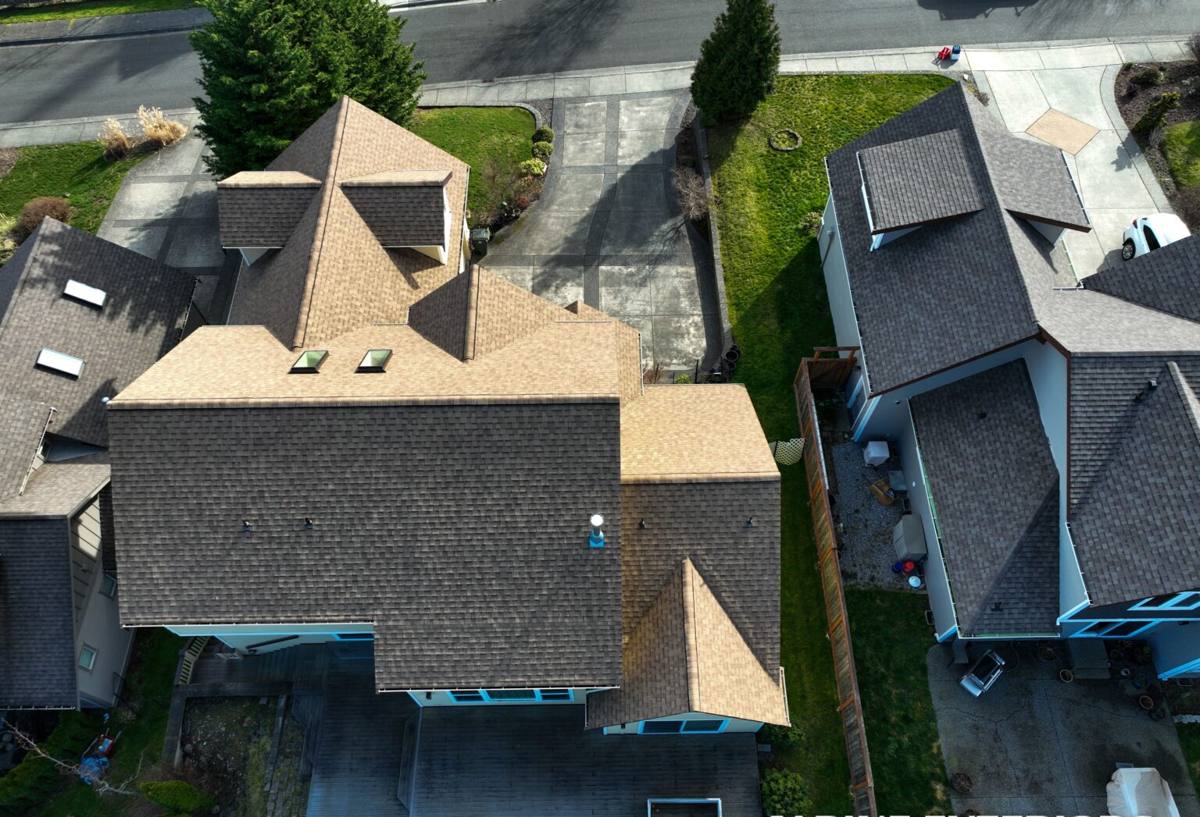
Lynden sits close enough to the Salish Sea and the Fraser Valley that homes here deal with a specific combination of stressors: salt-tinged marine air moving up the valley, long stretches of driving rain off the water, and a moss season that can run from October through April in a wet year. Any one of these is manageable for cedar. Together, over years, they compound.
Salt Air and Wood Fiber
Salt-laden moisture doesn't rot wood by itself, but it accelerates the breakdown of paint and stain films, and it draws moisture into end grain and fastener holes faster than dry inland air would. Once a finish starts chalking or hairline-cracking, salt air gets underneath it faster than in a drier climate, which shortens the repaint cycle.
Driving Rain and Grain Orientation
Wind-driven rain doesn't just fall on a wall — it gets pushed sideways into laps, joints, and butt seams. Cedar is more rot-resistant than pine or fir, but it is still wood, and wood absorbs water at end grain many times faster than it does through a painted face. Every board end, every mitered corner, every place a fastener penetrates the face is a point where a driving rain event can push moisture in faster than it dries out between storms.
Moss, Shade, and the North Wall Problem
Whatcom County's moss season is long, and moss doesn't need much to get established — a shaded north-facing wall, a spot near a downspout, a section that stays damp under a tree canopy. Moss and algae growth on wood siding holds moisture directly against the wood surface for extended periods. That's the exact condition that leads to soft spots, peeling finish, and eventually rot, and it's very hard to fully prevent on a wood-clad home with any shaded exposure — which describes a lot of lots in this area.
The Maintenance Math Homeowners Don't Get Told Up Front
Cedar siding is not a one-time install-and-forget product, and any contractor who tells you otherwise is setting you up for a surprise. To get anywhere close to its potential lifespan, cedar needs:
- A quality primer and finish coat applied correctly at install — back-primed on all six sides, not just the face
- Repainting or restaining on a cycle that's realistically every 5-8 years in a wet marine climate, sometimes sooner on sun- and rain-exposed elevations
- Regular inspection of caulk joints, butt seams, and any spot where trim meets siding
- Prompt attention to moss and algae growth before it gets a foothold
- Replacement of individual boards as end-grain rot or insect damage shows up, which becomes more common after the 15-year mark
None of that is unreasonable to ask of a homeowner who loves the look and is willing to stay on top of it. But it's a real, recurring cost — in both money and attention — that often isn't spelled out clearly when the siding goes up. We'd rather tell you that cost exists before you sign a contract than let you discover it in year seven.
Installation Sensitivity: Where Most Cedar Failures Actually Start
In our experience, cedar siding rarely fails because the wood itself was bad. It fails because of how it was installed. A few of the most common issues we see on wood siding jobs that weren't back-primed, flashed, and detailed correctly:
- Missing or inadequate back-priming — leaves the back face of each board exposed to moisture wicking from the sheathing side, invisible until the board is already compromised
- Insufficient rainscreen gap — cedar installed tight against the weather barrier without a drainage gap traps moisture instead of letting it drain and dry
- Poor flashing at windows, doors, and butt joints — the majority of rot we've been called to repair on older wood-sided homes starts at a flashing detail, not in the open field of the wall
- Nail placement and fastener corrosion — the wrong fastener, or one placed too close to an edge, splits the board or corrodes and stains the finish over time
This is a material where the installer's skill matters as much as the product quality, and where corners cut during install don't show up as a problem until years later, when they're expensive to trace and fix. We didn't want to be in the position of installing a product where a huge share of the long-term outcome depends on details that are easy to shortcut and hard for a homeowner to inspect after the fact.
Cedar vs. James Hardie: A Straight Comparison
| Factor | Cedar Siding | James Hardie Fiber Cement |
|---|---|---|
| Moisture absorption | Absorbs at end grain and face if finish fails | Engineered to resist moisture-related swelling and rot |
| Combustibility | Combustible | Non-combustible core material |
| Finish lifespan | Repaint/restain typically every 5-8 years in marine climates | ColorPlus factory finish warrantied well beyond that window |
| Moss/algae vulnerability | Holds moisture against wood when growth establishes | Does not feed rot the way organic wood fiber can |
| Insect susceptibility | More resistant than pine/fir, still a wood product | Not a food source for insects |
| Warranty structure | Varies by finish product, typically not transferable | Manufacturer warranty designed to be transferable to a new owner |
| Upfront material cost | Generally higher than fiber cement | Moderate, competitive with quality wood products |
Fiber cement isn't magic — it still needs correct installation, and it isn't literally maintenance-free. But the maintenance it does need is lighter and less frequent, and it doesn't have wood's fundamental vulnerability to sustained moisture exposure, which is the single biggest factor working against any wood product in a climate like Whatcom County's.
Why We Standardized on James Hardie
We install James Hardie fiber cement siding exclusively, and this isn't a brand preference — it's a decision built around what actually holds up on homes in this specific region. Hardie's HZ5 product line is engineered for climates with freeze-thaw cycling and moisture exposure like ours. It's non-combustible, which matters more each year given regional wildfire smoke and ember exposure concerns. The ColorPlus factory-applied finish is baked on under controlled conditions rather than field-applied, which means better adhesion and a longer color life than a jobsite paint job can typically achieve. And Hardie backs the product with a strong, transferable warranty — something that matters if you ever sell the home.
We also install it because we know it well. Standardizing on one system means every crew on every job has deep, repeated experience with Hardie's specific flashing, fastening, and joint details — the same category of details that, done wrong, cause most of the wood siding failures we described above. Consistency in what we install translates directly into consistency in how well it's installed.
What This Means If You're Deciding Between the Two
If you already own a cedar-sided home in the Lynden area and it's been maintained well, there's no reason to panic or assume it needs to come off tomorrow. Well-maintained cedar can last a long time. The conversation changes when you're facing a full re-side, when the existing cedar is showing widespread rot or finish failure, or when you're weighing whether to keep sinking money into a 5-8 year repaint cycle versus moving to a system with a longer maintenance interval.
A few questions worth asking yourself before you decide:
- Are you willing and able to commit to a repaint/restain cycle every 5-8 years, realistically, not aspirationally?
- Does your home have shaded or north-facing walls prone to moss, and are you prepared to manage that ongoing?
- Are you planning to sell within the next 10-15 years, and would a transferable warranty matter to a buyer?
- Is fire resistance a factor for your insurance or your own peace of mind?
If your answers point toward wanting something lower-maintenance with a longer finish life and stronger warranty backing, that's the exact case fiber cement is built for.
Get an Honest Look at Your Options
We're happy to come take a look at your home, tell you straight what condition your current siding is in, and walk through what a James Hardie re-side would actually involve and cost for your specific house. No pressure, no hard sell on a product you don't need yet — just a straightforward assessment from a crew that installs one system and knows it thoroughly. Reach out for a free estimate using the form below.