 Lynden Siding
 If you're re-siding a home in Lynden, you've almost certainly looked at both vinyl and James Hardie fiber cement and wondered why the price tags are so different — and whether that difference is worth it. This page is our honest answer. We only install James Hardie fiber cement siding, so you should know that up front. But we'd rather explain the real trade-offs between the two products than pretend vinyl doesn't have real strengths, because you're the one who has to live with this decision for the next few decades.
What Vinyl Siding Actually Is
Vinyl siding is an extruded PVC (polyvinyl chloride) panel, usually formed to mimic a lap or shake profile and colored all the way through the material. It hangs on the wall rather than being fastened rigidly — the nailing slots are designed to let panels expand and contract with temperature swings. That's not a flaw; it's how the product is engineered to work.
Vinyl's real advantages are upfront cost and installation speed. It's lightweight, panels click together quickly, and material cost per square foot is meaningfully lower than fiber cement. For a homeowner on a tight budget, that matters, and we're not going to tell you it doesn't.
Where Vinyl Struggles
The trade-offs show up over time, not on installation day:
- Heat distortion: Vinyl softens and can warp when exposed to reflected or concentrated heat — dark colors, south-facing walls, and heat bouncing off nearby windows are all known contributors.
- Cold brittleness: In freezing temperatures, vinyl becomes more brittle and can crack on impact — hail, a thrown rock, a ladder bump.
- Color life: Because color is mixed into the plastic, UV exposure gradually fades and chalks the surface over years. Some fading is close to unavoidable with any exterior product, but vinyl's color shift is a known long-term characteristic of the material.
- Moisture behind the panel: Vinyl itself doesn't rot, but it's not a water barrier — it relies entirely on the water-resistive barrier and flashing behind it. If that underlayment is compromised, vinyl won't show you a problem until it's well established, because you can't see behind it without pulling panels.
- Fire behavior: Vinyl is a petroleum-based plastic and will soften, melt, and burn under fire exposure. That's a real consideration for homes near vegetation or with tight neighbor setbacks.
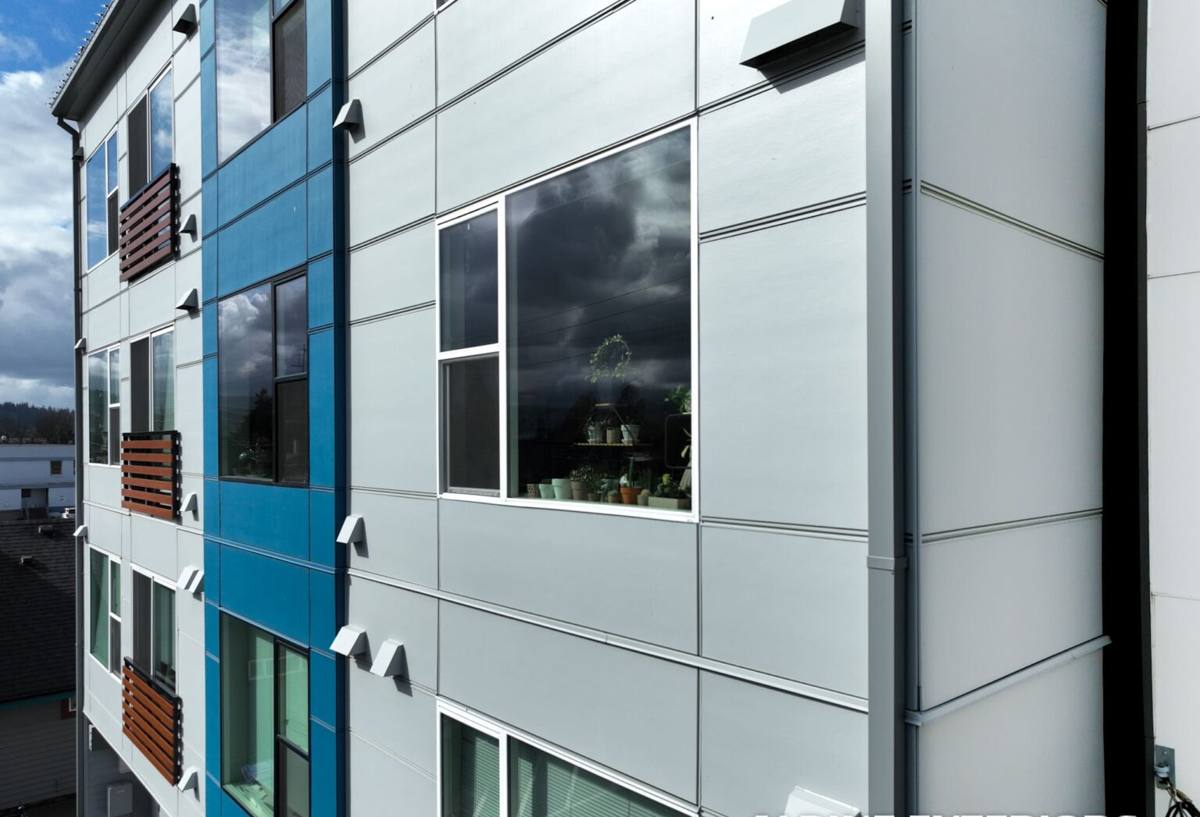
What James Hardie Fiber Cement Is
James Hardie siding is manufactured from a mix of Portland cement, sand, and cellulose fiber, cured under pressure into a dense, rigid board. It's not plastic and it's not wood — it's closer in nature to fiber-reinforced masonry. The company factory-applies its ColorPlus finish through a baked-on process, rather than relying on job-site painting or mixed-in pigment.
Hardie also engineers regional product lines. The HZ5 line, rated for harsher wet climates, is what we spec for homes in this part of Washington. It's formulated and tested for high-moisture, freeze-prone regions rather than being a one-size-fits-all national product.
Why That Matters Here
Whatcom County sits close enough to the Salish Sea that homes catch real salt-laden air, on top of Western Washington's long wet season and the driving rain that comes with fall and winter storms off the coast. Add in the shaded, damp conditions that let moss colonize roofs and north-facing walls for much of the year, and you've got a climate that is genuinely hard on exterior materials — not in a dramatic, one-time way, but through slow, cumulative exposure across mild but relentless months. Fiber cement's density and non-combustible composition hold up to that kind of grinding, wet-cycle exposure differently than a plastic panel does; it doesn't soften in a warm spell or go brittle in a cold snap the way vinyl can.
Side-by-Side Comparison
| Factor | Vinyl Siding | James Hardie Fiber Cement |
|---|---|---|
| Material | Extruded PVC plastic | Cement, sand, cellulose fiber |
| Combustibility | Combustible, will melt/burn | Non-combustible |
| Color | Mixed into material, fades over time | Factory-baked ColorPlus finish |
| Cold weather behavior | Can become brittle, crack on impact | Stable, not impact-brittle from cold |
| Heat weather behavior | Can warp/distort from reflected heat | Dimensionally stable |
| Moisture/rot resistance | Material won't rot, but is not a moisture barrier itself | Engineered HZ5 formulation for wet climates |
| Typical lifespan (installed to spec) | 20-30 years, product dependent | Multiple decades; Hardie backs it with a long transferable warranty |
| Upfront material + labor cost | Lower | Higher |
| Repainting needed | Not typically repainted (replaced instead) | Factory finish delays repainting for many years |
| Resale perception | Viewed as a budget/standard upgrade | Often viewed as a premium, durable upgrade |
Installation Sensitivity: The Part Nobody Talks About
Both products perform worse — sometimes dramatically worse — when installed wrong, but they fail differently.
Vinyl Installation Mistakes
Vinyl is forgiving to hang quickly but unforgiving to hang wrong. Nailing it too tight (not leaving room for thermal expansion) causes buckling and waviness. Poor flashing and weather-barrier work behind vinyl is easy to hide and hard to catch during a walkthrough, because the panel conceals the substrate completely.
Fiber Cement Installation Mistakes
Fiber cement demands more from the installer: correct fastener type and placement, proper clearances at grade and roof lines, sealed cut edges, and manufacturer-spec flashing and house-wrap detailing. Done wrong, fiber cement can trap moisture at butt joints or fastener penetrations. This is exactly why James Hardie certifies installers and why installation quality — not just the product itself — determines whether you get the decades of performance the material is capable of. We install strictly to Hardie's published specifications, which is a big part of what backs the warranty.
Cost: What Actually Drives the Number
We won't quote you a number on a page like this — every home is different — but here's what actually moves the price on either product:
- Square footage and the number of corners, dormers, and trim details (complexity, not just size, drives labor hours)
- Whether existing siding needs to be removed and the sheathing/weather barrier inspected or replaced
- Siding profile — lap, shake-style panels, and board-and-batten all price differently
- Trim and fascia scope bundled into the same project
- Access — two-story walls, tight lot lines, and landscaping obstacles add labor time on any siding job
Vinyl will generally come in lower on materials and labor speed. Fiber cement costs more upfront because the material, the fasteners, the cutting equipment, and the labor hours are all a step up. The honest way to think about it is cost per year of service, not cost per square foot on installation day — but we understand that upfront budget is a real constraint, and we'd rather you go in with clear eyes than a sales pitch.
Warranty: Read the Fine Print
Vinyl warranties vary a lot by manufacturer and product tier, and many prorate coverage — meaning the payout shrinks the longer you've owned the siding, and often doesn't cover labor to reinstall. James Hardie backs its fiber cement products with a lengthy, transferable limited warranty, and the ColorPlus finish carries its own separate finish warranty. Transferability matters if you plan to sell the home within the coverage window — it's a real, verifiable selling point rather than a marketing line, and buyers' agents and inspectors in this market increasingly recognize the name.
Why We Standardized on James Hardie
We don't install vinyl, LP SmartSide, cedar, primed spruce, or other fiber cement brands. That's a deliberate professional standard, not a sales gimmick. After years of installing and repairing siding on homes across this climate, fiber cement — specifically James Hardie's HZ5 formulation, installed to Hardie's own specifications — is the product we're willing to put our name behind for durability, fire safety, and long-term appearance in a marine, wet-cycle climate like ours. Narrowing to one product line also means our crews install it constantly rather than occasionally, which is where installation quality actually comes from.
A Practical Checklist for Comparing Bids
- Ask exactly which siding product and product line is being quoted — not just "vinyl" or "fiber cement," but the specific manufacturer and series
- Ask whether the existing weather barrier and sheathing will be inspected before new siding goes on
- Ask what fastening schedule and clearances the installer follows, and whether they're manufacturer-certified for that product
- Get the warranty in writing, including whether it's prorated and whether it's transferable to a future homeowner
- Ask how cut edges and joints will be sealed — this is where most long-term moisture problems start on any siding type
- Compare total project scope, not just siding — trim, flashing, and fascia work should be spelled out, not assumed
The Bottom Line
Vinyl siding is a legitimate, widely used product with a lower upfront cost — we're not going to tell you otherwise. But for Lynden and the rest of Whatcom County, where salt air, driving rain, and a long moss season put steady pressure on exterior materials year after year, we've chosen to build our business around James Hardie fiber cement because it's what we trust to hold its color, its shape, and its integrity through that cycle, installed correctly, backed by a real warranty.
If you're weighing your options, we're happy to walk your home, look at your existing siding and substrate, and give you a straight answer about what we'd recommend and why. Reach out for a free, no-pressure estimate using the form below.