 Lynden Siding
 Vinyl Siding Isn't a Bad Product. It's the Wrong Product for This Climate.
We get asked about vinyl siding often enough that it's worth explaining, plainly, why we don't install it. This isn't a knock on every vinyl panel ever manufactured or every contractor who hangs it. Vinyl is inexpensive, widely available, and easy to install quickly, which is exactly why it became the default siding choice across much of the country over the last few decades. In a dry inland climate with mild winters, a lot of vinyl siding installations hold up reasonably well for a long time.
Lynden isn't that climate. We sit in Whatcom County, close enough to the Salish Sea and the Nooksack lowlands that homes here deal with a specific combination of salt-laden air, sustained driving rain off the water, and a moss season that can run half the year in shaded, north-facing exposures. That combination is hard on any siding material, but it is particularly unforgiving of vinyl's specific weaknesses. After years of tear-offs, warranty calls, and repair jobs on homes with failing vinyl, we made a decision as a company: we only install James Hardie fiber cement siding. Here's the reasoning, laid out honestly.
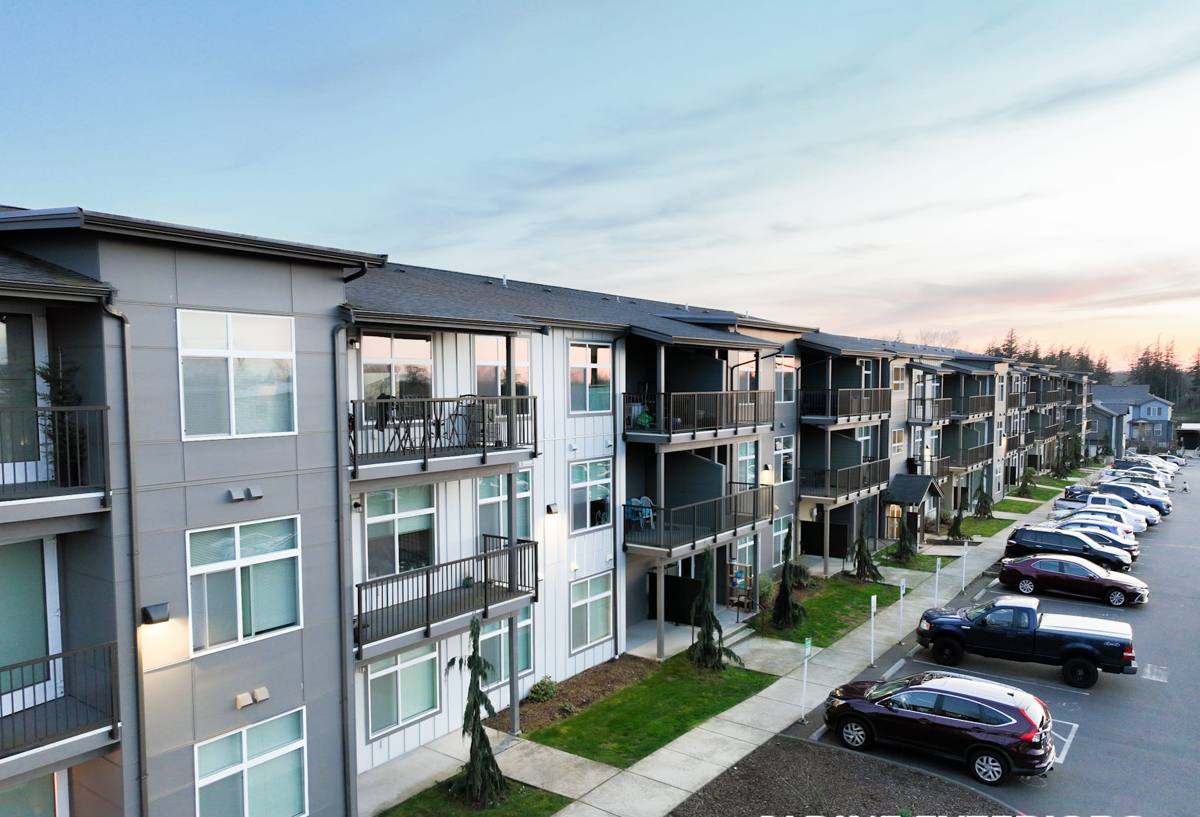
How Vinyl Siding Actually Behaves on the Wall
Vinyl siding is a thin PVC panel, typically between .038" and .046" thick, hung in overlapping courses on a wall. It's designed to "float" — it isn't fastened rigidly to the wall the way wood or fiber cement is. Nails go through slotted holes and are left slightly loose on purpose, because the panel needs room to expand and contract with temperature swings. That design works fine on paper. In practice, it means the entire performance of the siding depends on a nailing job being done exactly right, panel by panel, for the life of the house.
Expansion, Contraction, and the Whatcom County Temperature Swing
Western Whatcom County doesn't have brutal winters, but it does have a real freeze-thaw cycle, cold snaps off the Fraser Valley, and big daily temperature swings between a clear summer morning and an afternoon in direct sun. Vinyl expands and contracts more than almost any other siding material with temperature change. Over enough cycles, panels that were nailed even slightly too tight will buckle, bow, or pop loose at the corners. Panels nailed too loose rattle in wind and can blow off entirely in a strong southwesterly storm — something Lynden gets its share of in the fall and winter.
Wind Exposure Off the Lowlands
Open farmland and river valley exposure means wind isn't gentle here during winter storm systems. Vinyl siding is rated for wind resistance, but that rating assumes correct fastening on every course and proper starter strip, J-channel, and corner post installation. A single missed detail anywhere on the wall becomes the weak point the wind finds first. We've replaced sections of vinyl that failed at exactly one bad nailing run, not because the product itself was defective.
Moisture Is the Real Issue in This Region
Vinyl siding is not waterproof — it's water-resistant, and it relies on a drainage plane behind it (housewrap, and ideally a rainscreen gap) to manage the water that inevitably gets behind the panels through seams, penetrations, and butt joints. In a drier climate, that's a manageable amount of water. In a region with sustained driving rain coming off the water and long stretches of overcast, damp weather, the volume of water working behind vinyl siding is significantly higher, and it stays wet longer between drying cycles.
The panels themselves don't rot, which is the argument usually made in vinyl's favor. But the sheathing, housewrap, and framing behind poorly detailed vinyl siding absolutely can, and by the time it shows up as soft trim or a stained interior wall, the damage is already done and hidden behind a siding system that gave no early warning sign. Fiber cement isn't immune to water intrusion either if it's installed wrong, but it doesn't add the same expansion-driven seam movement that opens up water paths over time.
Moss, Algae, and the Long Whatcom Growing Season
Vinyl's textured, low-gloss surface and the horizontal laps where panels overlap are good places for moss spores and algae to take hold, especially on north- and west-facing walls that stay shaded and damp through our long fall-to-spring wet season. Once established, moss and mildew growth on vinyl is difficult to remove without damaging the surface — pressure washing too aggressively can drive water behind the panels or strip what little factory finish is there. It's a maintenance cycle that repeats every year in shaded exposures, which describes a lot of tree-lined Lynden lots.
Fading, Chalking, and the Color Problem
Vinyl siding color is mixed into the resin, not applied as a coating, so it can't be repainted successfully in most cases — paint doesn't bond well to PVC and the color mismatch between panels ages differently in sun exposure anyway. UV exposure over years causes vinyl to chalk and fade, and darker colors fade faster and can warp more from heat absorption. Once a vinyl color has faded unevenly across sun-exposed and shaded walls, or once you need to replace a damaged panel, matching the original color from ten or fifteen years ago is often impossible because manufacturers discontinue and update their color lines.
The Warranty Reality
Vinyl siding warranties look impressive on paper — lifetime coverage is common marketing language. What matters is the structure underneath that language. Most vinyl warranties are prorated, meaning the coverage value declines every year you own the home, and many are non-transferable or only partially transferable to a new owner, which matters if you plan to sell. Labor costs for removal and reinstallation are frequently excluded or capped at a low dollar figure that hasn't been updated in years. We've read enough of these warranty documents with homeowners to know the "lifetime" claim rarely means what it sounds like it means at year twelve when a windstorm takes off a section of panels.
Vinyl vs. Fiber Cement: A Straight Comparison
| Factor | Vinyl Siding | James Hardie Fiber Cement |
|---|---|---|
| Upfront material cost | Lowest of common siding options | Higher upfront cost |
| Wind/impact resistance | Depends entirely on correct fastening | Rigid, less installation-sensitive |
| Moisture behavior | Panel resists water; assembly behind it can trap it | Engineered for wet climates (HZ5 line); proper rainscreen detailing |
| Fire resistance | Melts/deforms; not fire-rated | Non-combustible |
| Color/finish | Molded-in color, fades and chalks, can't be repainted well | Factory-baked ColorPlus finish, repaintable if needed |
| Typical lifespan before major issues | 15-25 years depending on exposure | 30-50 years with proper install and maintenance |
| Warranty structure | Often prorated, limited labor coverage | Strong non-prorated product warranty, ColorPlus finish warranty |
Why We Standardized on James Hardie Fiber Cement
We didn't arrive at "Hardie only" as a marketing position. It came out of years of seeing which siding held up on Whatcom County homes and which siding generated callbacks. Fiber cement is dense, rigid, and non-combustible, which matters given the wildfire smoke seasons the whole region has seen in recent summers. Hardie's HZ5 product line is specifically engineered for climates like ours — freeze-thaw cycles, sustained moisture, and coastal-influenced weather — with a formulation designed to resist moisture-related damage better than standard fiber cement.
The ColorPlus factory finish is baked on under controlled conditions rather than field-painted, which gives more consistent, longer-lasting color than a site-applied coat and holds up better against the fading that plagues vinyl in full-sun exposures. Because the boards are rigid and fastened directly rather than floating, correct installation is still essential, but the finished result is far less dependent on getting a slotted-nail-hole detail perfect on every single panel. And the warranty backing it is structured in a way we can explain to a homeowner without hedging.
What This Means If You're Comparing Bids
If you're getting quotes for new siding in Lynden or anywhere else in Whatcom County, it's worth asking every contractor the same set of questions, regardless of what material they're proposing:
- What siding material and product line are you quoting, specifically — not just "vinyl" or "fiber cement," but the manufacturer and product series?
- What does the warranty actually cover — is it prorated, and does it include labor for repairs?
- Is a rainscreen or drainage gap included behind the siding, or is it installed directly against housewrap?
- How is the installer accounting for wind exposure on this specific lot?
- What's the manufacturer's climate rating or recommendation for this region?
- Can the color/finish be repainted down the road if it fades or you want to update it?
A contractor who can answer those questions specifically, with product literature to back it up, is worth more than one who quotes a price per square and moves on.
Fair to Vinyl: Where It Still Makes Sense
To be fair to the product, vinyl siding isn't a bad choice everywhere. On a budget-driven project, a rental property, or a drier inland climate with less wind-driven rain, well-installed vinyl from a reputable manufacturer can perform acceptably for a couple of decades. Our position isn't that vinyl siding is junk — it's that given what Lynden's climate does to it over time, and given the repair calls we've seen, we don't think it's the right long-term investment for homes in this specific area, and we'd rather not put our name on an installation we don't believe in.
Get a Straight Answer for Your Home
Every house and every lot is a little different — sun exposure, tree cover, wind direction, and how close you are to the water all change how siding performs over time. If you'd like an honest look at your home's siding situation, we offer a free, no-pressure estimate and we'll tell you what we'd actually recommend, not just what's easiest to sell.