 Lynden Siding
 Siding in Acme: A Different Kind of Weather Test
Acme sits up in the Nooksack River valley, tucked against the foothills that climb toward Mount Baker, and that setting shapes what a house has to put up with year-round. The tree cover is heavier here than out on the flats around Lynden proper, the humidity lingers longer under that canopy, and the same marine-influenced weather systems that move through the rest of Whatcom County still reach up the valley — driving rain, long gray stretches, and the kind of damp air that never fully dries out between storms. Add in shaded rooflines and north-facing walls that see less sun, and you've got a recipe for a siding material's worst-case scenario: sustained moisture contact with limited drying time.
We've worked on homes throughout this part of the county long enough to know that what holds up on a sunny south-facing wall in town doesn't always hold up the same way on a shaded wall in Acme. That's part of why we standardized on one siding system rather than offering a menu of products — we'd rather install the one that performs consistently across these conditions than sell whatever's cheapest and hope the site conditions are forgiving.
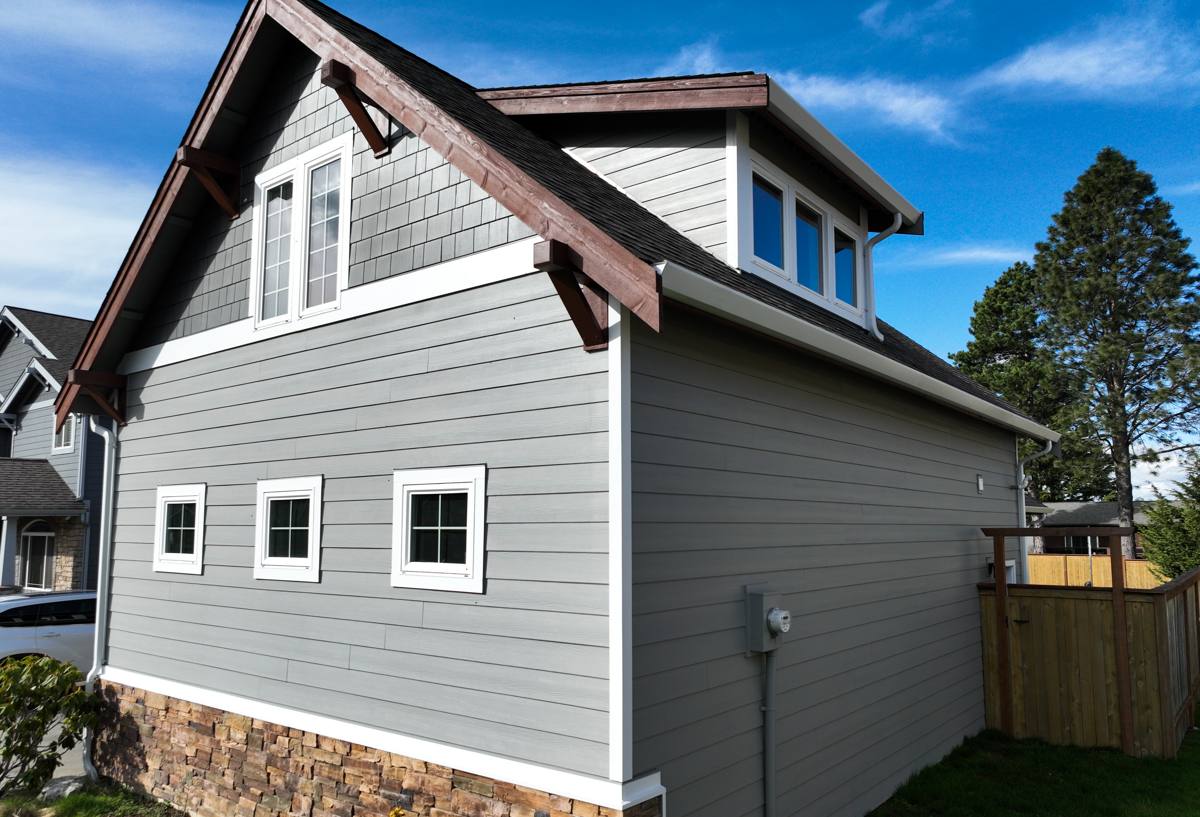
What Acme Homes Actually Face
Moss and Sustained Shade
Moss doesn't grow because a material is bad — it grows because moisture sits on a surface long enough for spores to take hold. In a valley with heavier tree cover, north walls, porch ceilings, and anything under an overhang can stay damp for days after a storm passes. Over years, that constant low-grade moisture exposure is what breaks down materials that aren't built to shrug it off, and it's what turns a light green tint into a real maintenance chore if it's left unaddressed.
Driving Rain and Wind-Driven Moisture
Rain that comes in at an angle doesn't just run down a wall — it gets pushed into seams, laps, and butt joints. Homes in exposed spots or clearings around Acme can catch more wind-driven rain than you'd expect for how far inland they are. That makes the quality of flashing, caulking, and lap detail at every joint just as important as the siding material itself.
Temperature Swings and Freeze-Thaw
Valley locations tend to see sharper overnight temperature drops than the coast, especially in fall and winter. Materials that absorb moisture and then freeze are working against themselves — swelling, cracking, and loosening fasteners over repeated cycles. It's a slow process, but it's a real one, and it shows up first at the corners, seams, and any spot where water was already lingering.
Why We Only Install James Hardie
Lynden Siding Contractors installs James Hardie fiber cement siding exclusively. We don't offer vinyl, LP SmartSide, primed wood, or other fiber cement brands as alternatives, and that's a deliberate call, not a limitation of what we're capable of installing. In a valley environment like Acme's — shade, moisture, moss pressure — the material matters more than almost anywhere else in the county.
- Non-combustible core. Hardie's fiber cement composition doesn't feed a fire the way wood-based products can, which matters given how many Acme properties border trees and brush.
- Engineered for Pacific Northwest moisture. Hardie's HZ10 product line is formulated specifically for wetter, colder climates like ours, rather than being a general-purpose product used everywhere.
- Factory-applied ColorPlus finish. The color is baked on at the factory under controlled conditions, which holds up better against sustained damp and shade than most field-applied paint systems, and it comes with its own finish warranty.
- Dimensionally stable. Fiber cement doesn't swell and contract with moisture the way wood-based composites can, which matters directly for freeze-thaw resilience.
- Long, transferable warranty. A meaningful warranty backing the product gives homeowners real protection, not just a manufacturer's marketing claim.
We're not going to tell you every other siding product on the market is junk — most have a legitimate place somewhere. But for what Acme's climate throws at a house over 20, 30, or 40 years, we've made our decision, and we stand behind it on every job we take on.
Where Correct Installation Matters Most
Even the best siding material fails early if it's installed wrong. In a shaded, moisture-heavy environment, small installation mistakes compound faster than they would in a drier spot.
| Installation Detail | Why It Matters in Acme's Climate |
|---|---|
| Proper clearance from grade and roofing | Prevents wicking moisture from splashback and roof runoff in a valley that sees heavy rain volume |
| Correct fastener placement and spacing | Keeps panels secure through freeze-thaw cycling without loosening or popping |
| Sealed and flashed joints | Blocks wind-driven rain from getting behind the siding at seams and penetrations |
| Ventilation behind the cladding | Lets shaded, damp walls actually dry out between rain events instead of staying wet |
| Caulking at trim and transitions | Stops moss and algae from getting a foothold in gaps that trap standing moisture |
Roofing, Windows, and Decks — The Rest of the Envelope
Siding is only one piece of how a home in Acme handles weather. We also handle roofing, window replacement, and deck construction, because these systems all interact. A roof that's shedding water improperly can dump extra moisture straight onto a wall. Windows with failed flashing or worn seals feed water directly into the wall cavity behind otherwise sound siding. Decks built without the right ledger flashing or gapped decking hold moisture against the house and against themselves. Treating the exterior as one connected system, rather than a set of unrelated projects, is how you actually solve a moss or moisture problem instead of just moving it somewhere else.
What a Siding Project Looks Like Here
Assessment First
Before we talk product or price, we look at what's actually happening on the house — where moisture is collecting, whether there's rot or damage under the existing siding, how much sun exposure different walls get, and what the roofline and gutters are doing to water flow around the structure. On a shaded, tree-lined lot, that assessment often turns up issues a homeowner wouldn't see from the ground.
Tear-Off and Substrate Check
Once the old siding comes off, we check the sheathing and framing underneath for moisture damage. This step matters everywhere, but it's especially important on homes that have had long-term moss coverage or shaded walls, since that's exactly where hidden water damage tends to show up.
Installation to Spec
We install James Hardie siding following the manufacturer's clearance, fastening, and flashing requirements — not a shortcut version of them. That's what keeps the warranty valid and what actually gives the material a fighting chance against this valley's climate.
Finish and Cleanup
Trim, caulking, and touch-up work get done to match the ColorPlus finish, and the site gets cleaned up so you're not left dealing with debris or old material.
Cost Factors for an Acme Siding Project
Every home is different, but a few factors consistently move the price on projects up in the valley:
| Factor | Why It Affects Cost |
|---|---|
| Home size and wall complexity | More corners, gables, and dormers mean more cutting, fitting, and labor time |
| Extent of hidden damage | Rot or moisture damage found under old siding needs repair before new siding goes on |
| Access and site conditions | Wooded lots, slopes, or limited equipment access can add time |
| Siding profile and trim selection | Lap width, panel style, and trim detail all affect material and labor cost |
| Tear-off scope | Full removal of old siding versus a simpler re-side affects labor hours |
A Local Crew, Not a Rotating Sales Team
We're based in Whatcom County and work throughout the Lynden area, including up into Acme and the surrounding valley communities. That matters for a few practical reasons: we know how differently a shaded valley lot behaves compared to an open lot near town, we're not driving in from out of the region to do a one-off job, and if a warranty issue or a question comes up years down the road, we're still local and reachable. A siding job is a long-term investment in the house — it's worth having someone accountable nearby, not a name from a stack of business cards.
Signs Your Acme Home May Need Siding Attention
- Moss or algae buildup that keeps returning even after cleaning
- Soft spots, bubbling, or visible warping in siding panels
- Paint that's peeling or failing faster than it should
- Gaps opening up at seams, corners, or trim
- Rising energy bills that suggest the wall assembly isn't insulating like it used to
- Visible rot or discoloration around window and door trim
If you're seeing any of that on a home in Acme, or you're just planning ahead for a siding, roofing, window, or deck project, we're happy to take a look and walk you through what we'd actually recommend for your specific house. There's no pressure and no obligation — just a straight assessment and a free estimate.