 Lynden Siding
 Exterior Work Built for Aldergrove's Climate
Aldergrove sits close enough to Lynden and the Whatcom County border that homeowners here deal with the same weather patterns our crews see every day: long wet stretches from fall through spring, salt-tinged air moving in off the Georgia Strait and Boundary Bay, and moss that doesn't take a season off. If you own a home in Aldergrove, you already know the drill — gutters that need clearing twice a season, north-facing walls that never quite dry out, and paint or caulk lines that seem to fail faster than they should. That's not bad luck. It's the regional climate doing what it does to exterior building materials that weren't engineered for it.
We're based just across the line in Lynden, Washington, and Aldergrove falls within the practical service radius we work in regularly. That matters more than it sounds like it should. A crew that only shows up once for a big job doesn't learn how a specific neighborhood's homes age. A crew that works this corridor year-round does.
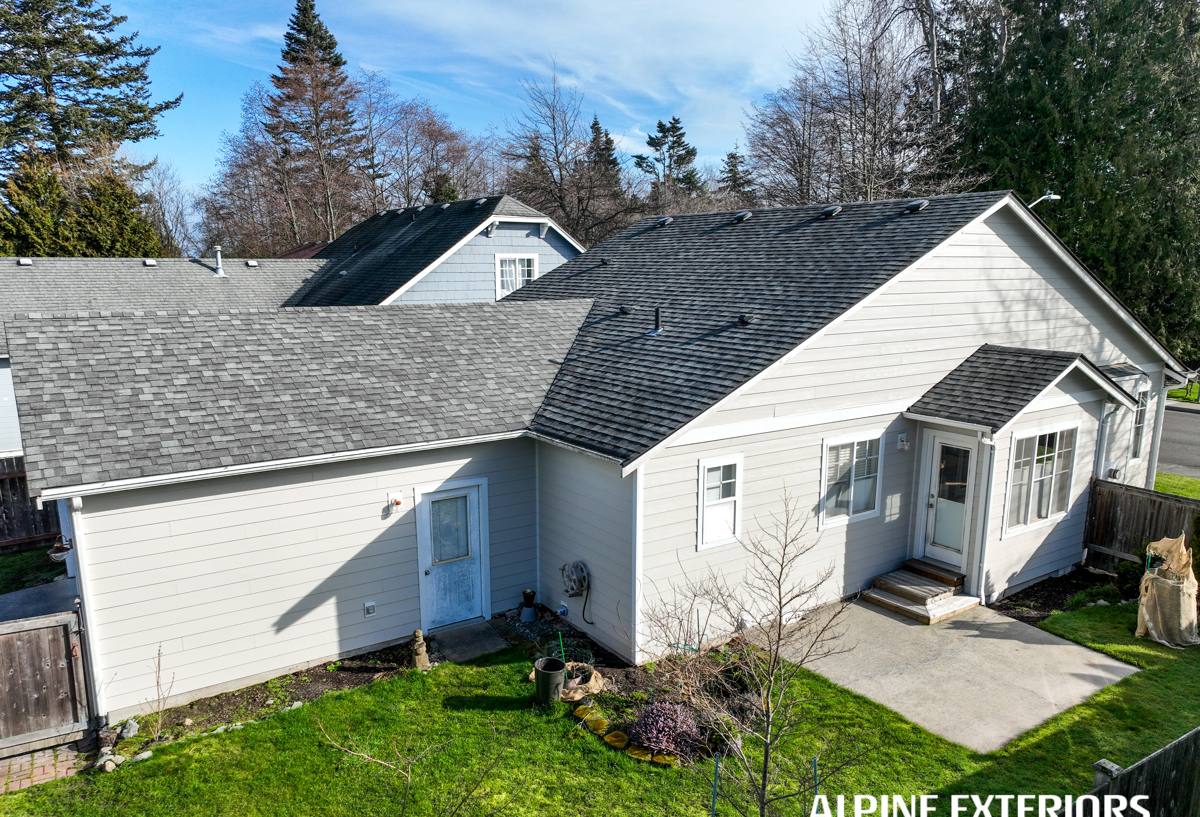
What Driving Rain and Salt Air Actually Do to a House
Every exterior material on a house is fighting two things at once in this part of the world: moisture intrusion and surface degradation. They're related but not the same problem, and understanding the difference is the whole reason we standardized on one siding product instead of offering several.
Moisture Intrusion
Driving rain — rain pushed sideways by wind rather than falling straight down — gets forced into laps, seams, and fastener points that a calm-weather install might never test. Over years, water that gets behind or into a siding panel doesn't just sit there. It swells wood-based products, delaminates weak composites, and feeds rot in the sheathing and framing behind the cladding. By the time it shows up as a soft spot or a stain on the interior wall, the damage has usually been building for a while.
Salt Air and Surface Wear
Homes closer to the water — and Aldergrove is close enough to catch some of it — deal with airborne salt that accelerates corrosion on fasteners, fades paint faster, and breaks down cheaper coatings ahead of schedule. It's a slower process than moisture intrusion, but it compounds the same way: a compromised painted surface lets more water in, and the cycle speeds up.
Moss and the Never-Fully-Dry Wall
The long moss season here isn't just a roof problem. Shaded siding, north walls, and anything under overhanging trees stays damp longer than it should, and moss and algae take hold on porous or textured surfaces. Beyond the cosmetic issue, sustained dampness against a wall is exactly the condition that shortens the life of moisture-sensitive siding materials.
Why We Install Only James Hardie Fiber Cement
We get asked regularly why we don't offer vinyl, LP SmartSide, primed spruce, cedar, or other fiber cement brands like Cemplank or Allura. The honest answer is that we looked at how each of those products performs under exactly the conditions Aldergrove homes face — sustained moisture, salt air, and heavy shade — and decided we didn't want to put our name behind installs we'd have to explain away in five or ten years.
- Wood-based siding (primed spruce, cedar, LP SmartSide): these products can look great and perform fine when detailing is perfect and maintenance never slips, but they rely on an intact factory or field coating to keep moisture out of a wood substrate. In a climate with this much sustained wet weather, one missed caulk line or one skipped repaint cycle starts a clock on rot.
- Vinyl siding: it's affordable and low-maintenance in mild, dry climates, but it's a thin material that can warp, crack in cold snaps, and fade under UV exposure — and it doesn't offer the fire resistance or impact durability homeowners are increasingly asking for.
- Other fiber cement brands: Cemplank and Allura are legitimate fiber cement products, and we're not here to run them down. Our decision comes down to factory finish quality, product line engineering for this specific climate, and warranty structure — areas where we've found James Hardie's system to be the strongest fit for what we're building here.
James Hardie fiber cement is non-combustible, dimensionally stable in wet-dry cycling, and available in HZ5 and HZ10 formulations engineered specifically for climates like the Pacific Northwest — meaning the product itself is built to handle sustained moisture exposure rather than just tolerate it. The ColorPlus factory finish process bakes color onto the board under controlled conditions, which holds up better against fading and chipping than field-applied paint, and it comes with a real transferable warranty backing that performance.
Siding Installation, Done Right
Material choice only gets you halfway there. Fiber cement siding is installation-sensitive — proper clearances, flashing details, and fastening patterns matter as much as the board itself, especially in a wet climate where a poorly flashed window or a siding course installed tight to a deck ledger becomes a moisture entry point within a few seasons.
What a Proper Install Includes
- Correct starter strip and clearance from grade, decks, and roof lines to prevent wicking
- Weather-resistant barrier installed and lapped correctly behind the siding
- Flashing integrated at every window, door, and penetration — not just caulked over
- Manufacturer-specified fastener spacing and depth, since over-driven or under-driven fasteners are one of the most common causes of premature siding failure
- Proper joint treatment and factory-finish touch-up only where the manufacturer allows it
We follow James Hardie's installation specifications closely because that's what keeps the warranty valid and, more importantly, what actually keeps water out of the wall assembly for the long haul.
Roofing, Windows, and Decks Work Together
Siding doesn't perform in isolation. A roof with failing flashing dumps water down onto siding it was never built to handle. Windows with degraded seals push moisture into the wall cavity right behind the cladding. A deck ledger board attached without proper flashing is one of the most common rot points we find on older homes in this region. We handle all four — siding, roofing, windows, and decks — because treating them as one connected exterior system is the only way to actually solve the moisture problems this climate creates, instead of fixing one symptom while another keeps feeding the damage.
Signs Your Exterior System Needs a Look
- Soft or spongy siding, especially near ground level or under decks
- Persistent moss or algae staining that returns within weeks of cleaning
- Paint that's peeling, bubbling, or chalking faster than it should
- Visible gaps or cracking caulk around windows and doors
- Interior stains on walls or ceilings near exterior corners
- Roof valleys or flashing showing rust or visible gaps
Comparing Siding Options for This Climate
| Material | Moisture Resistance | Maintenance Burden | Fire Resistance | Typical Coating Life |
|---|---|---|---|---|
| James Hardie Fiber Cement | Engineered for wet climates (HZ5/HZ10) | Low — ColorPlus finish holds up for years | Non-combustible | 15+ years factory finish |
| Vinyl | Moderate; seams and warping are weak points | Low, but fades and can crack in cold | Combustible, can melt/warp near heat | Color molded in, fades over time |
| Primed Spruce / Cedar | Low without diligent upkeep | High — repainting and caulk checks needed regularly | Combustible | 3-7 years before repaint needed |
| LP SmartSide | Moderate; relies on intact coating and sealed edges | Moderate — edge sealing and caulking matter | Combustible, treated for some fire resistance | Varies with coating system |
| Other Fiber Cement (Cemplank, Allura) | Good — similar base material to Hardie | Low to moderate | Non-combustible | Varies by finish and manufacturer |
What Local Actually Means for This Work
A crew that works Whatcom County and the near border area regularly develops a feel for which walls take the worst weather, which roof lines shed water properly and which don't, and how a given product actually ages here versus how it performs in a showroom or a brochure written for a national market. That's the value of hiring someone local rather than a crew passing through on a regional contract: you're getting judgment built on repeated exposure to this exact climate, not a generic install.
It also means accountability. If something needs a warranty call or a follow-up inspection five years down the road, you're not tracking down a company that did one job in the area and moved on.
What to Ask Before Hiring Any Exterior Contractor
- Are they licensed and insured for the work, and can they show proof without you having to push?
- Do they install to the manufacturer's written specifications, or their own shortcuts?
- Is the warranty from the manufacturer transferable if you sell the home?
- Will they show you the flashing and moisture-barrier details before the siding goes on, not just the finished look?
- Do they work on roofing, windows, and decks too, or only the one trade — and do they understand how those systems interact?
Cost Factors Worth Understanding
Every home is different, so we won't quote numbers that don't apply to your specific project, but the real cost drivers on a siding job are consistent: the amount of existing siding and sheathing that needs repair or replacement before new material goes on, the complexity of the home's shape (corners, dormers, trim details), whether windows and flashing are being addressed at the same time, and the siding profile and finish you choose within the James Hardie lineup. A home with hidden moisture damage behind the old siding will always cost more to do right than one where the sheathing is sound — which is exactly why a thorough inspection before quoting matters more than a fast estimate.
Get a Free, No-Pressure Estimate
If you're in Aldergrove and dealing with siding that's showing its age, moss that won't quit, or you're just planning ahead before the next wet season sets in, we're happy to take a look and walk you through what we see — no pressure, no obligation. Use the form below to request a free estimate.