 Lynden Siding
 Why Bellingham's Marine Climate Is Tough on Windows
Bellingham sits close enough to the water that salt-laden air, driving rain, and long stretches of damp, shaded weather are just part of owning a home here. Whatcom County's marine climate is milder than most of the country, but "mild" doesn't mean easy on building materials. Windows take the brunt of it because they're full of moving parts, seals, and seams — exactly the kind of assembly that salt air, wind-driven rain, and a long moss season are good at breaking down over time.
Salt Air and Hardware Corrosion
Homes closer to Bellingham Bay and the surrounding shoreline deal with airborne salt that settles on exposed metal. Over years, that accelerates corrosion on window hardware — locks, hinges, balance systems, and screws — especially on lower-grade components. A window can look fine from the curb while its hardware is quietly seizing up or rusting through underneath the paint.
Driving Rain and Water Intrusion
Storms off the water don't just drop rain straight down — wind pushes it sideways into wall assemblies, which is a much harder condition for a window to shed than a calm, vertical rain. If the flashing, sealant, or sill pan behind a window wasn't done correctly, wind-driven rain finds the gap. That's when you start seeing water stains on interior trim, soft spots in the sill, or peeling paint that keeps coming back no matter how many times it's repainted.
A Long Moss and Mildew Season
Bellingham's moss season runs long compared to drier parts of the state. Shaded, north-facing walls and window sills stay damp for weeks at a stretch, which gives moss and mildew time to establish themselves in wood trim, gasket seams, and weep holes. Once moss takes hold on a sill or sash, it holds moisture against the wood far longer than bare material would, which speeds up rot underneath paint that still looks intact.
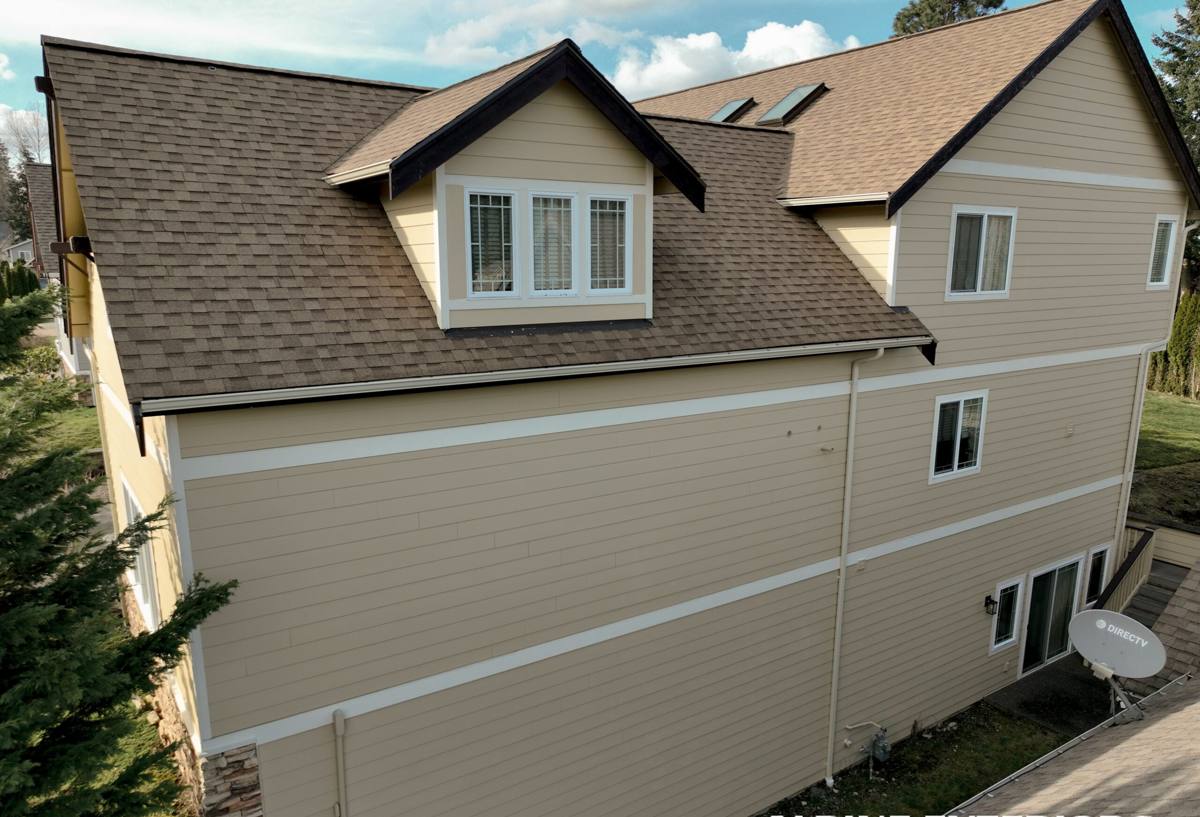
Signs Your Bellingham Home Needs Window Replacement
Most window failures don't happen overnight — they show up as small, easy-to-ignore symptoms first. Here's what we tell Bellingham homeowners to watch for:
- Fogging or a milky haze between the panes of a double-pane window (the seal has failed and the gas fill is gone)
- A draft you can feel near the frame even with the window fully closed and latched
- Windows that are hard to open, close, or lock, or that have started to stick or bind
- Soft, spongy, or visibly rotted wood at the sill, corners, or bottom rail
- Paint that bubbles or peels repeatedly at the same spot no matter how often it's touched up
- Moss or dark green growth building up on the sill or exterior trim
- A noticeable rise in heating costs without any other explanation
- Frames that look slightly warped, bowed, or out of square
One or two of these on their own might just mean a repair. Several at once, especially on the same window, usually means the unit has reached the end of its useful life.
What a Correct Window Replacement Actually Involves
The window itself only does half the job — the other half is how it's installed. In a climate that throws wind-driven rain at a house for months at a time, installation details matter as much as the product you choose.
Flashing and Sill Pans
Every opening needs a sill pan and properly lapped flashing so that any water that gets past the window itself drains back out instead of into the wall cavity. This is the single most common place we find shortcuts on older or poorly-done installs, and it's usually invisible until something starts leaking.
Sealants and Weather Barriers
The window has to tie into the home's weather-resistive barrier correctly — sealed on the sides and top, but left open at the bottom so trapped moisture can escape rather than pool. Using the wrong sealant, or sealing all four sides solid, is a common mistake that actually traps water instead of keeping it out.
Insulation and Air Sealing
The gap between the window frame and the rough opening needs to be filled with an appropriate low-expansion foam or insulation — not stuffed with fiberglass batting alone, and not left empty. Done right, this closes off drafts and cuts down on the condensation that tends to form on cold glass during our wetter months.
Choosing the Right Window Material for This Climate
There's no single "best" window material for every home, but in a marine climate with salt air and long wet seasons, some materials hold up with less maintenance than others.
| Material | Moisture & Salt Air Behavior | Maintenance | Best Fit |
|---|---|---|---|
| Vinyl | Won't corrode or rot; performs well in coastal air | Low — occasional cleaning | Most homes prioritizing value and low upkeep |
| Fiberglass | Very stable in moisture and temperature swings; resists warping | Low | Homes wanting higher durability and paintable finish |
| Wood-clad | Good insulator, but end-grain and joints are moisture-sensitive if not maintained | Higher — periodic sealing/paint upkeep | Homes prioritizing a traditional wood interior look |
| Bare aluminum | Prone to corrosion and condensation in salt air and cold glass conditions | Moderate to high | Rarely our recommendation for this climate |
We're upfront about the trade-offs rather than pushing one material for everyone. Wood-clad windows can look great and perform well, but they ask for more upkeep than vinyl or fiberglass in a climate that stays damp as long as ours does — that's simply a maintenance-burden difference, not a defect. Our default recommendation for most Bellingham homes leans toward vinyl or fiberglass because they hold up with the least attention in salt air and driving rain.
Energy Performance and Glass Options for This Climate
U-Factor and Why It Matters Here
U-factor measures how much heat a window lets escape — the lower the number, the better it insulates. In the Pacific Northwest we care more about U-factor than solar heat gain, since our region doesn't deal with intense summer sun the way the Southwest does. Look for NFRC-labeled U-factor ratings when comparing quotes rather than taking a salesperson's word for "energy efficient."
Low-E Glass and Condensation Resistance
Low-E (low-emissivity) coatings help keep interior heat in during our cool, wet months and also improve a window's condensation resistance — a real concern here, where interior humidity plus cold glass on a rainy night is a recipe for fogged-up panes and eventual moisture damage to sills and trim. Double-pane with Low-E glass is standard on nearly every replacement we install; triple-pane is worth discussing for north-facing rooms or homes with persistent condensation issues.
What Affects the Cost of a Window Replacement
Every home is different, but the same handful of factors drive most of the price difference between jobs.
| Factor | Why It Matters |
|---|---|
| Window size and quantity | Larger openings and whole-house jobs shift per-unit pricing and scheduling |
| Material (vinyl, fiberglass, wood-clad) | Material cost and expected lifespan vary significantly |
| Glass package | Double vs. triple pane, Low-E coatings, and tempered glass (required near doors/floors) add cost |
| Removal complexity | Hidden rot behind an old frame means extra repair before the new window can go in |
| Trim and siding tie-in | Matching trim profiles or coordinating with siding work adds labor |
As a broad, honest range for this region, many standard vinyl replacement windows land in the low-to-mid four figures per opening installed, with wood-clad units, larger openings, or jobs that uncover rot running higher. We'll always give you a firm, itemized number after we've actually looked at the openings — not a phone estimate.
Permits and Local Considerations in Bellingham
Whether a window replacement needs a permit generally depends on whether it's a like-for-like swap or a change to the size or structure of the opening. Bedroom windows also have egress requirements that come into play if you're changing the opening size, so that's worth flagging early rather than after the old window is already out. Older homes in some established Bellingham neighborhoods may also have design or historic-review considerations depending on the property — if that applies to your home, we'll walk you through what it means for your project before we start.
Our Window Replacement Process
- On-site assessment of every window, including flashing, sill condition, and hidden rot risk — not just a quick look from outside
- Accurate measurement and product selection based on your home's exposure, budget, and style
- Permit handling where required, so nothing holds up your project mid-job
- Careful removal, with rot repair to framing done before the new window goes in — never covered over
- Installation with correct sill pan, flashing, sealant, and insulation at every opening
- Cleanup and a walkthrough so you can see and test every window before we consider the job done
- Warranty documentation covering both the product and our installation work
Why Hire a Crew That Already Works in Bellingham
We're based just up the road in Lynden, and Bellingham is regular territory for us — not an occasional drive-by job. That matters in a few concrete ways: we already know which sides of a house typically take the worst of the wind-driven rain in this area, we're used to tying new window flashing into existing siding correctly rather than treating it as an afterthought, and if a warranty issue ever comes up, we're a short trip away rather than a call center. A crew that only occasionally works this area doesn't build that same read on how local homes actually perform through a Whatcom County winter.
If your windows are fogging, drafting, sticking, or just showing their age, we're happy to take a look and give you a straight answer about whether repair or replacement makes sense. Fill out the form below for a free, no-pressure estimate on your Bellingham home.