 Lynden Siding
 Bellingham Siding Takes a Different Kind of Beating
Bellingham sits close enough to the water that salt air is a real factor in how siding ages, and it sits directly in the path of the driving rain that rolls off the Strait and up through Whatcom County most of the fall and winter. Add a long, damp moss season that can run from October well into spring, and you have three separate stressors working on a home's exterior at the same time: airborne salt that accelerates corrosion on fasteners and trim, wind-driven rain that gets pushed sideways into laps and seams that were never designed to shed water horizontally, and moss and algae that hold moisture against the siding surface for weeks at a stretch.
None of these on their own is unusual for the Pacific Northwest. What makes Bellingham siding repair different from a drier inland climate is that damage rarely comes from one cause. A cracked panel that would just look bad in a dry climate becomes an entry point for wind-driven rain here, and once water gets behind the siding, moss and algae on the surface keep that area from drying out between storms. That combination is what turns a small cosmetic problem into a rot or delamination problem if it sits too long.
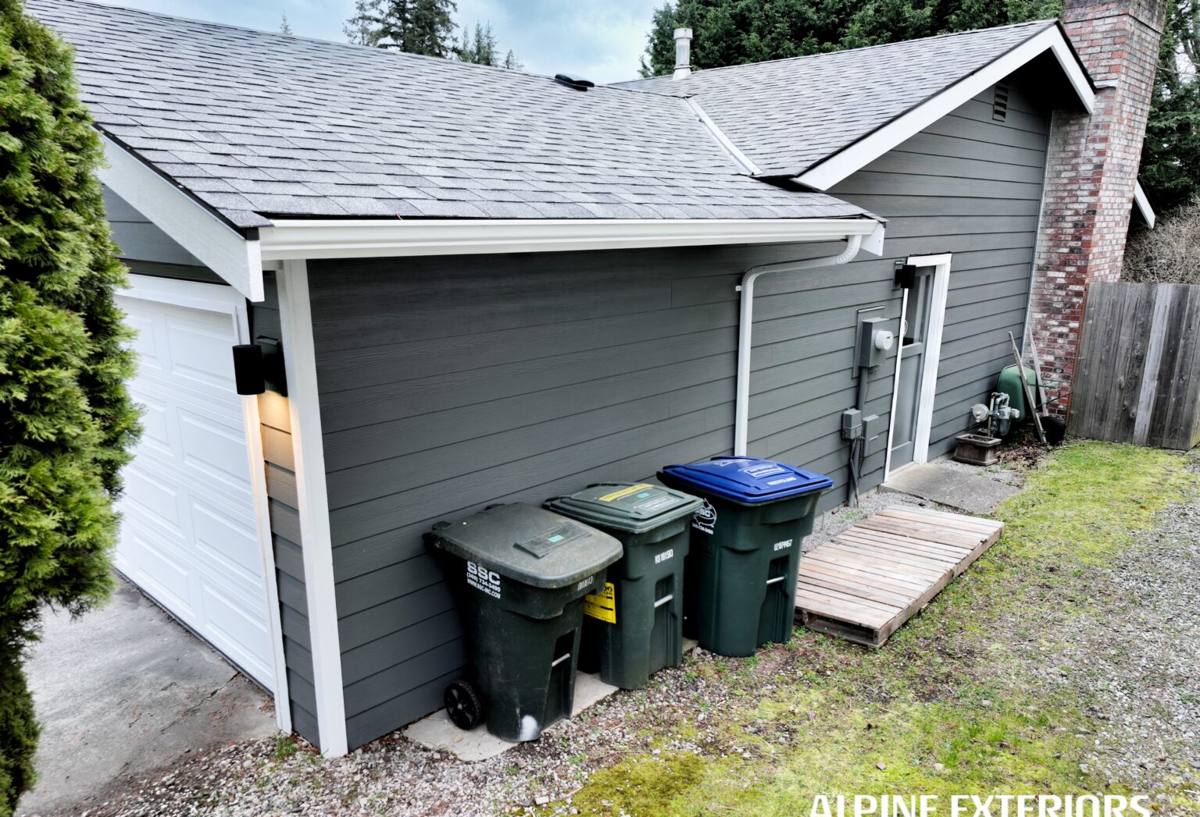
Signs Bellingham Homeowners Should Not Ignore
Most siding repair calls we get in this area start with something a homeowner noticed on a walk around the house, not something dramatic. Here's what we tell people to look for:
- Cracked, chipped, or split panels, especially near corners and window trim where wind pressure concentrates
- Soft or spongy spots when you press on the siding, which usually means moisture has already gotten in
- Persistent dark streaking or green/black growth that comes back within weeks of cleaning
- Gaps opening up at seams, laps, or where siding meets trim, flashing, or the foundation
- Paint or factory finish that's peeling, chalking, or bubbling in patches rather than evenly across a wall
- Fastener heads that are rusting, backing out, or leaving streaks below them
- Warping or bowing panels, particularly on north- and west-facing walls that stay shaded and wet longer
Any one of these can be a minor fix. Two or three showing up in the same area of a wall usually means there's a moisture problem behind the siding that needs to be traced back to its source before anything gets patched.
What a Correct Repair Actually Involves
Diagnosing the Cause, Not Just the Symptom
A siding repair that only addresses the visible crack or gap without figuring out why it happened tends to fail again within a season or two, especially in a climate that gives water this many chances to find its way in. Before we touch a panel, we look at how water is moving around that section of the wall: is the damage from direct wind-driven rain, from a failed flashing detail above it, from a downspout dumping water against the wall, or from moss holding moisture against the surface long-term? The repair only holds if the actual cause gets fixed, not just covered.
Checking What's Behind the Siding
Any time we open up a damaged section, we check the water-resistive barrier and flashing underneath it. Siding is the visible layer, but it's the barrier behind it that actually keeps a house dry. If that layer has failed, degraded, or was installed wrong to begin with, replacing the visible panel without addressing what's behind it just resets the clock on the same failure.
Matching Material and Finish
On a repair, matching matters. Panel profile, exposure, and color all need to line up with the existing siding or the patch will stand out for the life of the house. This is one of the practical advantages of working almost exclusively with James Hardie fiber cement: it's a consistent, well-documented product line with predictable profiles and a factory-applied ColorPlus finish, which makes matching an existing installation far more reliable than trying to blend a repair into some other material that may have faded, chalked, or simply isn't made the same way anymore.
Repair vs. Replace: How We Help You Decide
Not every damaged section needs a full re-side, and not every repair is worth doing instead of planning for replacement. We walk homeowners through the real trade-offs rather than defaulting to the bigger job.
| Factor | Leans Toward Repair | Leans Toward Replacement |
|---|---|---|
| Extent of damage | Isolated to one or two sections/walls | Spread across most of the home's exterior |
| Underlying barrier condition | Water-resistive barrier and flashing are intact | Barrier has failed or was never installed correctly |
| Siding material | Existing material can be reliably matched | Original material is discontinued, faded beyond matching, or a product we don't work with |
| Age of siding | Siding is well within its expected service life | Siding is near or past the age where widespread failure is likely |
| Cause of damage | One-time event (impact, isolated flashing failure) | Systemic moisture exposure across multiple walls |
When a home has isolated damage on siding that's otherwise sound, targeted repair is the honest answer and the more cost-effective one. When the damage points to a systemic moisture problem, or the existing material simply can't be matched, we say so and explain why — we're not interested in patching a wall that's going to need to be redone in two years.
Why We Only Work With James Hardie Fiber Cement
We install and repair James Hardie siding exclusively — we don't install vinyl, LP SmartSide, Cemplank, Allura, or unprimed cedar or spruce siding, and we're upfront about why. In a climate like Whatcom County's, with sustained wet seasons and salt air near the water, the materials that hold up best long-term are non-combustible, dimensionally stable, and engineered specifically for wet regional exposure. Hardie's HZ5 product line is formulated for exactly this kind of climate, and the factory-applied ColorPlus finish holds up to UV and moisture far better than field-applied paint, which matters both for new installs and for keeping repaired sections looking consistent with the rest of the house. It also comes with a strong transferable warranty backed by a large, established manufacturer, which is worth something when you're deciding what to trust on a home that's going to sit through thirty more Bellingham winters.
That standardization also makes repair work more reliable for homeowners. Because we work with one product system rather than half a dozen, we know its profiles, fastening requirements, and finish options well enough to make a repair that actually blends in and performs the same as the surrounding siding — not just something that patches the hole.
Our Repair Process
- On-site inspection. We look at the damaged area and the surrounding siding, and check what's happening behind it where the damage allows.
- Cause diagnosis. We identify whether the damage is from wind-driven rain, a flashing or barrier failure, moss/moisture buildup, or physical impact.
- Honest scope recommendation. We tell you plainly whether targeted repair makes sense or whether the damage points to a bigger issue worth addressing now.
- Repair or replacement of the affected section, including any compromised barrier or flashing underneath, not just the visible panel.
- Material and finish matching so the repaired area blends into the rest of the wall rather than standing out as a patch.
Timing Matters in This Climate
Because Bellingham's wet season runs long, we recommend addressing visible siding damage as soon as it's noticed rather than waiting for a dry stretch. A crack or gap that sits open through even a few weeks of driving rain and damp, moss-favorable conditions can do meaningfully more damage to the wall behind it than the same crack would in a drier climate.
Why It Matters That We Already Work in Bellingham
Siding repair done right depends on understanding how a specific home's exposure — which walls take the worst of the wind-driven rain, which sides stay shaded and damp long enough to grow moss, how close the property is to salt air off the bay — actually affects where and how damage shows up. A crew that works Whatcom County regularly has already seen how these patterns play out on homes similar to yours, which means less guesswork diagnosing the cause and a repair that's built for the conditions the wall will actually face, not just the conditions on the day of the estimate.
Get an Honest Look at Your Siding
If you're seeing cracked panels, soft spots, persistent moss or algae, or gaps opening up around trim or seams, it's worth having someone look before the next round of storms works on it further. We'll give you a straightforward read on what's causing it and what it actually takes to fix it — no pressure, no upsell to a full re-side unless that's genuinely the right call. Reach out below for a free estimate.