 Lynden Siding
 Nooksack's Climate Is Harder on Siding Than It Looks
Nooksack sits in a stretch of Whatcom County that gets the full package: marine-influenced salt air drifting in off the Sound, long stretches of driving rain through fall and winter, and a moss season that can run half the year on shaded north and east walls. None of that is dramatic on its own, but siding doesn't fail from one bad storm — it fails from the same wall getting wet, drying slowly, and staying damp longer than it should, year after year.
Salt-laden moisture speeds up corrosion on fasteners and trim metal. Driving rain finds every gap in flashing and caulk that a calmer climate would never test. And moss doesn't just look bad — its root structure holds moisture against the siding surface and, on wood-based products, that moisture eventually gets past the paint film. A siding product and installation that would hold up fine in a dry inland climate can start showing problems here in a fraction of the time.
That's the lens we use on every Nooksack job: not "what siding looks good on day one," but "what siding and what installation will still be doing its job in twenty years on this specific wall, facing this specific weather."
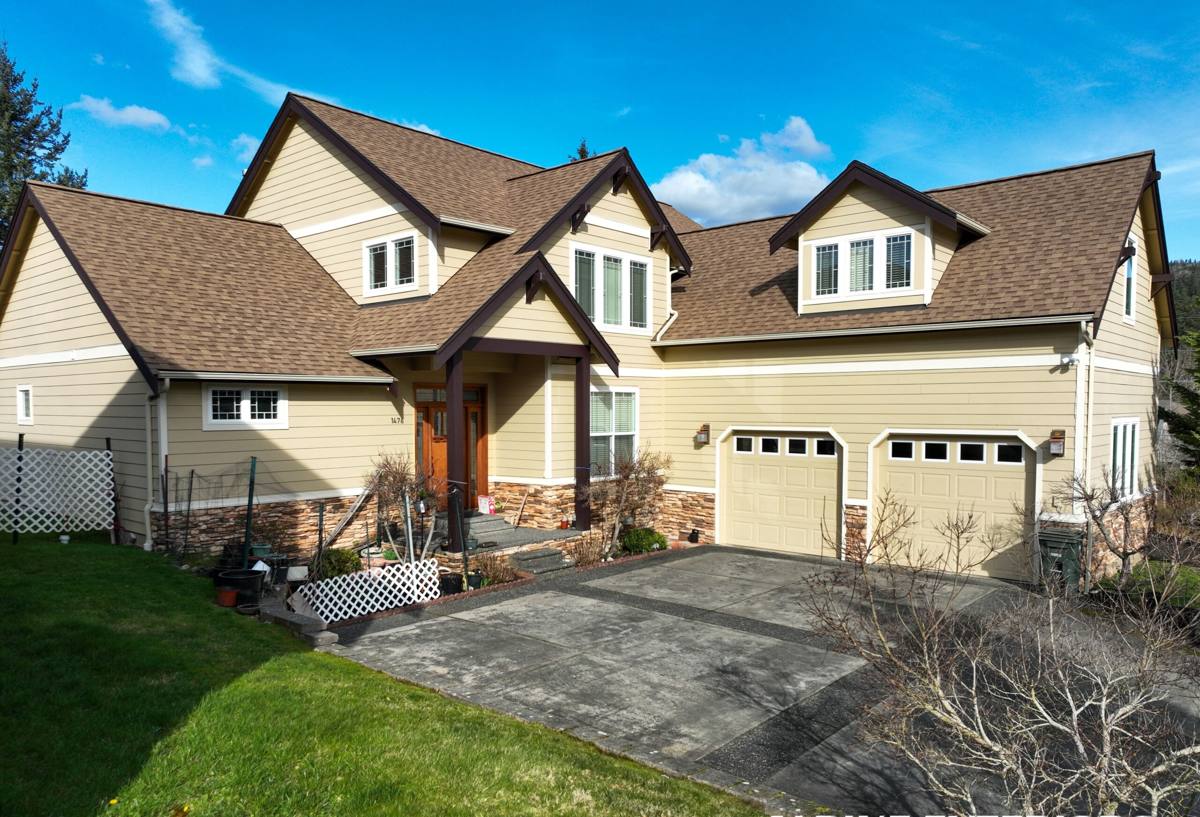
Why We Install Only James Hardie Fiber Cement
We don't install vinyl, LP SmartSide, Cemplank, Allura, primed spruce, or cedar. That's not a marketing position — it's a standard we hold because we've seen what this climate does to siding over a full service life, not just in the first few years.
Vinyl expands and contracts with temperature swings and can warp or crack in sustained cold snaps; it also isn't a rigid substrate, so it telegraphs every irregularity underneath it. LP SmartSide and cedar are wood-based products — well-engineered in LP's case, genuinely attractive in cedar's — but both rely on an intact paint or finish film to keep moisture out, and Whatcom County's rain and moss season put that film under constant stress. Once moisture gets past a compromised seam or a cracked coating on a wood-based product, it doesn't dry out quickly here the way it might in a drier region.
James Hardie fiber cement is a different category of material. It's cement, sand, and cellulose fiber — non-combustible, dimensionally stable, and manufactured with a factory-applied ColorPlus finish that's baked on rather than field-applied. That finish is the single biggest difference in how a wall performs after ten winters of Nooksack rain: it doesn't rely on a contractor getting field paint exactly right, and it holds color and integrity through moisture cycling in a way raw wood substrates can't match.
HZ5 Engineering for This Region
James Hardie manufactures its products in different HZ (HardieZone) formulations engineered for different climate zones across the country. Whatcom County falls in a zone where moisture and moderate freeze-thaw cycling are the primary stresses, and the HZ5 product line is engineered specifically for that combination — different from the drier-climate formulation used elsewhere in the country. That's not a marketing footnote; it affects how the product handles moisture absorption and expansion over decades of exposure.
What a Correct Installation Involves
Fiber cement siding is only as good as the installation behind it. Hardie's own warranty is conditioned on installation to their published specifications, and in a wet climate like this, the details that get skipped on a rushed job are exactly the ones that cause callbacks two or three winters later.
- Proper clearances: siding held above grade, decks, roof lines, and horizontal surfaces per Hardie spec, so water can't wick up into the board or sit against the bottom edge
- Rain-screen or drainage plane behind the siding: a gap that lets any moisture that does get behind the boards drain and dry out instead of sitting against the sheathing
- Correct fastener type, spacing, and depth: corrosion-resistant fasteners set to the right depth — not overdriven, which cracks the board's fiber cement, and not underdriven, which leaves it loose and prone to moisture intrusion at the hole
- Flashing at every penetration: windows, doors, hose bibs, light fixtures, and roof-to-wall transitions all need proper flashing, since these are the spots where driving rain actually gets in
- Sealed and primed cut edges: factory edges come primed, but every field cut exposes raw material that has to be sealed before installation, or it becomes the weak point in the whole wall
- Correct joint treatment: butt joints and panel seams detailed to shed water rather than trap it
Skip any one of these and the product itself stops mattering — even the best siding in the world fails at its weak point. This is the work that separates a wall that looks right for a season from one that performs for decades.
Our Process, Start to Finish
1. On-Site Assessment
We walk the property and look at the specific conditions on each elevation — which walls take the most weather, where moss and moisture staining are already showing, what the current siding and flashing look like underneath any trim we can access, and what the substrate condition is before we ever talk product.
2. Honest Scope and Estimate
We give a straightforward, no-pressure estimate that reflects the actual condition of your home — not a generic per-square-foot number. If there's sheathing damage or rot behind existing siding, we tell you before work starts, not after the old siding is off.
3. Tear-Off and Substrate Check
Old siding comes off and we inspect the sheathing and framing underneath. Any water damage gets addressed before new siding goes up — installing James Hardie over a compromised substrate defeats the purpose of choosing a durable product in the first place.
4. Weather Barrier and Drainage Plane
House wrap or building paper goes on correctly lapped, with a drainage plane installed to Hardie's specification so the wall system can manage incidental moisture the way it's designed to.
5. Installation to Spec
Clearances, fastening, flashing, and joint treatment all done to James Hardie's published installation guidelines — the details covered above, done the same way on every job regardless of schedule pressure.
6. Final Walkthrough
We walk the finished job with you, point out anything you should know for maintenance, and make sure you're clear on what's covered under warranty.
Comparing Siding Options for a Climate Like This
| Factor | James Hardie Fiber Cement | Vinyl | Wood-Based (LP SmartSide, Cedar) |
|---|---|---|---|
| Moisture resistance | Cement-based, doesn't absorb and swell | Doesn't absorb moisture, but relies on gaps/laps for drainage | Depends entirely on intact finish film |
| Moss and mildew resistance | Factory finish holds up under sustained damp shade | Moss can grow on surface but doesn't penetrate material | Moss retains moisture against a moisture-sensitive substrate |
| Dimensional stability | Minimal expansion/contraction | Expands and contracts with temperature, can warp | Can swell, cup, or crack with moisture cycling |
| Finish maintenance | Factory-baked ColorPlus finish, no repainting on typical cycle | Color molded in, but can fade and chalk over time | Requires periodic repainting or refinishing |
| Fire resistance | Non-combustible | Combustible, can melt or deform near heat | Combustible |
| Typical cost position | Mid-to-upper range, reflects material and labor | Lower upfront cost | Mid range, but ongoing maintenance adds to lifetime cost |
The upfront cost comparison only tells part of the story. What matters more for a Nooksack property is total cost over the life of the siding — including repainting, repair from moisture intrusion, and how the material actually performs through wet Whatcom County winters, not just how it looks the day it goes up.
Signs Your Current Siding Is Already Struggling
If you're on the fence about whether it's time to look at replacement, these are the signs worth taking seriously in this climate:
- Persistent moss or algae streaking on north- and east-facing walls that comes back within weeks of cleaning
- Soft or spongy spots when you press on siding near the bottom courses or around windows
- Paint that's bubbling, peeling, or chalking heavily rather than just fading evenly
- Visible gaps or separation at seams, corners, or trim joints
- Warping, cupping, or boards that no longer sit flat against the wall
- Rust staining running down from fasteners or trim metal
- Musty smell or interior wall staining near exterior walls, which can indicate moisture has already gotten through
Any one of these on its own isn't necessarily an emergency. Several of them together, especially on the walls that take the most weather, usually means the siding is past the point where cleaning and spot repair will hold it.
Why a Crew That Already Works Nooksack Matters
Siding installation isn't one-size-fits-all across a region. A crew that works this part of Whatcom County regularly already knows which elevations on a typical Nooksack property take the worst of the driving rain, how aggressively moss establishes itself on shaded walls here, and what drainage and flashing details actually hold up through a full wet season rather than just through the manufacturer's minimum spec. That's knowledge you only get from doing the work here repeatedly, not from a general installation manual.
It also means faster, more accurate estimates — we're not guessing at regional conditions, we're accounting for what we've already seen on similar homes nearby. And if a warranty question or a maintenance question comes up years down the line, you're working with a crew that's still local, not chasing down someone who did a handful of jobs in the area and moved on.
Warranty and Long-Term Value
James Hardie backs its fiber cement products with a transferable, non-prorated limited warranty, and the ColorPlus finish carries its own separate finish warranty covering fading and chipping. Warranty terms are set by the manufacturer and vary by product line, but the structure matters: it's designed to hold up whether you're the original owner or you sell the home down the road, which is a real factor in resale value for a property in this market.
That warranty is also conditioned on correct installation — another reason the installation details covered above aren't optional extras. A warranty is only as good as the job that was done to earn it.
If your Nooksack-area home is due for new siding, or you're just not sure whether what you have will hold up through another few winters, we're happy to take a look and give you a straightforward, no-pressure estimate — no obligation, just an honest read on where things stand. The form below gets you started.