 Lynden Siding
 Why Decks in Maple Falls Wear Out Faster Than the Brochure Says
Maple Falls sits up against the foothills of the North Cascades, under heavy tree cover, at a higher elevation than most of Whatcom County. That combination — shade, rainfall, and elevation — is hard on a deck in ways that don't show up on a spec sheet. A deck built for a sunny lot in a subdivision closer to town simply doesn't see the same conditions a deck under fir and cedar canopy sees here. Boards stay damp longer after a storm, moss and algae get a head start every fall, and the wood-to-metal connections that hold a deck together are exposed to more cycles of wet-and-dry than they were ever rated for.
We've replaced enough decks around Lynden and the surrounding Whatcom County towns to know the failure pattern isn't random. It's almost always the same few spots: the ledger board where the deck meets the house, the footings, and whatever fasteners were used the first time around. Understanding why those spots fail is the first step in building something that won't need replacing again in ten years.
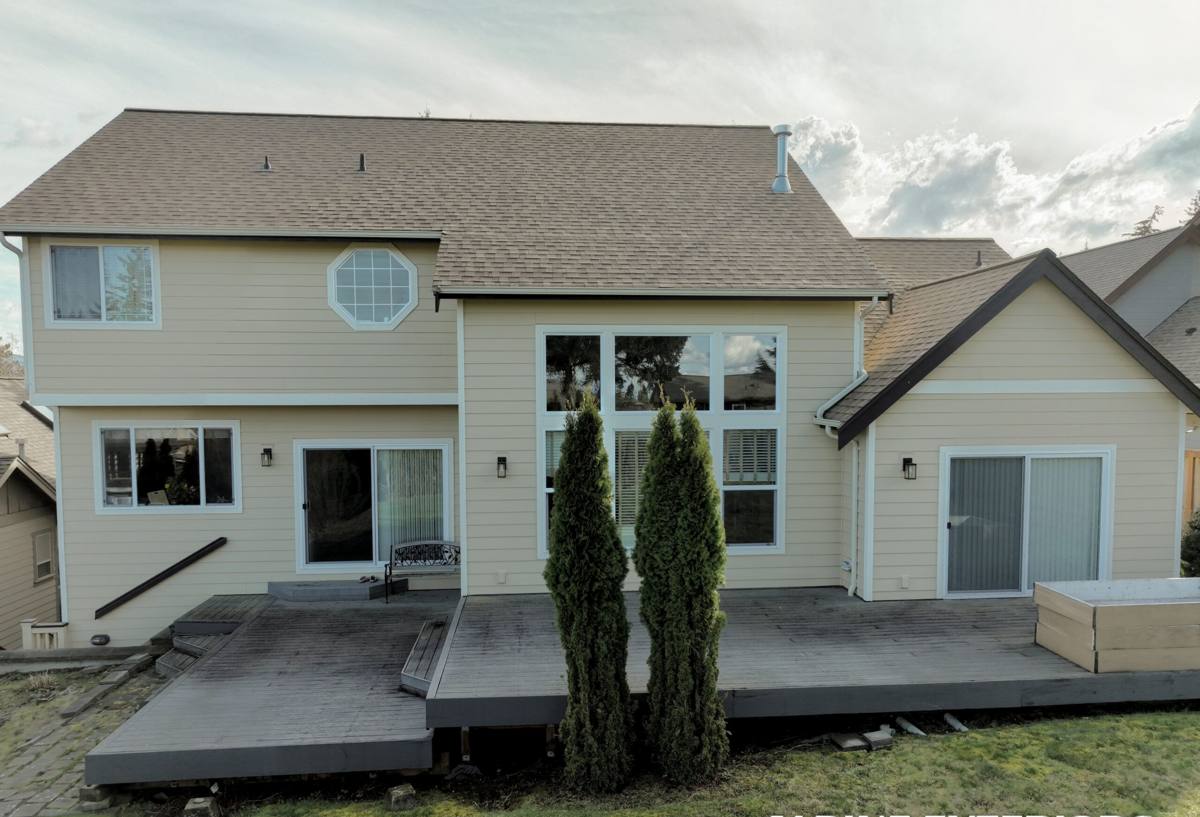
What the Local Climate Actually Does to a Deck
Shade and Moisture Don't Dry Out
A deck in full sun sheds water fast and dries between rains. A shaded deck under conifers doesn't get that break. Moisture sits in the wood grain, in fastener holes, and underneath the boards where airflow is already limited by low clearance or tight joist spacing. That's the environment moss and algae need, and it's why decks out this way tend to develop a slick green film on the north side or under trees well before a deck in a more exposed yard does.
Driving Rain and Long Wet Seasons
Whatcom County gets long stretches of steady, driving rain rather than short, hard downpours, and that pattern matters for how water gets into a structure. Wind-driven rain finds its way into ledger connections, under improperly flashed rim joists, and into any end-grain that isn't sealed or protected. Over years, that slow intrusion rots framing from the inside out — often before it's visible from the top of the deck.
Fastener and Hardware Corrosion
Across this region, exterior hardware sees a lot of wet-dry cycling and, closer to the water, salt-laden air that accelerates corrosion. Cheap or mismatched fasteners — the wrong coating for the lumber, or hardware that wasn't rated for ground contact or treated wood — corrode faster than they should and lose grip long before the boards on top look worn. A deck can look fine on the surface while its structural connections are quietly failing underneath.
Signs a Deck Needs Replacing, Not Just Patching
Not every tired-looking deck needs to come out. But there's a real difference between cosmetic wear and structural failure, and it's worth knowing which one you're looking at before you spend money on either repair or replacement.
- Soft, spongy, or spring-loaded decking boards, especially near the house or stairs
- Rust streaks bleeding out from screw heads or joist hangers
- A ledger board that's pulling away from the house or shows water staining behind it
- Visible rot or dark staining at the ends of joists or under the rim board
- Wobble or movement in the railing posts when pushed
- Persistent moss or algae that comes right back within weeks of cleaning
- Footings that are cracked, heaving, or no longer sitting flush and level
- A deck that was never permitted or built to code for its height and span
If what you're seeing is limited to a few worn boards on an otherwise sound frame, repair is a legitimate option. If it's the framing, the footings, or the ledger connection, patching individual boards just delays a bigger job and adds risk in the meantime.
Choosing Materials for a Shaded, Wet Lot
The right decking material for Maple Falls isn't necessarily the same one that makes sense on a sunny lot in town. Shade changes how a material performs, especially around moss resistance and moisture retention.
| Material | Upfront Cost | Maintenance | Performance in Shade & Wet Conditions |
|---|---|---|---|
| Pressure-treated wood | Lowest | Annual cleaning, periodic sealing/staining | Prone to moss and mildew in shade if not maintained on schedule; splinters and checks over time |
| Cedar | Moderate | Regular sealing to hold color and resist decay | Naturally more rot-resistant than treated pine, but still needs upkeep in a wet, shaded yard |
| Composite (capped) | Moderate to higher | Occasional wash-down; no sealing or staining | Resists rot and doesn't need sealing, but capped composite can still grow surface moss in deep shade if not rinsed periodically |
| PVC decking | Highest | Lowest — wash-down only | Best moisture resistance of the group; doesn't absorb water, which matters most under heavy canopy |
We don't push one product on every job. A well-maintained cedar deck can look great for decades if the owner is willing to clean and seal it on schedule. A composite or PVC deck costs more up front but trades that maintenance schedule for material stability — worth discussing honestly against your budget and how much upkeep you actually want to do, especially with moss season working against you most of the year.
What a Correct Deck Replacement Actually Involves
A deck is only as good as what's underneath the boards. Replacing a deck properly means addressing the structure, not just swapping decking on top of an old frame.
Footings and Framing
Footings need to be sized and set to local frost depth and soil conditions, not guessed at. Framing lumber should be rated for its exposure — ground contact where it touches or sits near soil, and properly fastened joist hangers rated for the load and species of lumber used.
Ledger Flashing
The ledger board connection to the house is the single most common source of hidden rot on decks in this climate. A correct install uses proper flashing that directs water away from the house framing, not just caulk or paint, which fail long before the deck does.
Fasteners and Hardware
All structural hardware should be corrosion-resistant and matched to the lumber's chemical treatment — mismatched metals accelerate corrosion in exactly the wet, cycling conditions this area sees. Hidden fastener systems on composite and PVC decking should be installed per manufacturer spec so warranties stay valid.
Drainage and Airflow
Wherever possible, we build in airflow underneath the deck and grade the ground below it to shed water rather than trap it. In a shaded yard, that airflow is what keeps moss and rot from getting a foothold between cleanings.
How We Handle a Deck Replacement Job
- On-site evaluation. We look at the existing frame, footings, and ledger connection to determine what's salvageable and what needs to come out — not every deck needs a full teardown to the ground.
- Straight recommendation. You get an honest read on repair versus replacement, and material options that fit your budget and how much maintenance you want to take on.
- Permitting. Deck replacements involving new footings, structural changes, or height above grade typically require a permit through the local jurisdiction. We handle that process rather than leaving it on you.
- Build. Footings, framing, ledger flashing, decking, and railing installed to code, with attention to the drainage and airflow details that matter most under tree cover.
- Walkthrough. We go over the finished deck with you, including what maintenance (if any) the material you chose will need going forward.
Permits, Setbacks, and Code Around Maple Falls
Deck permitting requirements vary depending on the deck's height, size, and whether it's attached to the house, and they're enforced by the local building jurisdiction rather than being optional paperwork. Guardrail height, stair geometry, footing depth, and ledger attachment are all inspected items, not judgment calls. An unpermitted deck can also become a real problem at resale, when a buyer's inspector or lender asks for documentation that doesn't exist. We pull the permits a job actually requires and build to the inspected standard, so you're not left explaining a deck that was never signed off.
Why a Crew That Already Works This Area Matters
A contractor who mostly builds decks in dry, sunny neighborhoods closer to the water doesn't necessarily think about shade, moss, and canopy drainage the same way a crew that works Maple Falls regularly does. We've seen how decks fail out here specifically — where the rot starts, which fasteners hold up, which materials actually resist moss instead of just claiming to. That's not something you get from a general contractor working from a standard spec sheet; it comes from building and repairing decks in these exact conditions, on these exact lots, season after season.
It also matters for practical reasons: knowing the local permitting office, understanding typical lot grading and drainage patterns in this part of Whatcom County, and being available for the periodic check-ins a wood deck might need without a long drive each time.
Ready to Talk About Your Deck?
If your deck is showing soft spots, rust stains, persistent moss, or you're just not sure whether it needs a repair or a full replacement, we're happy to take a look. The estimate is free, there's no pressure, and you'll get a straight answer about what your deck actually needs — use the form below to get started.