 Lynden Siding
 Why Custer Siding Wears Differently Than Siding Ten Miles Inland
Custer sits close enough to the coast that homes here take a different kind of weather beating than siding fifteen or twenty minutes inland in Lynden proper. The salt-laden air off the water accelerates corrosion on fasteners, trim, and any exposed metal flashing. Add Whatcom County's long wet season — months of driving rain pushed sideways by wind off the Strait — and you get siding systems that are constantly wet, constantly drying, and constantly working to shed water before it finds a seam. Then there's moss. Shaded north walls, tree-lined lots, and the sheer number of damp weeks per year turn moss and algae growth into a near-constant maintenance issue rather than an occasional one.
None of this is unique to any one house in Custer — it's the baseline condition every exterior on this side of the county deals with. The homes that hold up are the ones where the siding, the water-resistive barrier behind it, and the flashing details were all sized for this climate from the start, not borrowed from a spec sheet written for a drier region.
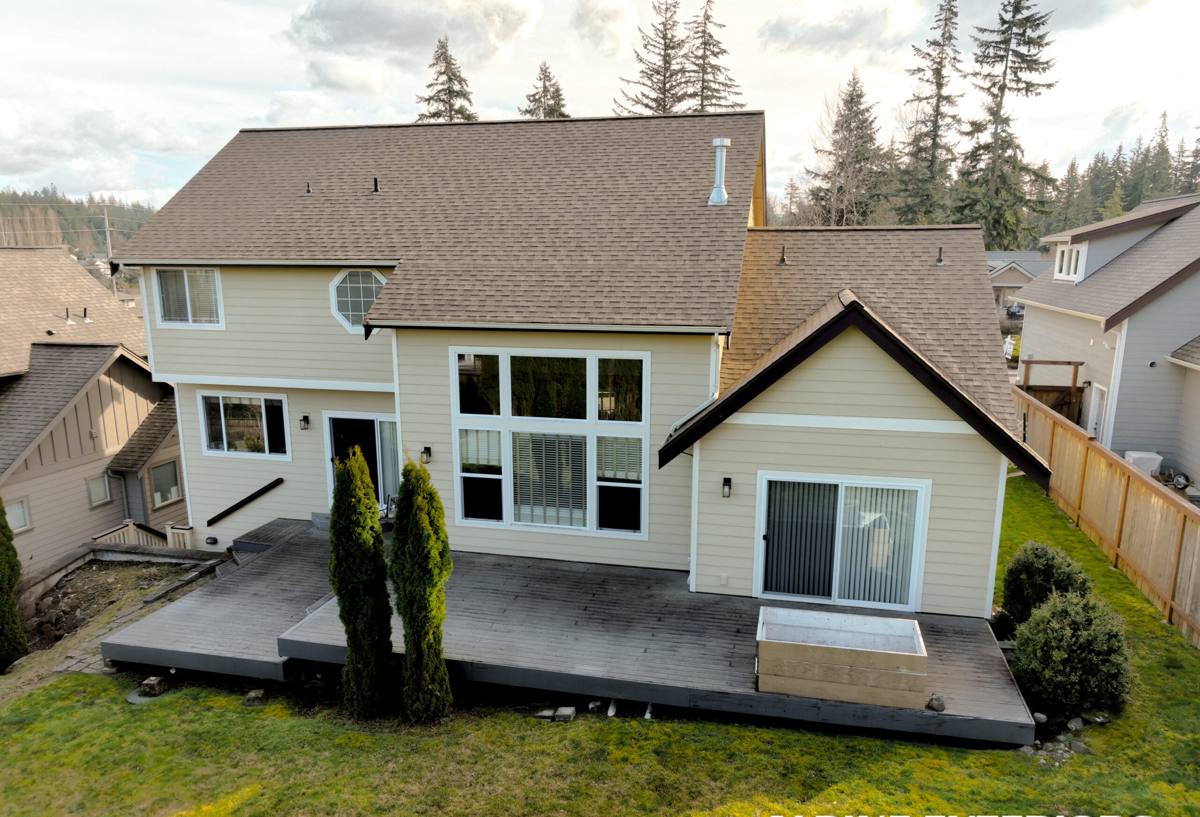
Signs Your Siding Has Reached the End of Its Service Life
Most siding failure in this area doesn't show up as one dramatic problem. It shows up as a slow accumulation of small ones that eventually add up to a replacement job instead of a repair job. Homeowners in Custer typically call us after noticing one or more of the following:
- Soft or spongy spots when you press on the siding, especially near the bottom courses and around window trim
- Paint that won't hold — bubbling, peeling, or needing a repaint every two to three years instead of every seven to ten
- Persistent moss or black streaking that comes back within weeks of cleaning
- Visible gaps, warping, or buckling boards, particularly on the walls facing prevailing wind and rain
- Rot at butt joints, corner trim, or anywhere siding meets a deck ledger, porch roof, or window sill
- A musty smell in an interior wall that has an exterior wall behind it
Any one of these can be an isolated repair. Several at once, especially on a home over fifteen or twenty years old, usually means the water-resistive barrier underneath has been compromised and the siding itself is past the point where patching makes financial sense.
What a Correct Siding Replacement Actually Involves
Siding replacement done right is not just "old boards off, new boards on." The visible siding is the last layer of a system, and most of the failures we see trace back to something behind the siding that was never done correctly in the first place. A proper job in this climate includes:
Full Tear-Off and Inspection
We remove the old siding entirely rather than siding over it. That lets us see the sheathing underneath — soft spots, old water staining, or rot get addressed before anything new goes up. Covering a compromised wall with new siding just hides the problem for a few more years.
A Water-Resistive Barrier Built for This Rainfall
Behind every new installation is a weather-resistive barrier taped and lapped correctly at every seam, with special attention to inside corners, window and door openings, and anywhere two planes of the house meet. In a climate that gets sustained, wind-driven rain rather than brief downpours, sloppy WRB work is where most premature failures start.
Flashing at Every Penetration
Windows, doors, hose bibs, light fixtures, and deck ledgers all need proper flashing detail, not just a bead of caulk. Caulk is a maintenance item that needs renewing; flashing is a permanent water management detail. Given the salt air here, we also pay close attention to fastener and flashing material selection to slow corrosion.
Proper Clearances
Siding needs a gap above grade, above roof lines, and above decks and patios so it isn't sitting in standing water or splash-back. This is one of the most commonly skipped details in older installations and a major contributor to bottom-course rot.
Manufacturer-Spec Installation
Fastener spacing, board overlap, caulking at butt joints, and finish coating all have to match the manufacturer's published installation instructions. Installed off-spec, even premium siding will underperform and can void the warranty.
Why We Install Only James Hardie Fiber Cement
We don't carry vinyl, LP SmartSide, Cemplank, Allura, primed spruce, or cedar. That's a deliberate standard, not a limitation of what we know how to install. In a climate like Custer's — salt air, sustained moisture, heavy moss pressure — the trade-offs of those other materials show up faster and cost homeowners more over time than the siding they saved on up front.
Vinyl expands and contracts with temperature swings, can crack in impact or cold snaps, and its seams and J-channels give moisture places to collect. Engineered wood products like LP SmartSide perform well when the finish and caulking are maintained on a strict schedule, but any lapse in that maintenance in a wet climate lets moisture into the wood-based core, and that damage isn't always visible until it's advanced. Untreated or primed-only wood siding — spruce, cedar — looks excellent on day one, but in this rainfall and moss environment it demands a repaint and re-caulk cycle most homeowners underestimate, and it's the material most susceptible to the rot patterns we see on tear-offs.
James Hardie fiber cement is non-combustible, dimensionally stable across temperature and moisture swings, and doesn't feed moss the way wood fiber products can. The ColorPlus factory finish is baked on under controlled conditions rather than field-applied, which matters enormously in a climate where field-painted finishes fight rain for half the year to cure properly. Hardie's HZ5 product line is engineered specifically for climates with sustained moisture exposure, which describes this part of Whatcom County well. It also carries a strong transferable warranty — but only when installed to spec, which is why installation quality matters as much as the product choice itself.
Material Comparison for This Climate
| Material | Moisture Behavior | Moss/Algae Resistance | Maintenance Cycle | Fire Rating |
|---|---|---|---|---|
| James Hardie fiber cement | Dimensionally stable, does not absorb and swell | Resists growth well; cleans easily | Wash occasionally; repaint rarely needed with ColorPlus | Non-combustible |
| Vinyl | Doesn't rot, but seams trap moisture; warps in heat | Moderate; grows moss in shaded, damp areas | Low, but seams/trim degrade over time | Combustible, can melt/deform |
| LP SmartSide | Engineered wood core vulnerable if finish fails | Moderate with maintained finish | Strict caulk/paint schedule required | Combustible |
| Cedar / primed spruce | Absorbs moisture, prone to cupping and rot | Low; feeds moss and mildew growth | High — frequent repaint/reseal | Combustible |
Our Process, Start to Finish
We keep the process straightforward because a siding replacement is disruptive enough without added surprises:
- On-site assessment — we walk the exterior, check for soft spots and existing damage, and take measurements
- Written estimate — scope, product line and color, and price broken down by area of the house
- Scheduling — we plan around Whatcom County's wetter months where possible, and sequence work to keep the home weather-tight at every stage
- Tear-off and sheathing inspection — old siding removed, any rotten sheathing identified and repaired before moving forward
- WRB and flashing installation — the water management layer goes in and gets inspected before any siding is hung
- Hardie installation to manufacturer spec — correct fastening, clearances, and joint treatment throughout
- Trim, caulking, and touch-up — final detail work at corners, windows, and transitions
- Final walkthrough — we go over the finished job with you before calling it complete
What Drives the Cost of a Custer Siding Job
Every home is different, but the same handful of factors move the price up or down on most siding replacement estimates we write in this area:
| Factor | Why It Matters |
|---|---|
| Extent of hidden sheathing damage | Rot found during tear-off has to be repaired before new siding goes on — this is the biggest source of change orders |
| Home size and wall complexity | More corners, dormers, and roof transitions mean more flashing and cutting labor |
| Hardie product line and profile | Lap siding, shingle-style panels, and board-and-batten carry different material and labor costs |
| Trim and accent work | Trim boards, fascia, and soffit replacement are often bundled with siding for a clean finished look |
| Access and site conditions | Tight lots, landscaping, or second-story sections affect staging and labor time |
We'd rather walk a homeowner through these variables in person and give an honest number than quote a low estimate that grows once tear-off starts.
Why a Crew That Already Works Custer Matters
Siding installation quality depends heavily on details that don't show up in a brochure — how much overlap to leave for expansion, where a wall needs extra flashing because of prevailing wind direction, how aggressive a repaint or re-caulk schedule needs to be on a shaded, moss-prone elevation. A crew that regularly works Custer and the surrounding Whatcom County coastline has already made the adjustments that come from seeing what actually happens to a wall after five winters of salt air and driving rain — rather than learning it on your house.
That local pattern recognition also shows up in scheduling. We know which months tend to bring the longest stretches of dry weather for tear-off and dry-in, and we plan around that rather than promising a timeline that ignores the region's rain patterns.
Before You Call a Contractor: A Short Checklist
- Ask what water-resistive barrier they use and how they detail seams and corners — not just what siding brand they install
- Ask whether they do a full tear-off or side over existing siding
- Ask to see their fastener and clearance specs, and whether they follow the manufacturer's published install guide
- Ask how they handle unexpected sheathing rot found during tear-off
- Ask about warranty — both the manufacturer's product warranty and the contractor's labor warranty
- Ask how many jobs they've done in your specific area, not just the wider region
Ready to Talk About Your Siding
If your Custer home is showing any of the wear signs above, or you're just planning ahead, we're happy to take a look and walk you through what a correct James Hardie installation would involve for your specific house. Request a free, no-pressure estimate using the form below and we'll get you scheduled for an on-site assessment.