 Lynden Siding
 Why Birch Bay Decks Take More Punishment Than Inland Decks
Birch Bay sits right on the water, and that changes what a deck has to survive. A deck built the same way you'd build one in inland Whatcom County will age faster here. Salt-laden air corrodes exposed metal faster than plain moisture does. Wind off the water drives rain sideways into ledger boards, railings, and stair stringers that would stay dry in a more sheltered yard. And the long gray stretch from fall through spring keeps every horizontal surface damp enough, long enough, for moss and algae to take hold. None of this means a deck can't last in Birch Bay — it means the build has to account for conditions a generic deck spec doesn't.
We build and repair decks throughout Lynden and Whatcom County, and Birch Bay jobs get their own set of decisions from day one: fastener grade, footing depth, drainage detailing, and decking material all shift once salt air and standing moisture are part of the picture.
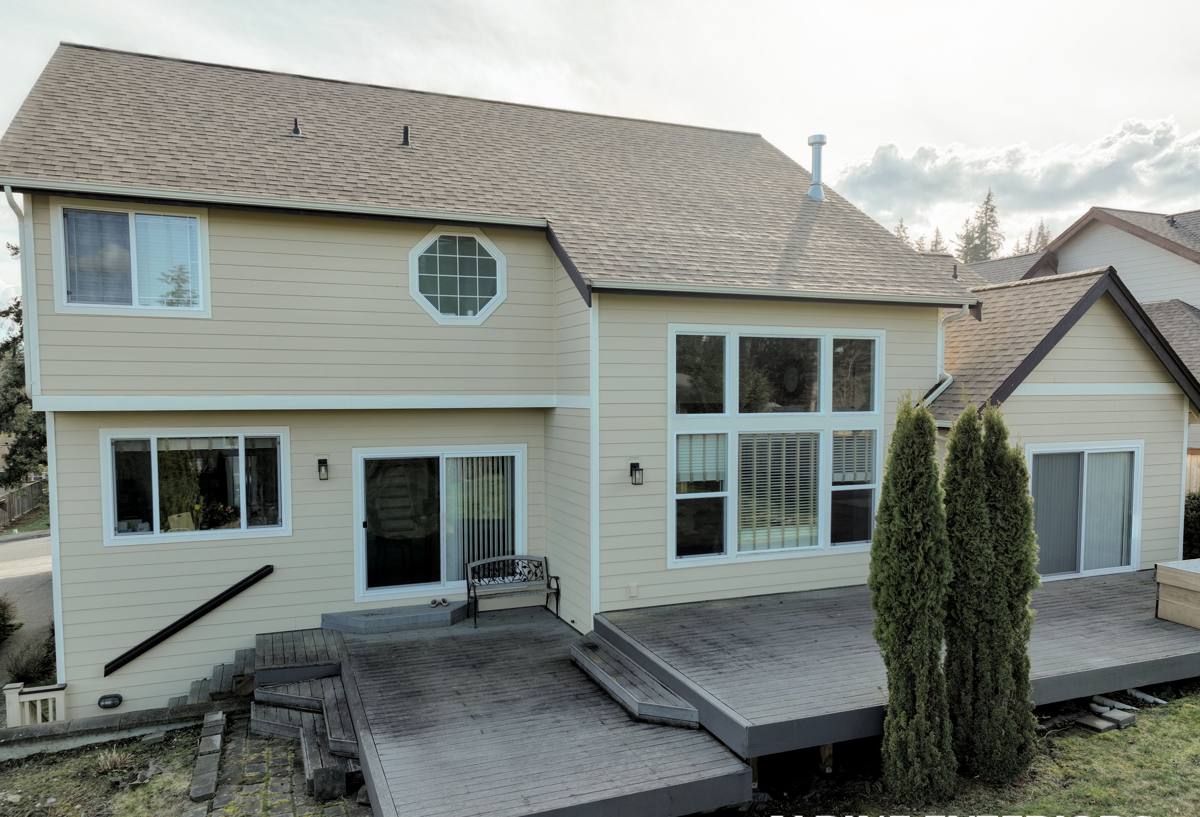
What a Correctly Built Deck Looks Like Here
Framing and Substructure
The framing is the part of a deck nobody sees once it's finished, which is exactly why it's where corners get cut. In a marine climate, we treat the substructure as the part that has to outlast the boards on top of it. That means pressure-treated framing lumber rated for ground contact where it's within a few inches of soil or standing water, proper joist spacing for the decking material chosen (composite and PVA boards often need tighter spacing than wood), and airflow underneath the deck so moisture doesn't sit trapped against the joists all winter.
Fastener and Hardware Selection
This is the single most common shortcut we see fail early in coastal-adjacent builds. Standard galvanized fasteners and joist hangers corrode noticeably faster in salt air than they do a few miles inland. We use stainless steel or heavy-duty coated fasteners rated for coastal and treated-lumber exposure, and we're deliberate about hardware compatibility with whatever treated lumber or composite system is going in — mismatched metals against ACQ-treated wood accelerate corrosion, and that's a problem you don't see until the hardware is already failing.
Decking Material Choices
There's no single "right" decking material for Birch Bay — it depends on your budget, how much upkeep you want to do, and how close the deck sits to the water. Here's how the common options actually compare in this climate:
| Material | Moisture / salt air behavior | Maintenance | Typical lifespan here |
|---|---|---|---|
| Pressure-treated wood | Handles moisture well when properly sealed; needs re-sealing to resist salt air staining | Annual cleaning, re-seal every 1-2 years | 15-20 years with upkeep |
| Cedar | Naturally moisture-resistant, but softens faster under constant marine humidity without maintenance | Regular cleaning and staining | 15-20 years with upkeep |
| Composite decking | Doesn't rot or splinter; some boards can show surface staining from salt residue and algae in shaded, damp spots | Periodic washing, no sealing/staining | 25-30 years, manufacturer-dependent |
| PVC decking | Fully moisture-resistant, best resistance to salt air and mildew staining | Occasional washing | 25-30+ years, manufacturer-dependent |
We'll walk through these trade-offs honestly during the estimate — including the up-front cost difference and what the maintenance actually looks like year to year, not just what the sales brochure says.
Footings and Foundations in Coastal Soil
Soil near the water can behave differently than soil a few miles inland — drainage, moisture retention, and frost behavior all factor into how deep and how wide footings need to be. We follow current Whatcom County building code for footing depth and size rather than guessing, and we pull permits where required. A deck that's structurally undersized at the footings is one of the more expensive things to fix later, because fixing it means partially rebuilding from the ground up.
For decks going in on a slope toward the water, or in yards with visibly poor drainage, we also look at how water moves under and around the deck once it's built — not just whether the footings themselves are sound.
Railings, Stairs, and Code Requirements
Railings and stairs are where safety code and coastal durability overlap most directly. Whatcom County follows the state building code for guard height, baluster spacing, and stair rise/run — we build to those specs as a baseline, not an upsell. On top of code compliance, railing hardware in a Birch Bay build gets the same corrosion-resistant treatment as the framing hardware, because railing posts and their connectors take direct weather exposure from every angle, not just from above.
Metal railing systems and cable rail in particular need hardware rated for coastal exposure — standard hardware on these systems corrodes visibly within a couple of seasons near the water, well before the railing itself would otherwise need replacing.
Moss, Mildew, and What Long-Term Maintenance Actually Requires
Whatcom County's wet season runs long, and Birch Bay's proximity to the water extends the window where deck surfaces stay damp. Moss and algae don't just look bad — on wood decking they hold moisture against the board surface, and on any material they make the deck surface slick and genuinely dangerous on stairs and ramps.
A few things reduce how much moss problem you'll have long-term, independent of which decking material you choose:
- Board spacing and airflow that lets water drain and surfaces dry between rain events, rather than pooling
- Keeping overhanging branches trimmed back so the deck gets some direct sun and airflow rather than staying in permanent shade
- Cleaning debris out of board gaps and along the house ledger a couple times a year, since trapped organic matter is what moss and mildew actually feed on
- Choosing a decking material that matches how much maintenance you're actually willing to do — wood needs more attention than composite or PVC in this climate
- Sealing or staining wood decking on a schedule rather than waiting until it visibly needs it, since damage from missed seasons is harder to reverse
None of this eliminates moss entirely — it's a fact of life this close to the water — but it's the difference between an annual pressure-wash and a deck that needs board replacement years early.
How We Approach a Birch Bay Deck Build
Every deck is different depending on the lot, the slope, and what you actually want to use it for, but our process follows the same sequence on every job:
- On-site assessment — we look at the yard's exposure to wind and water, existing drainage, soil conditions, and how the deck will connect to the house.
- Design and material walkthrough — we talk through layout, decking material, and railing options with honest trade-offs on cost and maintenance for this specific site.
- Permitting — we handle the Whatcom County permit process for the footing and structural work as required.
- Framing and footings — built to code depth and spacing, with corrosion-resistant hardware throughout.
- Decking, railing, and stair installation — installed with attention to drainage and airflow underneath and around the structure.
- Final walkthrough — we go over maintenance expectations for the specific material installed so there are no surprises a year in.
Common Problems We Find on Existing Birch Bay Decks
When we're called out to repair or replace an older deck near the water, the same handful of issues show up repeatedly:
- Corroded standard-grade fasteners and joist hangers well before the lumber itself has failed
- Ledger board attachment points that have taken on moisture from years of driving rain without proper flashing
- Undersized or shallow footings that were adequate on paper but weren't built for this soil and moisture combination
- Heavy moss buildup in shaded, low-airflow sections that's been left untreated long enough to hold moisture against the boards
- Railing posts with hardware corrosion that isn't visible until the post has some play in it
Most of these are avoidable with the right materials and detailing at the time of the original build — which is a large part of why we make those choices deliberately rather than defaulting to whatever's cheapest.
Why Hire a Crew That Already Works Birch Bay
A contractor who mostly builds decks in drier, inland parts of the county isn't necessarily going to think about fastener corrosion, footing depth for this soil, or moss-prone shade patterns unless they've dealt with the consequences of skipping those steps. We're based in Lynden and work Whatcom County regularly, including Birch Bay's coastal conditions specifically — so those decisions aren't an afterthought, they're built into how we spec the job from the first conversation.
That local familiarity also means we're not guessing at permit requirements, typical soil behavior, or which decking products actually hold up here versus which ones just look good in a showroom.
Get an Estimate
If you're planning a new deck in Birch Bay or need an honest look at an aging one, we're happy to come take a look and walk you through the options — no pressure, no upsell. Fill out the form below for a free estimate.