 Lynden Siding
 Building a Deck That Actually Holds Up in Acme
Acme sits back from the coast, up against the foothills along the South Fork Nooksack, and that setting changes what a deck needs to survive. You're not fighting salt spray out here the way homes closer to Bellingham Bay or the Lynden flats sometimes are, but you're fighting something arguably tougher on wood and fasteners over time: shade, standing moisture, and a moss season that starts earlier and lasts longer under tree canopy than it does out in open, sun-exposed yards. A deck built with generic, big-box assumptions — the kind that would be fine in a dry, open lot — tends to underperform here within a few years. One built for this specific setting doesn't.
We've framed and rebuilt decks throughout Whatcom County long enough to know the difference between a deck that looks right on installation day and one that's still tight, dry, and safe a decade later. In a wooded, damp community like Acme, that difference almost always comes down to decisions made before the first board goes down — drainage, ledger flashing, footing depth, and fastener selection — not the decking material homeowners usually focus on first.
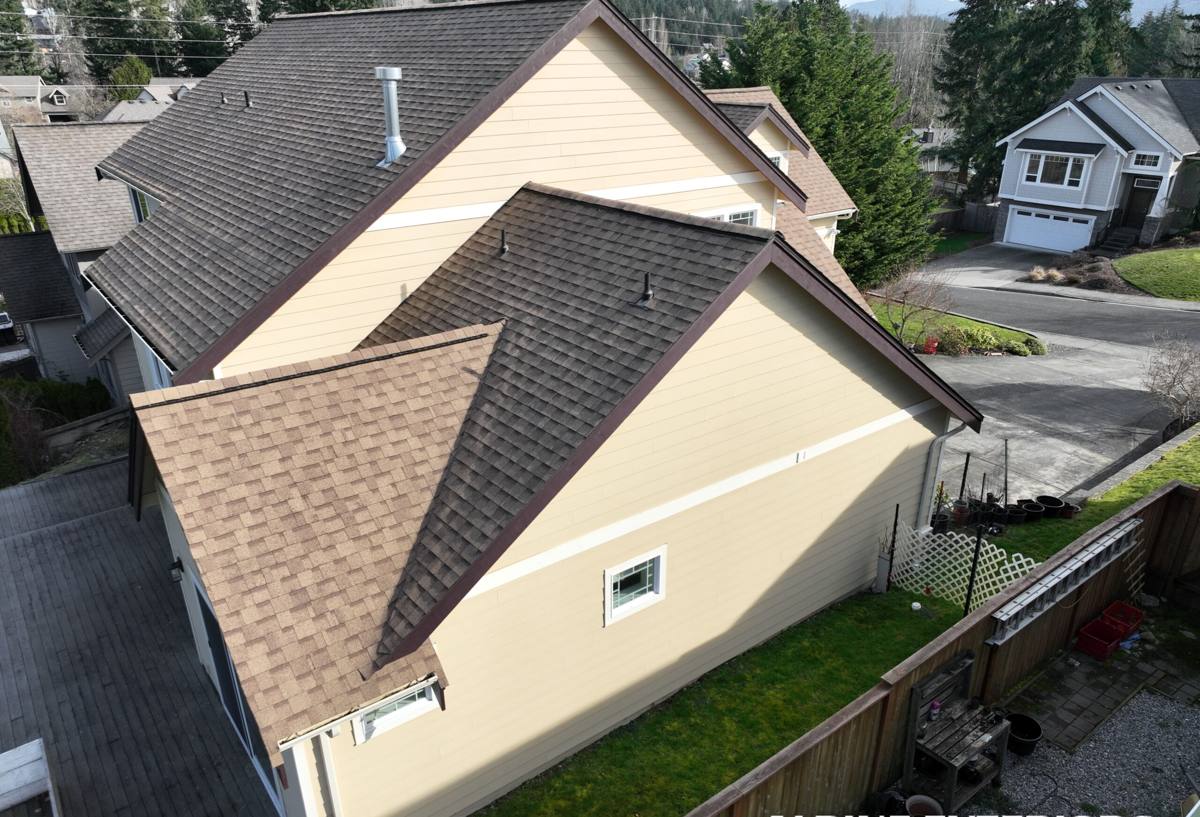
What Acme's Setting Actually Demands
Heavy Shade and Slow Drying
Properties tucked under fir and cedar canopy get less direct sun on the deck surface, which means rain and morning dew sit longer before they evaporate. That extended wet window is exactly what moss, algae, and rot-favoring fungi need. A deck design that ignores airflow underneath and between boards is setting itself up for a slick, green surface and softening joists within a handful of seasons.
Driving Rain and Ground Moisture
Whatcom County gets a lot of rain, and when storms come through with wind behind them, water gets driven sideways into places a level, straight-down rain never would — behind ledger boards, under loose flashing, into end-grain that wasn't sealed. On sloped or forested lots around Acme, ground moisture and runoff also tend to linger near footings longer than they would on open, well-drained sites, which matters for how deep and how well those footings are set.
Moss Season Longer Than Most People Expect
In shaded, damp settings like this, moss isn't a once-a-year nuisance — it can be an active concern from fall through spring, and on north-facing or heavily treed decks, sometimes longer. That has real implications for what decking material handles best and how the substructure needs to breathe.
What a Correctly Built Deck Involves
A deck is a structure first and a surface second. Homeowners naturally focus on the boards they'll walk on, but the parts that determine whether it lasts are mostly things you won't see once it's finished.
- Ledger attachment and flashing: Where the deck ties into the house is the single most common failure point on decks we're called to repair. Proper flashing — not just caulk — keeps water from getting behind the ledger and into the house framing.
- Footing depth and placement: Footings need to be sized and set below frost depth and clear of soft, saturated soil, which matters more on sloped or wooded Acme lots than on flat, open ground.
- Joist spacing matched to the decking: Composite and PVA boards often need tighter joist spacing than traditional lumber — following the manufacturer's span tables isn't optional if you want the warranty to mean anything.
- Fastener selection: In a consistently damp environment, standard fasteners corrode and streak the decking. Coated or stainless fasteners rated for ground contact and moisture exposure cost more up front and save the deck later.
- Airflow underneath: Adequate clearance between the ground and the framing, plus gapping between boards, lets the structure actually dry out between rain events instead of staying damp.
Choosing a Decking Material for This Environment
There's no single "best" decking material — there's the right material for a given budget, sun exposure, and maintenance appetite. In a shaded, moss-prone setting like Acme, those trade-offs shift compared to an open, sunny lot.
| Material | How it handles shade/moisture | Maintenance | Typical lifespan |
|---|---|---|---|
| Pressure-treated lumber | Absorbs moisture readily; needs to dry fully between rains or it stays damp longer in shade | Annual cleaning, periodic stain/seal | 10–15 years with upkeep |
| Cedar | Naturally rot-resistant but still needs airflow; can green up faster in deep shade without cleaning | Cleaning and refinishing every 1–2 years | 15–20 years with upkeep |
| Composite decking | Won't absorb water or rot, but a low-quality cap can still grow surface algae in constant shade | Occasional wash; no staining or sealing | 25+ years, per manufacturer warranty |
| PVC decking | Fully water-resistant, least affected by prolonged damp conditions | Lowest maintenance of the group | 25–30+ years, per manufacturer warranty |
We'll walk you through this honestly during the estimate rather than pushing whatever's easiest to sell. If a client wants the look and feel of real wood and understands the maintenance commitment that comes with it in a shaded lot, that's a legitimate choice. If low maintenance matters more, composite or PVC earns its higher upfront cost here faster than it would on a sunny, open site.
Footings and Framing on Acme's Terrain
Acme's mix of wooded, sometimes sloped properties means every site gets evaluated individually rather than built to a standard template. Soil that holds water near the surface, root systems from nearby trees, and grade changes all affect where and how deep footings should go. We check drainage patterns around the build site before finalizing footing placement — moving a footing a foot or two, or adding drainage gravel underneath, is a lot cheaper than dealing with a settling deck later.
On sloped lots, we also pay close attention to how the deck's height and any stair runs interact with the grade, since water shed off the deck surface has to go somewhere that doesn't undermine the footings or send runoff back toward the house foundation.
Our Process
- Site visit: We walk the property, look at sun/shade exposure, drainage, and how the deck will tie into the house, and talk through what you actually want to use the space for.
- Design and material selection: We put together a plan with honest material trade-offs for your specific site, not a one-size-fits-all recommendation.
- Permitting: Deck permits are handled through Whatcom County for properties outside city limits, and we manage that process so it's not on you to figure out.
- Build: Footings, framing, ledger flashing, decking, and railings, with inspections at the appropriate stages.
- Final walkthrough: We go over the finished deck with you, including basic care specific to your site's sun and shade exposure.
Living With a Deck in a Moss-Prone Spot
Even a well-built deck in a shaded Acme setting needs some seasonal attention — the goal of good construction is to make that upkeep minimal, not eliminate it entirely.
- Sweep leaves and debris off the surface regularly, especially between boards where they trap moisture
- Rinse or lightly scrub visible moss or algae before it gets established rather than after
- Keep gutters and downspouts near the deck clear so water isn't dumping directly onto or under it
- Trim back overhanging branches where practical to let more light and air reach the surface
- Check railings and stair connections once a year for any looseness, which shows up faster in consistently damp conditions
- Reseal wood decking on the schedule recommended for the product — skipping a cycle in a shaded yard costs more than it does in full sun
Why a Crew That Already Works Acme Matters
A contractor who mostly builds in open, sunny subdivisions closer to town will design a deck the same way regardless of where it sits. A crew that's already worked wooded, foothill properties around Acme knows to check drainage before setting footings, to spec fasteners for constant dampness rather than occasional rain, and to plan for a moss season that runs longer than it does a few miles away. That familiarity with the local terrain and climate isn't a marketing line — it shows up in fewer callbacks and a deck that's still solid well past the point a generic build would need major repair.
If you're planning a new deck or replacing an aging one in Acme, we're glad to come take a look and give you a straightforward, no-pressure estimate — including an honest read on what your specific lot and tree cover mean for materials and maintenance. Use the form below to get started.