 Lynden Siding
 Siding That Has to Work Around Wiser Lake, Not Just Look Good
Wiser Lake sits in one of the damper pockets of Whatcom County, and homes there deal with a specific mix of punishment: moisture off the water that lingers in the air longer than it does a few miles into town, driving rain that comes sideways off the lake during winter storms, and a moss season that can stretch from October into May. Add the salt-tinged air that rolls in from the Strait off and on throughout the year, and you've got a set of conditions that will find every weakness in a siding job within a few years. We install fiber cement siding for homes around Wiser Lake because it's one of the few claddings built to shrug off that combination, and we've learned exactly how it needs to be detailed for lake-adjacent properties to make good on that promise.
This page is about that one job, done right, for that one area — not a general pitch for siding. If you own a home near Wiser Lake and you're weighing a re-side, here's what actually matters.
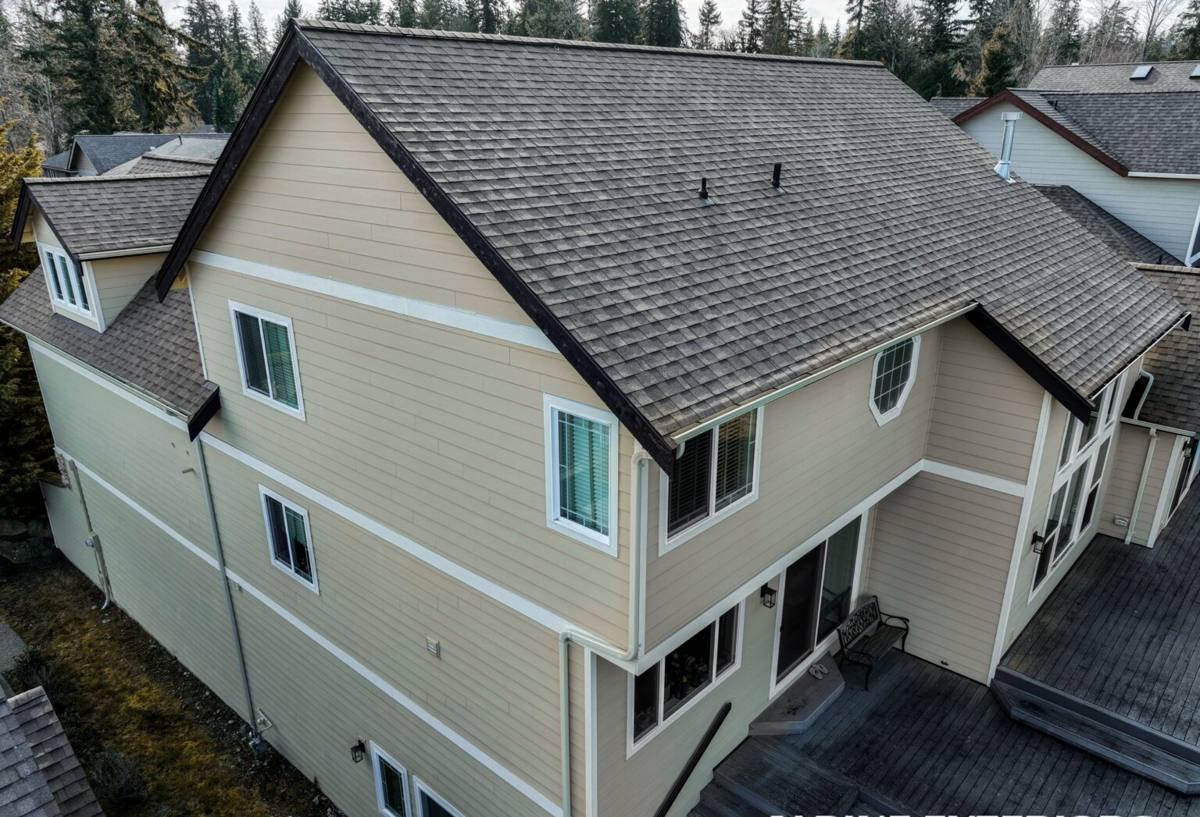
What Wiser Lake's Climate Does to Siding Over Time
Standing Moisture and Slow Drying
Homes tucked near the lake and surrounded by trees don't get the same drying wind that a house out in the open farmland gets. Morning dew and fog sit on north- and east-facing walls longer, and that extended damp window is exactly what lets moss, algae, and mildew establish themselves on a wall surface. Siding that absorbs moisture — or that has seams and edges where water can wick in — stays wet longer and starts to fail from the inside out, often before anything looks wrong on the surface.
Driving Rain Off the Water
Wind off open water hits siding at an angle, not straight down, which pushes moisture up under laps, around trim, and into any gap that wasn't sealed correctly. A siding product's water resistance means little if the installation didn't account for wind-driven rain in the first place — this is as much a detailing problem as a materials problem.
Moss and Organic Growth
Whatcom County's moss season is long, and Wiser Lake's shade and humidity make it longer still. Moss holds moisture against a wall surface around the clock, and on the wrong material that turns into rot, soft spots, or paint failure. On the right material, it's a surface issue you rinse off — not a structural one.
Why Fiber Cement Fits This Specific Location
Fiber cement is made from cement, sand, and cellulose fiber, which means it doesn't absorb and release moisture the way wood-based products do, and it doesn't warp, swell, or delaminate when it stays damp for weeks at a time. For a Wiser Lake property, that matters more than for a house on a dry, open lot across town. A few specific advantages carry real weight here:
- Dimensionally stable in constant humidity swings — it won't cup, bow, or telegraph waviness through paint the way some wood-fiber products can
- Non-combustible, which matters given wildfire smoke and ember exposure has become a real-season concern even in western Washington
- Holds a factory finish through repeated wet-dry cycles far better than field-applied paint on wood or engineered wood siding
- Resists the softening and edge-swelling that shows up on lake-adjacent homes within just a few winters on the wrong product
- Doesn't feed moss and mildew growth the way organic-based siding substrates can
We install James Hardie fiber cement exclusively, in the HZ5 climate-engineered formulation appropriate for the Pacific Northwest. Hardie engineers its HZ product lines by climate zone specifically because a house near a Puget Sound-region lake and a house in a dry inland climate need different moisture and freeze-cycle performance — that distinction is real, not marketing.
What "Correct" Actually Looks Like on a Wiser Lake Job
Fiber cement siding is only as good as its installation. We see homes around Whatcom County where the product itself is fine but the install left gaps for moisture — that's where the real failures happen, and it's avoidable.
Drainage Behind the Siding
Every wall gets a code-compliant water-resistive barrier and a rainscreen or drainage gap so any moisture that does get behind the siding has somewhere to go and can dry out, instead of sitting against the sheathing. On a lake-adjacent home, this single detail does more to prevent long-term rot than almost anything else in the job.
Clearances That Respect the Site
Hardie's specifications call for minimum clearances from grade, roof lines, decks, and horizontal surfaces — and around a lake property with landscaping, retaining walls, or a dock path close to the house, those clearances are easy to shortcut if the crew isn't paying attention. We hold them because that gap is what keeps splash-back and standing moisture off the bottom edge of the siding.
Fastening and Fitting
Fiber cement has to be fastened per manufacturer spec — correct fastener type, spacing, and penetration depth — and joints have to be flashed or sealed with the right materials, not just caulked and hoped for. Butt joints, corners, and penetrations (vents, hose bibs, light fixtures) are where water finds its way in on a poorly executed job, and they're exactly where we spend the extra attention.
Painted and Factory-Finished Edges
Any field-cut edge on ColorPlus-finished Hardie siding gets sealed with the manufacturer's touch-up system so the cut edge doesn't become the one spot on the wall that absorbs moisture. It's a small step that gets skipped on rushed jobs and matters enormously over a decade of Wiser Lake winters.
Our Process for Wiser Lake Homes
- On-site assessment — we walk the exterior, check for existing moisture damage, rot, or moss buildup, and look at drainage paths and grading around the foundation
- Tear-off and sheathing check — old siding comes off and we inspect the sheathing underneath for soft spots before anything new goes up; problems found here get addressed before the wrap goes on, not covered up
- Water-resistive barrier and rainscreen — installed per code and per Hardie's requirements, with attention to how water will actually move on your specific site
- Flashing and trim — windows, doors, and penetrations get properly flashed before siding closes them in
- Hardie panel or lap installation — fastened, spaced, and fitted to manufacturer spec, cut edges sealed
- Final walk-through — we go over the finished exterior with you before calling the job done
Why It Matters That We Already Work This Area
A crew that's done siding around Wiser Lake and the rest of Whatcom County knows what the moss cycle does to a north wall, knows how far wind-driven rain travels up a wall face near open water, and knows which details get skipped on jobs that fail early. That's not something you can fully substitute with a generic installation manual — it's pattern recognition built from working the same conditions repeatedly. It also means we're a known, findable local business if you ever need a warranty question answered or a minor repair years down the line, not a crew that worked the area once and moved on.
Fiber Cement vs. What We Don't Install
We get asked why we don't offer vinyl or engineered wood siding as a lower-cost option. The honest answer is climate-specific: around a damp, lake-adjacent site, those products' weak points — moisture-driven swelling and edge failure on engineered wood, and heat/impact brittleness plus a look that reads as cheaper on vinyl — show up faster than they would in a drier region. Fiber cement costs more up front and we think that difference is worth explaining plainly rather than glossing over.
| Factor | Fiber Cement (James Hardie) | Engineered Wood Siding | Vinyl Siding |
|---|---|---|---|
| Moisture/humidity tolerance | High — cement-based, won't swell | Moderate — vulnerable at cut edges and joints if moisture gets in | High to water itself, but seams can trap moisture behind panels |
| Moss/algae resistance | Good; factory finish resists staining, cleans up easily | Moderate; can hold moisture that feeds growth at damaged spots | Good on the surface, but growth can build in overlaps |
| Fire resistance | Non-combustible | Combustible (wood-based) | Combustible; can deform under heat |
| Finish longevity | ColorPlus factory finish, long fade/chip resistance | Field-painted or factory-coated; repaint typically needed sooner | Color molded through, but fades and chalks over time |
| Typical lifespan | 30-50+ years installed to spec | 15-30 years | 20-40 years |
What to Expect Cost-Wise
Fiber cement siding costs more than vinyl per square foot and generally more than engineered wood, reflecting both material cost and the more labor-intensive installation. Exact pricing depends on your home's size, the number of stories, trim complexity, tear-off scope, and whether sheathing repair is needed once old siding comes off — which is common on lake-area homes with any history of moisture intrusion. We give firm, itemized quotes after an on-site walk-through rather than ballpark figures over the phone, because guessing on a job like this does homeowners a disservice.
A Quick Checklist If You're Evaluating Your Current Siding
- Soft or spongy spots when you press on the siding, especially near the bottom courses or under windows
- Visible moss or dark staining that returns quickly after cleaning
- Paint that's peeling, bubbling, or chalking heavily on north- or lake-facing walls
- Gaps, warping, or waviness along seams and panel edges
- Interior signs — musty smell, damp drywall, or peeling interior paint on an exterior wall
- Siding that's original to a home built more than 25-30 years ago, especially if it's never been fully replaced
If any of those sound familiar, it's worth having someone look at the wall assembly, not just the surface.
Ready for a Straight Answer on Your Home
If you're near Wiser Lake and dealing with tired, damaged, or failing siding, we're glad to come take a look and tell you honestly what we see — including if fiber cement isn't the most urgent fix your home needs right now. Fill out the form below for a free, no-pressure estimate.