 Lynden Siding
 Roof Repair Built for Birch Bay's Coastline
Birch Bay sits right on the water, and that changes what a roof has to deal with compared to a home a few miles inland in Lynden or Everson. Salt-laden air off the bay accelerates corrosion on exposed fasteners, flashing, and vent caps. Wind-driven rain off the Strait of Georgia finds every gap a normal storm would miss, pushing water sideways under shingles and around penetrations instead of just running downhill. And Whatcom County's long, wet moss season packs organic growth into every north-facing slope and shaded valley, holding moisture against the roof deck for months at a time. A roof repair here needs to account for all three, not just patch the spot that's leaking.
We work on homes throughout Birch Bay regularly, alongside our base of work in Lynden and the rest of Whatcom County, so we're not guessing at what this coastline does to a roof. We've seen the same failure patterns often enough to know where to look first and what corners not to cut on the fix.
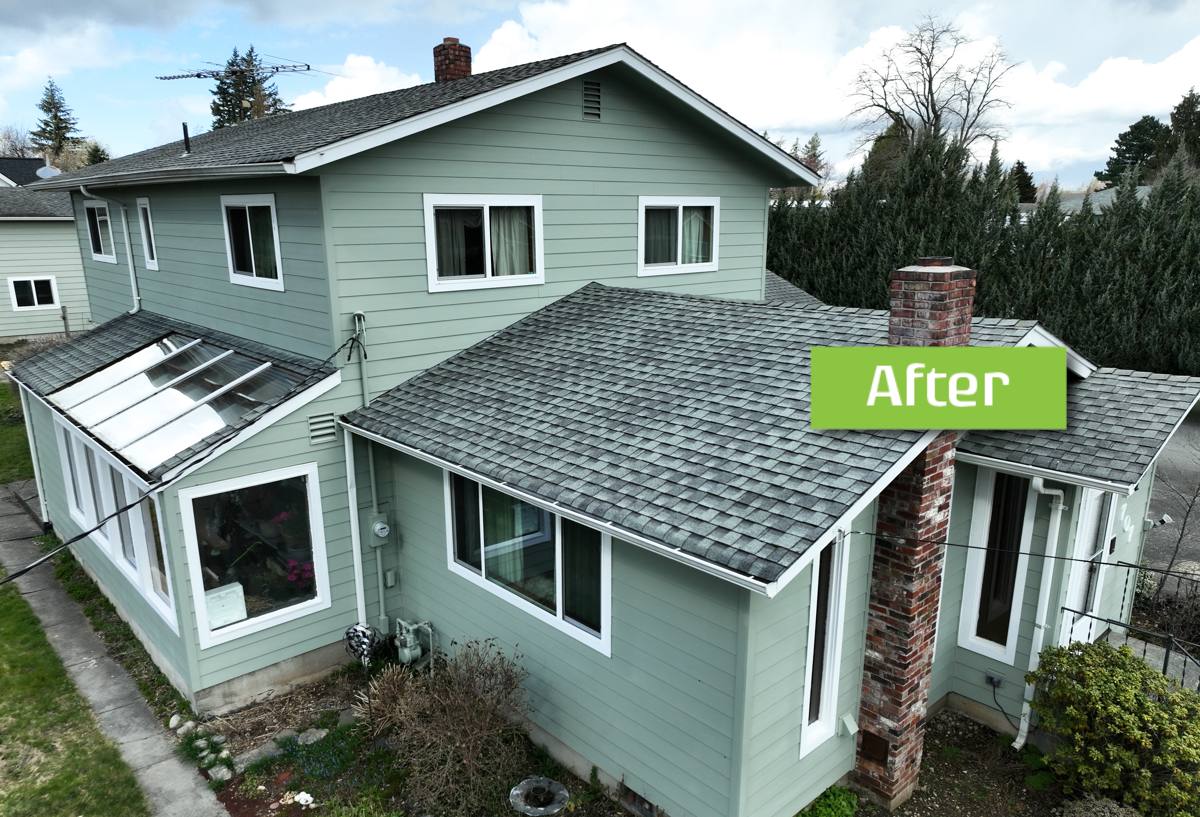
What Birch Bay's Climate Does to a Roof
Salt Air and Corrosion
Metal components age faster near the water. Nail heads, drip edge, flashing seams, and the fasteners holding down ridge caps corrode quicker in Birch Bay than they would on the same roof set back from the shoreline. Once a fastener starts to rust, it loses its grip on the roofing material around it, and that's often where a small leak starts — not a torn shingle, but a fastener that's simply given out.
Driving Rain
Birch Bay catches wind straight off the water, and wind-driven rain behaves differently than a straight-down downpour. It gets pushed uphill under shingle laps, into vent flashing, and through any gap in a chimney or wall-to-roof transition. A repair that only addresses the visible damage and ignores wind exposure on that side of the house tends to fail again in the next storm.
Moss and Trapped Moisture
Whatcom County's mild, wet winters are ideal moss conditions, and Birch Bay's tree cover and marine humidity make it worse in shaded areas. Moss doesn't just look bad — it holds water against the roofing material, lifts shingle edges as it grows, and works its way under laps and around fasteners. A roof that's been carrying a moss mat for a season or two often has hidden moisture damage well beyond what's visible from the ground.
Common Repair Calls We See in Birch Bay
- Corroded or lifted flashing around chimneys, skylights, and roof-to-wall transitions
- Fastener failure on ridge caps and shingle courses from salt exposure
- Moss-related shingle lifting and granule loss on shaded, north-facing slopes
- Wind-driven leaks around vent boots and pipe penetrations
- Soft or spongy decking discovered under a small visible leak, from long-term hidden moisture
- Gutter and edge damage from debris buildup combined with heavy rain volume
What a Correct Roof Repair Actually Involves
A roof repair that holds up on this coastline starts with a real diagnosis, not just a patch over the stain on the ceiling. Water travels before it shows up indoors — a leak that appears over a bedroom closet might be entering the roof several feet away, following a rafter or the underside of the decking before it drips. We trace the path, not just the symptom.
Our Process
- Inspection. We get on the roof (not just a ground-level look) and check the suspect area plus anything nearby that shares the same exposure — flashing, vents, valleys, and moss-prone slopes.
- Diagnosis. We identify the actual entry point and any secondary damage — soft decking, compromised underlayment, corroded fasteners — before quoting a fix.
- Honest scope. We tell you plainly whether this is a targeted repair or whether the damage has spread far enough that a repair would just be a temporary patch on a bigger problem.
- The repair itself. Matching materials where possible, replacing compromised decking rather than roofing over it, and re-flashing with attention to wind direction and water path — not just re-sealing the old flashing in place.
- Follow-through. We walk you through what we found and what we did, including anything worth keeping an eye on going forward (a shaded slope that'll need moss treatment again in a year or two, for example).
Repair vs. Replacement: How We Decide
Not every leak means a new roof, and not every roof with moss needs to be torn off. The honest answer usually comes down to how much of the roof's remaining service life is compromised versus how localized the damage is.
| Factor | Leans Toward Repair | Leans Toward Replacement |
|---|---|---|
| Age of roof | Under 12-15 years, especially asphalt shingle | Nearing or past manufacturer's expected lifespan |
| Extent of damage | Localized to one flashing point, valley, or slope | Multiple areas failing or widespread granule loss |
| Decking condition | Solid, dry decking under the damaged area | Soft, delaminating, or water-stained decking in several spots |
| Moss history | Recent growth, caught early | Years of untreated moss with visible shingle lift |
| Underlying cause | Isolated fastener or flashing failure | Systemic issue — poor original installation or ventilation |
We'll always tell you honestly which side of this table your roof falls on. A repair that's really a stopgap isn't a favor to you — it just delays a bigger bill and, on a house this close to the water, gives salt air and moisture more time to work on exposed decking.
Flashing, Vents, and the Details That Actually Fail
Most leaks on Birch Bay roofs don't come from the field of the shingles — they come from the details. Chimney flashing, skylight curbs, pipe boots, and roof-to-wall step flashing are where two different materials meet, and that joint is the weak point. Salt air corrodes the metal faster, and driving rain tests the seal harder than it would inland. When we repair these areas, we replace corroded flashing rather than re-caulking over it, and we check that step flashing is properly layered with the siding above it rather than just sealed at the surface. A bead of sealant over failing flashing is a short-term fix at best; on this coastline it doesn't hold long.
Moss Removal and Prevention as Part of the Repair
If moss contributed to the damage we're repairing, treating it is part of doing the job right — not an upsell. That means physically removing moss growth (not just killing it in place, which leaves a dead mat still holding moisture), clearing debris from valleys and gutters, and, where it makes sense, discussing zinc or copper strips that discourage regrowth on shaded slopes. None of this eliminates moss permanently in a climate like this one, but it buys years of extra life on the areas that are most exposed.
What to Check Before You Call Anyone
A few things are worth doing yourself before a repair call, and a few things aren't safe to check on your own:
- Look in your attic (if accessible) for water stains, dark streaks, or damp insulation — note where they are relative to the roof above
- Check gutters and downspouts for moss debris or standing water, which points to drainage problems making leaks worse
- Note when the leak shows up — during heavy wind from the water, or in any rain — since that tells us something about the entry point
- Don't get on the roof yourself, especially with moss present — wet, moss-covered roofing is genuinely slippery and steep coastal roofs are not a DIY inspection
- Don't rely on sealant-in-a-tube fixes from the ground with a long-handled applicator — they rarely address the actual failure point and can trap moisture
Why a Crew That Works Birch Bay Regularly Matters
A roofer who mostly works inland jobs isn't wrong about roofing in general, but they may not think to check corrosion on fasteners that would be fine anywhere else in Whatcom County, or may underestimate how far wind-driven rain travels up a slope facing the water. We work Birch Bay alongside our home base in Lynden and the surrounding county often enough that these aren't edge cases for us — they're the normal condition of the job. That shows up in where we look first, what we flag as a future problem even if it's not today's leak, and what materials and fastener choices we recommend for a spot this exposed.
Materials and Fasteners We Use for Coastal Repairs
For repair work in Birch Bay, we lean toward corrosion-resistant fasteners and flashing rather than the standard-grade hardware that's fine further inland. It costs a little more upfront on a small repair, but replacing a fastener twice in ten years because it rusted through costs more in the long run — and more importantly, a corroded fastener that fails hidden under a shingle can mean water damage long before anyone notices a leak. We'll walk you through the material choice on your specific repair and why, rather than defaulting to whatever's cheapest.
If you've got a leak, a soft spot, or a moss-covered slope in Birch Bay that's overdue for attention, we're glad to take a look. The estimate is free, there's no pressure to sign anything on the spot, and you'll get a straight answer about whether you need a repair or something more — just fill out the form below and we'll get in touch.