 Lynden Siding
 Why Storm Damage Hits Different in the Nooksack Area
Homes around Nooksack and Lynden sit close to the Sumas Gap, the low pass in the Cascade foothills where cold air from the Fraser Valley in British Columbia funnels south into Whatcom County. When that outflow wind event kicks in, usually in late fall through winter, it doesn't behave like a normal coastal storm. Gusts come from the northeast instead of the usual southwest, hit roofs from an angle most shingles and flashing details weren't optimized for, and they can persist for a day or more rather than blowing through in an afternoon. That's a big part of why roofs in this corridor take wind damage that homes twenty miles south rarely see.
Layer on top of that the everyday reality of Whatcom County weather — long stretches of driving rain, humid air off the Pacific, and a moss season that can run eight or nine months out of the year on a shaded, north-facing slope. None of these things individually destroy a roof overnight. What they do is find every existing weakness — a lifted shingle tab, a nail that backed out, a flashing seam that was never sealed quite right — and turn it into a leak over time. Storm damage repair out here isn't just about patching what a single wind event broke. It's about fixing that damage in a way that accounts for what the roof is going to face again next month.
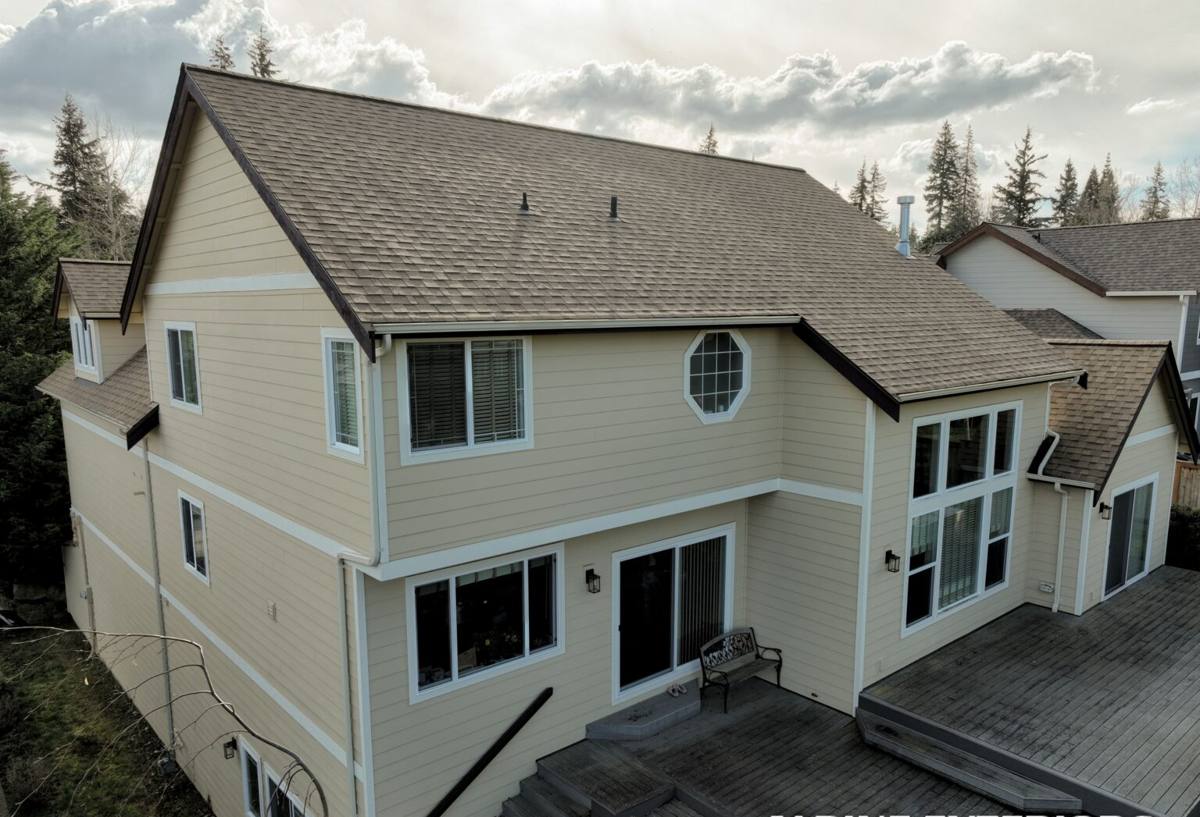
What Actually Counts as Storm Damage
Homeowners often assume storm damage means a dramatic hole or missing section of roof, and sometimes it is. More often it's subtler, and it's the subtler stuff that causes the real long-term cost if it sits unaddressed.
Wind-related damage
- Shingles that are cracked, curled, or torn but still nailed down — easy to miss from the ground
- Shingles lifted at the tab with the sealant strip broken, which lets wind get underneath the next time it blows
- Ridge cap shingles pulled loose or missing, since the ridge takes the highest wind load on the roof
- Flashing bent or separated around chimneys, vents, and sidewalls
Rain and moisture-related damage
- Water staining on the underside of decking, visible from the attic, even with no obvious exterior damage
- Saturated or sagging underlayment where a shingle gap let water sit for weeks before anyone noticed
- Gutter and downspout damage that redirects runoff back under the roof edge instead of away from the house
Debris impact
- Bruised or punctured shingles from fallen branches or wind-driven debris
- Granule loss in a concentrated area, which shows up as a shingle that looks "bald" compared to the rest of the field
Any one of these on its own might not need a full repair crew. But after a real wind event, they tend to show up together, and it's the combination — a lifted shingle plus a bent flashing plus a clogged gutter — that turns into a ceiling stain a month later.
What a Correct Repair Actually Involves
A lot of storm repair work in this region gets done as a surface fix: replace the shingles that are obviously torn, call it done. That approach holds up until the next outflow event or the next heavy rain, and then the same spot fails again. A repair that's actually going to last through another Whatcom County winter needs a few more steps.
1. Full inspection, not just the damaged spot
We look at the whole slope the damage occurred on, plus adjoining slopes and valleys, because wind damage rarely stays contained to one shingle. We also check the attic side when it's accessible — that's often the only place you can see whether water already got past the shingle layer.
2. Deck condition check
If water has been getting into the decking for any length of time, the plywood or OSB underneath can be soft or delaminated. Replacing shingles over compromised decking doesn't fix anything; it just hides the problem until it fails again, usually worse.
3. Underlayment and flashing repair, not just shingle swaps
The underlayment and flashing are what keep a roof watertight even if a shingle later fails. In a region with this much sustained rain, we treat these as part of the repair, not an afterthought — especially around chimneys, skylights, and roof-to-wall intersections where most leaks actually originate.
4. Matching materials correctly
Shingle color and profile drift over time as products weather and get reformulated. We match as closely as the current market allows and are upfront when an exact match isn't possible, rather than installing something that will stand out or age differently than the surrounding roof.
5. Moss and debris clearing as part of the job
If moss growth contributed to the damage — moss holds moisture against the shingle and works its way under tabs — we clear it and treat the area as part of the repair, not as a separate upsell. Leaving moss in place next to fresh repair work undermines the work almost immediately.
Repair vs. Replacement: How We Make That Call
Not every storm-damaged roof needs full replacement, and not every roof can be responsibly patched. The honest answer depends on age, extent of damage, and what we find once we're actually up there.
| Factor | Leans toward repair | Leans toward replacement |
|---|---|---|
| Roof age | Under 12–15 years, shingles still flexible | Nearing or past expected lifespan, shingles brittle |
| Extent of damage | Isolated to one or two areas | Damage scattered across multiple slopes |
| Deck condition | Solid, dry decking under the damaged area | Soft, stained, or delaminated decking found |
| Granule loss | Localized to the impact area | Widespread thinning across the whole roof |
| Underlying moss history | Minor, treatable | Long-term moss damage affecting large sections |
We'll tell you plainly which side of that line your roof falls on, including when the honest recommendation is a repair that buys you several more years rather than a replacement you don't need yet.
Working With Insurance on a Storm Claim
Most storm damage repair in this area involves an insurance claim, and the documentation matters as much as the repair itself. Before we touch anything, we photograph the damage in detail — the specific shingles affected, any deck damage found once shingles are pulled, and the condition of flashing and underlayment. That documentation is what supports your claim and protects you if the adjuster's initial estimate doesn't match what the roof actually needs once a crew is up there looking closely. We're glad to walk an adjuster through what we found directly if that's useful to your claim.
Why a Crew That Already Works Nooksack Matters
A roofing crew that's unfamiliar with this specific corridor of Whatcom County is working from general assumptions about Pacific Northwest weather. A crew that already works the Nooksack and Lynden area knows the outflow wind pattern isn't theoretical — it's a recurring event with a predictable direction and season, and it changes where on a roof damage is most likely to show up first. That local knowledge also means faster response after a storm, since we're not routing a crew in from outside the county after every regional weather event when demand spikes and everyone is calling around at once. And because we're back through this area regularly for other jobs, we're not disappearing after the repair — if something about the fix needs a follow-up look, we're not hard to reach.
After the Storm: A Homeowner Checklist
Before any crew gets on your roof, there are a few things worth checking yourself, safely, from the ground or the attic.
- Walk the yard and check for shingle pieces, granules, or flashing fragments on the ground
- Look at gutters for unusual amounts of granules — heavy granule shedding after a storm is a sign of impact damage
- Check the attic (if accessible) for any new water staining, damp insulation, or daylight showing through the decking
- Note the date and general weather event, since insurers often want that timeline
- Avoid walking the roof yourself after a storm — wet, moss-covered surfaces in this climate are genuinely dangerous underfoot
- Get photos from the ground of any visibly missing or lifted shingles before you call anyone
If several of these turn up together, that's usually a sign the damage is more than cosmetic and worth having looked at before the next rain gets underneath it.
Get an Honest Look at What Your Roof Needs
If a recent windstorm or the ongoing wet season has you wondering whether your roof around Nooksack needs attention, we're happy to come take a direct look and give you a straight answer — repair, monitor, or replace — with no pressure either way. Use the form below to request a free estimate.