 Lynden Siding
 Why Roofs Age Faster Around Nooksack
Nooksack sits in the flatter farm country north and east of Lynden, close enough to the river bottom and the marine air pushing in off Bellingham Bay and the Sound that roofs here rarely fail the way they do in drier parts of the state. It's almost never one dramatic storm. It's the accumulation of a wet climate working on a roof for years: driving rain that finds every marginal seam, humidity that never fully clears between weather systems, and a moss season that can run from October clear through April in a shaded or north-facing section of roof.
None of that is exotic weather. It's just persistent, and persistent is what wears out shingles, flashing, and decking. A roof that would last 25-30 years in a dry inland climate often needs real attention closer to 18-22 years out here, and homes with heavy tree cover or poor original ventilation can see trouble sooner. If you're starting to see granules in the gutters, moss ridges along the shaded slopes, or soft spots near valleys and chimneys, that's the climate doing what it does — and it's worth a straight assessment before it turns into decking damage.
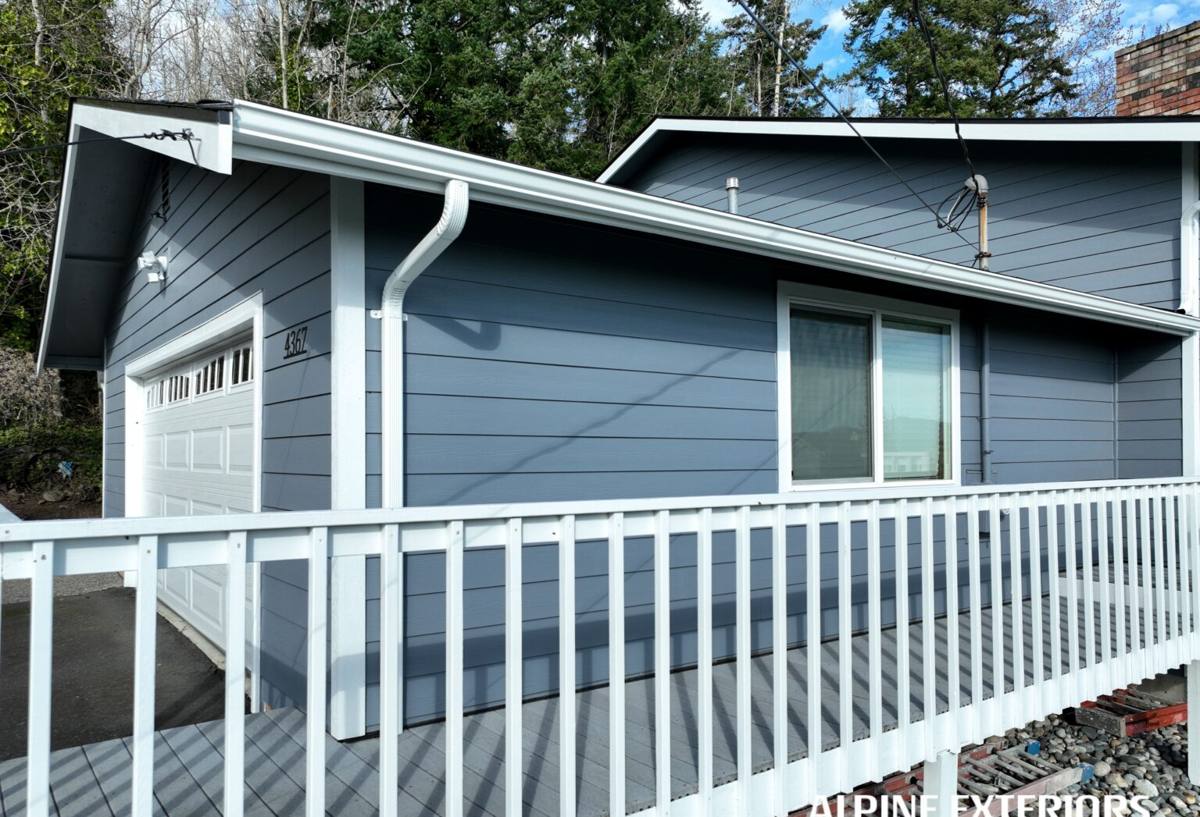
Repair, Patch, or Full Replacement?
Not every roofing problem in Nooksack means a full tear-off. But there's a point where patching stops being the economical choice, and knowing where that line is matters more than any single symptom.
Signs a repair is still reasonable
- A localized leak traced to one flashing point (chimney, vent boot, skylight) with the rest of the roof in good shape
- Isolated missing or damaged shingles from wind, with matching material still available
- Moss on the surface but no visible lifting, curling, or granule loss underneath it
Signs it's time to talk replacement
- Multiple leak points, or a leak that keeps reappearing in a new spot after repair
- Shingles that are curling, cracking, or bald across large sections, not just one slope
- Soft, spongy decking you can feel underfoot when walking the roof
- Daylight or water staining visible from inside the attic along the roof plane
- The roof is original to a home built more than two decades ago and has never been re-covered
A short inspection usually settles the question. We'd rather tell you honestly that a repair will hold for another few years than sell a replacement you don't need yet — but we'll also tell you plainly when patching is just delaying a bigger bill.
What a Correct Replacement Actually Involves
"Roof replacement" gets used loosely, but a job done right in this climate has specific components that matter more here than they would somewhere dry.
Full tear-off, not a layover
Installing new shingles over an existing layer is faster and cheaper, but it traps moisture against the old material and hides decking problems instead of fixing them. In a climate that stays damp as long as Whatcom County's does, that trapped moisture is exactly the wrong thing to build into a new roof. We tear off to bare decking on every replacement so nothing gets sealed in.
Decking inspection and repair
Once the old material is off, the sheathing underneath gets checked panel by panel. Any wood that's soft, delaminating, or water-stained through gets replaced before anything new goes down — a beautiful shingle job over rotten decking is a short-term fix wearing a long-term price tag.
Ice-and-water shield where it actually matters
Self-adhered waterproof membrane goes at the eaves, in valleys, and around penetrations — the places wind-driven rain and ice damming are most likely to force water backward under the shingles. This isn't optional extra-cost upselling; it's the single detail most responsible for preventing the slow leaks that show up two winters after a cheap re-roof.
Synthetic underlayment across the field
We use synthetic underlayment rather than old-style felt. It handles repeated wet-dry cycling better, doesn't sag or tear as easily during install in damp conditions, and gives the roof a second line of defense if any water does get past the shingle layer.
Balanced ventilation
Intake at the soffits, exhaust at the ridge, sized to move air through the attic space. Ventilation is where a lot of roofs in this area quietly fail — not from the outside, but from trapped moisture underneath, condensing on the decking and rotting it from the inside over several seasons.
Choosing a Roofing Material for This Climate
There's no single "best" roofing material — the right choice depends on budget, roof pitch, how long you plan to own the home, and how much moss maintenance you're willing to do. Here's how the common options compare for a Nooksack property.
| Material | Typical Lifespan Here | Moss Resistance | Upfront Cost |
|---|---|---|---|
| Standard 3-tab asphalt shingle | 15-20 years | Low — needs periodic cleaning | Lowest |
| Architectural (dimensional) shingle | 20-25 years | Moderate; algae-resistant granules help | Moderate |
| Metal panel roofing | 40-50+ years | High — moss struggles to hold on smooth metal | Highest |
| Synthetic/composite shingle | 30-40 years | Moderate to high depending on product | Moderate-High |
Most Nooksack homeowners land on architectural shingle — it's a real step up from 3-tab in both wind resistance and moss/algae resistance, without moving into metal-level cost. Metal earns its keep on steeper pitches, homes near heavy tree cover, or for owners planning to stay put long enough for the lifespan to pay for itself. We'll walk through the honest trade-offs for your specific roof rather than steering you toward whatever's most profitable to install.
Moss Isn't Cosmetic — It's a Moisture Problem
Moss on a roof isn't just an eyesore. Moss holds water against the shingle surface long after the rest of the roof has dried, and its root structure works into the granule layer and eventually the shingle mat itself. On a north-facing slope shaded by trees or a neighboring structure, that cycle can shave real years off a roof's service life.
A few things we build into new roofs specifically for moss-prone properties:
- Zinc or copper strips near the ridge, which release trace metal ions in the rain that inhibit moss growth downslope over time
- Algae-resistant shingle products on the shaded or heavily-treed sections where standard granules would black-streak or moss over faster
- A conversation about trimming back overhanging branches, which does more for roof longevity than almost any product choice
None of this makes moss impossible — nothing does, in this climate — but it meaningfully slows it down and buys the roof years of extra life.
How the Roof Connects to Your Siding and Exterior
As a siding contractor, we look at a roof replacement as part of the whole building envelope, not an isolated project. Roof edges, fascia, and the transition into siding are where a lot of water damage actually originates — a roof can be perfectly sound and still feed water into wall cavities if the flashing where it meets the siding isn't detailed correctly.
When we replace a roof, we check and correct where needed:
- Kick-out flashing at roof-to-wall intersections, which directs water away from siding instead of behind it
- Fascia and trim condition, replacing anything rotted before new gutters go back up
- Gutter attachment and flow, since undersized or clogged gutters push water back under the roof edge and down behind siding
Fixing the roof while ignoring these transition points is a common way homeowners end up with a new roof and a hidden siding problem within a couple of years.
Our Process, Start to Finish
- On-site inspection. We walk the roof (and the attic, if accessible) and give you a straight assessment — repair, replace, or something in between.
- Written estimate. Material options, scope, and price laid out clearly, with the reasoning behind each recommendation.
- Scheduling around the weather. Roofing needs a dry work window; we plan around Whatcom County's forecast rather than fighting it, which protects the decking and underlayment from getting installed wet.
- Tear-off and decking repair. Old material removed, sheathing inspected and repaired before anything new is installed.
- Underlayment, flashing, and shingle or metal installation to manufacturer spec, with ice-and-water shield at vulnerable points.
- Site cleanup. Magnetic sweep for nails, debris hauled, gutters checked clear.
- Final walkthrough so you can see the finished work and ask questions before we call it done.
What Drives Cost
Every roof is priced from measurements and site conditions, but these are the factors that move the number most:
| Factor | Why It Matters |
|---|---|
| Roof size and pitch | Steeper roofs take longer and need more safety setup |
| Number of layers to remove | Tearing off two old layers costs more than one |
| Decking condition | Rotted sheathing found underneath adds material and labor |
| Material choice | Architectural shingle, synthetic, and metal all price differently |
| Roof complexity | Valleys, dormers, skylights, and chimneys all add flashing detail work |
| Access | Tight lots or difficult staging can add time |
We'd rather give you a number based on an actual look at your roof than a phone estimate that changes once we're up there — the inspection is free either way.
Why Local Experience Matters for This Job
Roofing crews that don't work this area regularly tend to under-spec ventilation and skip the moss-prevention details, because those steps aren't as necessary in drier climates. A crew that already works Nooksack, Lynden, and the rest of Whatcom County knows which slopes on which orientations tend to hold moisture, understands why a dry install window matters more here than almost anywhere else in the state, and isn't guessing at how much ice-and-water shield or ventilation your specific roof needs. That local pattern recognition is the difference between a roof that just looks new and one that's actually built for another two-plus decades of this climate.
If your roof is showing its age, or you just want a straight opinion on where it stands, we're happy to take a look. Reach out for a free, no-pressure estimate using the form below.