 Lynden Siding
 Nooksack's Climate Is Hard on Roofs in Specific Ways
Homes around Nooksack and the rest of Lynden's rural service area don't fail the way roofs do in drier climates. The damage here is slow and cumulative: months of low-angle drizzle, stretches of driving rain that push water sideways under poorly lapped materials, and a moss season that can run eight months out of the year on north-facing slopes and anywhere shaded by fir and cedar. Add the marine air that moves up the river valleys off the Sound, and you get a roof environment that's constantly damp rather than occasionally soaked. That distinction matters. A roof built for a climate with hard freezes and dry summers behaves differently than one that has to shed water and resist organic growth almost year-round.
The homes we see failing early in this area almost never failed because the shingles themselves were bad. They failed because of details: underlayment that wasn't rated for prolonged moisture exposure, flashing that was reused instead of replaced, or a deck that was already softening under old shingles when the new layer went down on top of it. A correct installation in Whatcom County has to treat moisture management as the primary job, not an afterthought to getting shingles on fast.
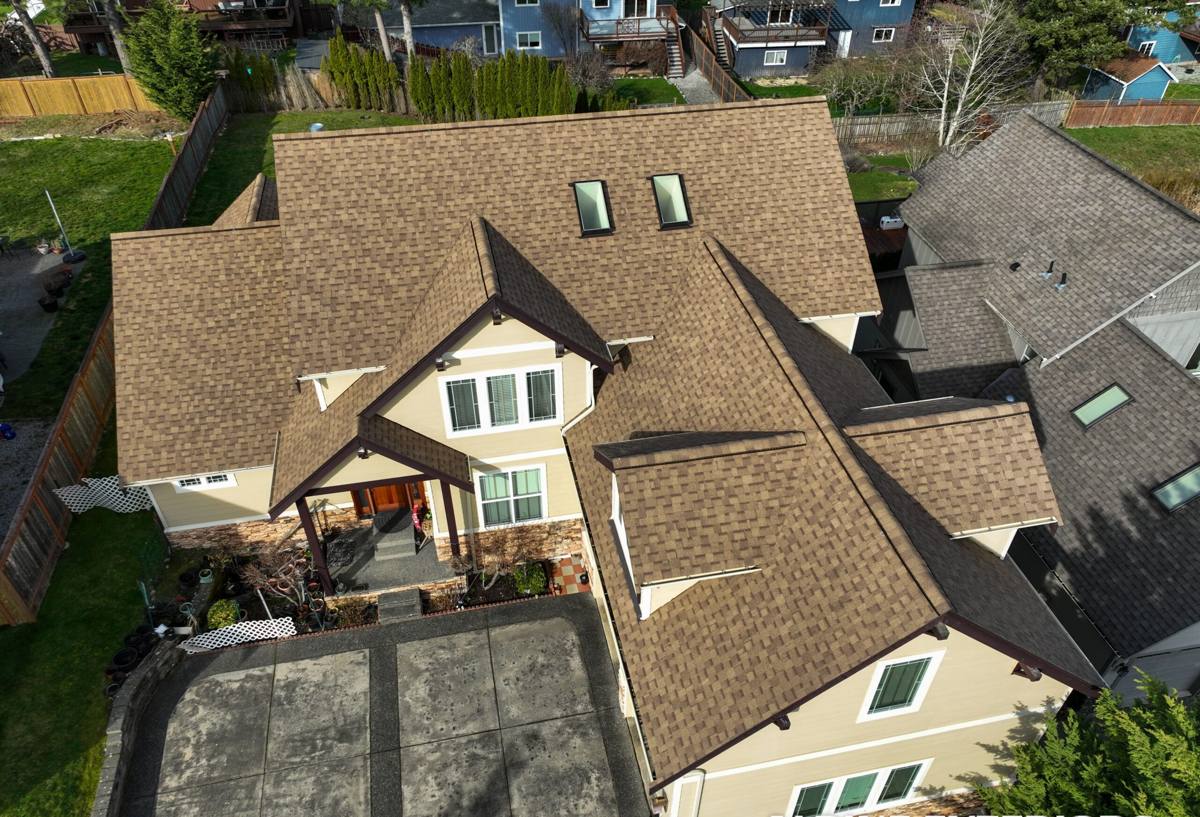
What a Correct New Roof Installation Actually Involves
"New roof" gets used loosely. A real replacement is a sequence of steps, and skipping or shortcutting any one of them is where problems start five or ten years later, not five or ten weeks later — which is exactly why it's tempting to cut corners.
Full Tear-Off and Deck Inspection
We remove the old roofing down to the deck rather than layering over it. That's the only way to actually see the plywood or plank decking underneath. In this climate, decking near valleys, chimneys, and old vent boots is where we most often find soft or delaminated wood from years of slow leaks that never showed up as a stain on the ceiling. Any compromised sheathing gets replaced before anything else happens — installing new roofing over a weak deck just hides the problem and shortens the life of everything above it.
Underlayment and Moisture Protection
Given how much of the year this area sits under damp air, we use synthetic underlayment as the standard base layer, with self-adhered ice-and-water membrane at the eaves, valleys, and any roof-to-wall transitions — the spots where wind-driven rain is most likely to find a way under the surface layer. This isn't an upgrade we push as an add-on; it's what a roof in this climate needs to actually perform for its expected lifespan.
Flashing Details That Matter Most Here
Flashing around chimneys, skylights, dormers, and sidewalls is where most roof leaks actually originate, not in the field of the shingles. We replace flashing rather than reuse it, and we pay particular attention to step flashing at wall intersections and kickout flashing where a roof edge meets a wall — a spot that's easy to miss and, when missed, sends water directly into the wall assembly instead of off the roof.
Ventilation That Matches the Roof
Proper intake and exhaust ventilation keeps the attic space at roughly the same temperature and humidity as the outside air. In a climate this damp, poor ventilation doesn't just waste energy — it traps moisture in the attic, which shows up as condensation on the underside of the decking and can rot framing from the inside where nobody's looking. We size and balance ventilation to the specific roof, not a generic rule of thumb.
Material Options for Nooksack-Area Homes
Most homes in this area are roofed in either architectural asphalt shingles or standing-seam metal, with a smaller number of synthetic or composite products in the mix. Each has real tradeoffs once you factor in moss resistance, upfront cost, and how the material behaves under sustained damp conditions rather than just its rated lifespan on paper.
| Material | Typical Lifespan Here | Moss/Algae Resistance | Relative Upfront Cost |
|---|---|---|---|
| Architectural asphalt shingle | 20–30 years | Moderate; benefits from copper/zinc strips or algae-resistant granules | Lowest |
| Standard 3-tab asphalt shingle | 15–20 years | Lower; more prone to granule loss in wet, mossy conditions | Low |
| Standing-seam metal | 40–60 years | High; smooth surface sheds moss and debris well | Highest |
| Synthetic/composite shingle | 30–50 years | Moderate to high, varies by product | Mid to high |
We don't push one material as universally right. A lower-slope roof shaded by tall firs is a different situation from an open, south-facing roof getting more sun and drying time. We'll walk the specific roof with you and explain which factors actually apply to it before recommending a product.
Moss, Algae, and What Happens After Installation
No roofing material is immune to moss in this environment — the question is how much maintenance it needs and how forgiving it is if that maintenance slips. Moss holds moisture against the roofing surface, and over years that moisture works its way under shingle edges and granule layers, accelerating wear well ahead of the material's rated lifespan. A new roof done right includes zinc or copper strips near the ridge on shingle roofs, which release trace metals that inhibit moss growth as rain washes over them — a low-maintenance defense that works passively rather than requiring annual treatment.
We also make sure gutters, downspouts, and any roof-to-deck transitions are clear and functioning at handoff, since standing water and trapped debris are what let moss get a foothold in the first place. None of this replaces periodic inspection, but it meaningfully extends the interval between problems.
Our Installation Process, Start to Finish
Every job follows the same sequence, whether it's a straightforward gable roof or something with multiple valleys and dormers:
- On-site inspection and measurement, including a look at the attic space and current ventilation setup
- Written estimate detailing material options, scope, and a realistic timeline
- Material order and scheduling, with weather windows factored in given how often rain moves through this area
- Tear-off, deck inspection, and any necessary sheathing repair
- Underlayment, ice-and-water membrane, and new flashing installation
- Roofing material installation per manufacturer specification
- Ridge and ventilation components, moss-inhibiting strips where applicable
- Full site cleanup, including magnetic sweep for nails and debris removal
- Final walkthrough with the homeowner before we consider the job done
Before we leave a job site, we go through the same checklist every time:
- Deck free of soft spots, properly fastened, no exposed old nails
- Flashing sealed and lapped correctly at every penetration and wall transition
- Ventilation intake and exhaust balanced and unobstructed
- Shingle or panel lines straight, exposure consistent across the whole roof
- Gutters and downspouts clear and properly pitched
- Yard, driveway, and landscaping cleared of debris and stray fasteners
Permits, Codes, and Local Conditions
Roof replacement in unincorporated Whatcom County and within Lynden city limits typically requires a permit, and inspections check things like proper flashing, ice-barrier placement at eaves, and ventilation. We handle the permit process as part of the job rather than leaving it to the homeowner, and we build inspection timing into the schedule so it doesn't add delay. Wind exposure is also a real design factor here — open, elevated lots in this part of the county can see stronger sustained gusts than more sheltered in-town lots, which affects fastening patterns and, on some jobs, the choice of material.
Why a Crew That Already Works This Area Matters
Roofing crews that mostly work drier inland climates or dense urban areas make assumptions that don't hold up here — lighter underlayment specs, less attention to valley and wall-transition flashing, ventilation sized for a different humidity profile. A crew that regularly works Lynden and the surrounding Nooksack area already knows which details get skipped elsewhere and can't be skipped here. That translates into fewer callbacks, fewer surprises during tear-off, and a roof that's actually specified for the conditions it has to survive rather than a generic regional average.
It also means faster, more accurate estimates. We're not guessing at local permit requirements, typical wind exposure, or how a given roof pitch and orientation will hold up to moss — we've already seen the pattern on similar homes nearby.
Cost Factors Worth Understanding Upfront
Roof replacement pricing is driven by a handful of variables, and understanding them helps make sense of why two seemingly similar roofs can come in at different numbers.
| Factor | Why It Affects Cost |
|---|---|
| Roof size and number of planes | More material and more edges, valleys, and transitions to detail |
| Pitch and access | Steeper or harder-to-access roofs take longer and require more safety setup |
| Deck condition | Rotten or soft sheathing found during tear-off adds material and labor |
| Material choice | Asphalt, metal, and synthetic products carry different upfront costs |
| Number of penetrations | Chimneys, skylights, and vents each need individual flashing work |
We give a firm written estimate after seeing the roof in person, not a phone quote, because the deck condition and flashing details aren't visible from the ground or from photos.
Signs a Nooksack-Area Roof May Need Replacing Rather Than Repair
Not every roof problem calls for full replacement, but there are signals that repair is only delaying the inevitable: granule loss heavy enough to see in gutters, shingles that are cupping or curling across large sections, soft spots when walking the roof, daylight visible through the attic decking, or moss so established it's lifting shingle edges rather than just sitting on the surface. If a roof is past the midpoint of its expected lifespan and showing more than one of these signs at once, we'll say so plainly and explain why, rather than stringing along repairs on a roof that's genuinely done.
If you're weighing a new roof for a home in or around Nooksack, we're glad to come take a look and give you a straight answer — no pressure, no inflated urgency, just what the roof actually needs. Use the form below to request a free estimate.