 Lynden Siding
 Why Maple Falls Homes Need a Different Approach to Siding
Maple Falls sits in one of the wetter, mossier corners of Whatcom County, and homes here take on a specific combination of punishment that a lot of siding products simply weren't built to handle. You've got moisture that lingers in the air for months at a time, wind-driven rain that gets pushed sideways into wall assemblies, and a moss and algae season that can run from early fall through late spring depending on the year. Add tree cover, shaded north-facing walls that never fully dry out, and the salt-tinged marine air that rolls in off the Puget Sound corridor, and you have a climate that finds every weak point in a siding system within a few years, not a few decades.
We install fiber cement siding on homes in and around Maple Falls because it's the one product category that's actually engineered for this kind of exposure. Specifically, we install James Hardie products exclusively. We don't install vinyl, LP SmartSide, Cemplank, Allura, or bare cedar or spruce — not because those products don't have a place somewhere, but because we've made a standard for what goes on the homes we work on, and Hardie's fiber cement, factory finish, and climate-specific product engineering is what meets it.
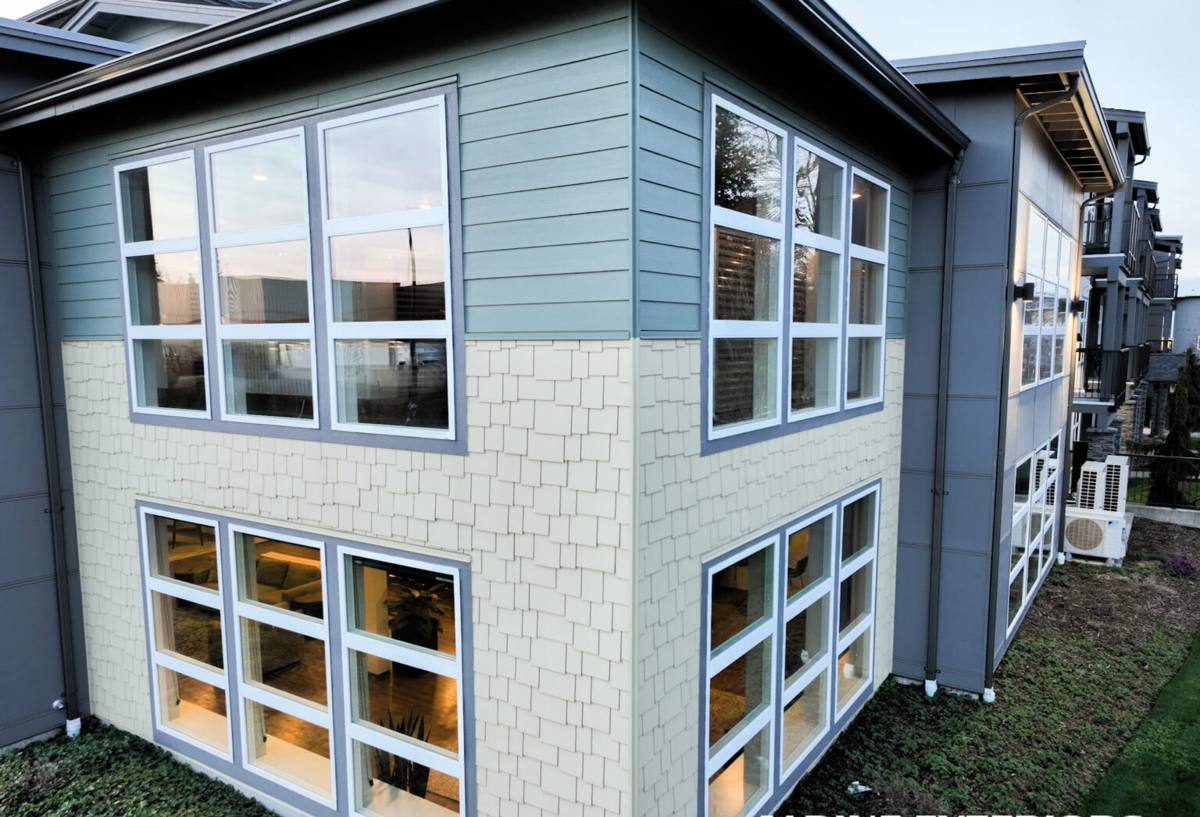
What This Climate Actually Does to Siding
Moisture That Doesn't Leave
Whatcom County's rain isn't just frequent, it's prolonged — low-intensity rain that soaks into anything porous over days, not minutes. Wood-based siding products absorb that moisture at the cut edges and fastener points, swell, and eventually delaminate or rot from the inside out. Fiber cement doesn't absorb water the same way; it's manufactured from cement, sand, and cellulose fiber, which means it doesn't swell, warp, or wick moisture along its length the way wood-based composite products can.
Moss, Algae, and Shade
Homes tucked under tree cover near Maple Falls often have entire wall sections that see direct sun for only a few hours a day, if that. Moss and algae take hold on any surface that stays damp, and once established, they hold moisture against the substrate and accelerate whatever decay process is already underway. A factory-applied finish that resists moisture penetration at the surface makes a real difference here — it's a lot easier to keep a hard, sealed surface clean than to keep bare or field-painted wood grain clean.
Wind-Driven Rain and Salt Air
This part of Whatcom County gets enough marine influence that homeowners closer to the water deal with salt-laden air working on fasteners, trim, and finishes. Combined with wind-driven rain during winter storm systems, siding here needs to shed water at laps and joints reliably, not just resist it in a lab test. Correct installation — proper lap dimensions, flashing, and fastening — matters as much as the material itself.
Why We Only Install James Hardie
Homeowners sometimes ask why we don't offer a cheaper alternative. The honest answer is that we used to see the callbacks. Vinyl siding can warp and gap in temperature swings and doesn't hold up well to impact in cold weather. Engineered wood products like LP SmartSide depend on an unbroken factory coating and careful field sealing at every cut — any breach lets moisture in, and moisture is the one thing this climate has in abundance. Fiber cement competitors to Hardie, like Cemplank or Allura, are similar products on paper, but we standardized on Hardie for the combination of their ColorPlus factory finish, their HZ5 product engineering for wetter climates, and a warranty structure we can stand behind when we hand a homeowner the paperwork.
Fiber cement itself is non-combustible, doesn't feed pests like carpenter ants or woodpeckers looking for soft wood, and holds paint and factory finish far longer than wood-based products because it doesn't move seasonally the way wood does. That stability is what keeps caulk joints and finish intact for decades instead of years.
James Hardie Product Lines That Fit This Area
- HardiePlank lap siding — the most common choice for Maple Falls homes, available in several profiles and exposures to match traditional Northwest architecture
- HardiePanel vertical siding — often used for accent gables, shop buildings, or a board-and-batten look on additions
- HardieTrim — non-combustible trim boards that won't rot at corners and window returns the way wood trim does
- ColorPlus finish options — factory-baked color that resists fading and holds up to UV and moisture better than field-applied paint
What a Correct Fiber Cement Installation Involves
The product only performs as well as the install. On homes near Maple Falls, we pay particular attention to the details that matter most in a wet, shaded climate:
- Water-resistive barrier and flashing first. Every window, door, and penetration gets properly flashed and integrated with the house wrap before any siding goes up — this is the layer that actually keeps bulk water out, not the siding surface alone.
- Correct lap and fastening. Hardie specifies minimum overlaps and fastener placement for a reason; under-lapped courses or over-driven nails are two of the most common causes of early failure we see when we're asked to look at someone else's install.
- Ground and hardscape clearance. Siding installed too close to grade, decks, or patios stays wet longer and invites moss and rot at the bottom course — we hold proper clearance even when it means adjusting trim details.
- Caulking and sealing at cut edges. Factory edges are sealed; field cuts need to be primed and sealed per manufacturer spec, especially on a home that will see months of standing damp air.
- Ventilation behind the cladding. A rainscreen gap where appropriate lets any moisture that does get behind the siding actually dry out, instead of sitting against the wall sheathing.
Our Process for Maple Falls Projects
Assessment
We start with a walk-around of the home, checking existing siding condition, moisture damage at trim and corners, moss buildup patterns, and how the home's orientation and tree cover affect different walls. This tells us where the real risk is, not just where the siding looks worn.
Scope and Product Selection
We talk through plank profile, exposure, and color with the homeowner, factoring in HOA or neighborhood expectations where relevant and how much sun exposure each wall gets, since that affects finish and color longevity discussions.
Tear-Off and Prep
Old siding comes off down to the sheathing where a full replacement is the right call, giving us a chance to inspect and repair any sheathing damage before it's covered up again — a step that's easy to skip and expensive to regret later.
Installation
Barrier, flashing, then siding, following Hardie's fastening and lap specifications exactly, with trim and caulking details built for a climate that stays wet for long stretches of the year.
Final Walkthrough
We review the finished work with the homeowner, covering basic care and what to expect from the ColorPlus finish over time.
Cost Factors for Maple Falls Homes
| Factor | Why It Matters Here |
|---|---|
| Home size and wall complexity | More corners, gables, and dormers mean more cutting, flashing, and labor time |
| Existing damage behind old siding | Shaded, moss-prone walls often have hidden sheathing repair needs discovered at tear-off |
| Plank profile and exposure | Different HardiePlank profiles carry different material and install costs |
| Trim scope | Full trim replacement in HardieTrim adds cost but removes a common rot point |
| Access and site conditions | Tree cover, slope, and driveway access around Maple Falls properties affect staging and labor time |
Maintenance Homeowners Should Expect
- Rinse siding periodically to keep moss and algae from establishing, especially on shaded or north-facing walls
- Keep gutters clear so overflow doesn't run down and sit against siding courses
- Trim back vegetation and tree limbs that keep wall sections damp and shaded
- Inspect caulking at trim joints every year or two and recaulk as needed
- Address any impact damage or chipped finish promptly rather than letting moisture find its way in
Compared to wood-based or vinyl siding, this is a shorter maintenance list — fiber cement with a factory finish simply asks less of the homeowner over the years it's on the wall.
Why Hire a Crew That Already Works This Area
Maple Falls and the surrounding Lynden-area homes aren't identical to jobs closer to Bellingham or out on the coast — the tree cover, drainage patterns, and moss pressure here are their own thing, and a crew that's worked these conditions knows where to spend extra attention before problems start. We're not guessing at flashing details or lap exposure based on a spec sheet; we're applying what we've seen hold up, and what hasn't, on homes facing this exact combination of rain, shade, and moss season.
If you're weighing a siding replacement or repair on a Maple Falls home, we're happy to take a look and talk through what your specific walls and exposure actually need — no pressure, no upsell to a product we don't stand behind. Reach out for a free estimate using the form below.