 Lynden Siding
 Windows Built for Kendall's Climate, Not Just the Showroom
Kendall sits in the foothills stretch of Whatcom County, north and east of Lynden, where the weather off the Pacific and the Nooksack valley combine to keep everything wetter, longer, than most homeowners expect. Driving rain that comes in sideways during winter storms, humid air that never quite dries out between fronts, and a moss season that can run from October through May all put steady pressure on window assemblies. A window that looks fine in a dry showroom can fail quietly here — not because the glass is bad, but because the flashing, sealant, and frame material weren't chosen or installed for this specific climate.
Window replacement in Kendall isn't just a cosmetic upgrade. It's a chance to correct water management details that may have been wrong from the original build, especially on older homes where flashing tape wasn't standard practice and builder-grade windows were installed with minimal weatherproofing.
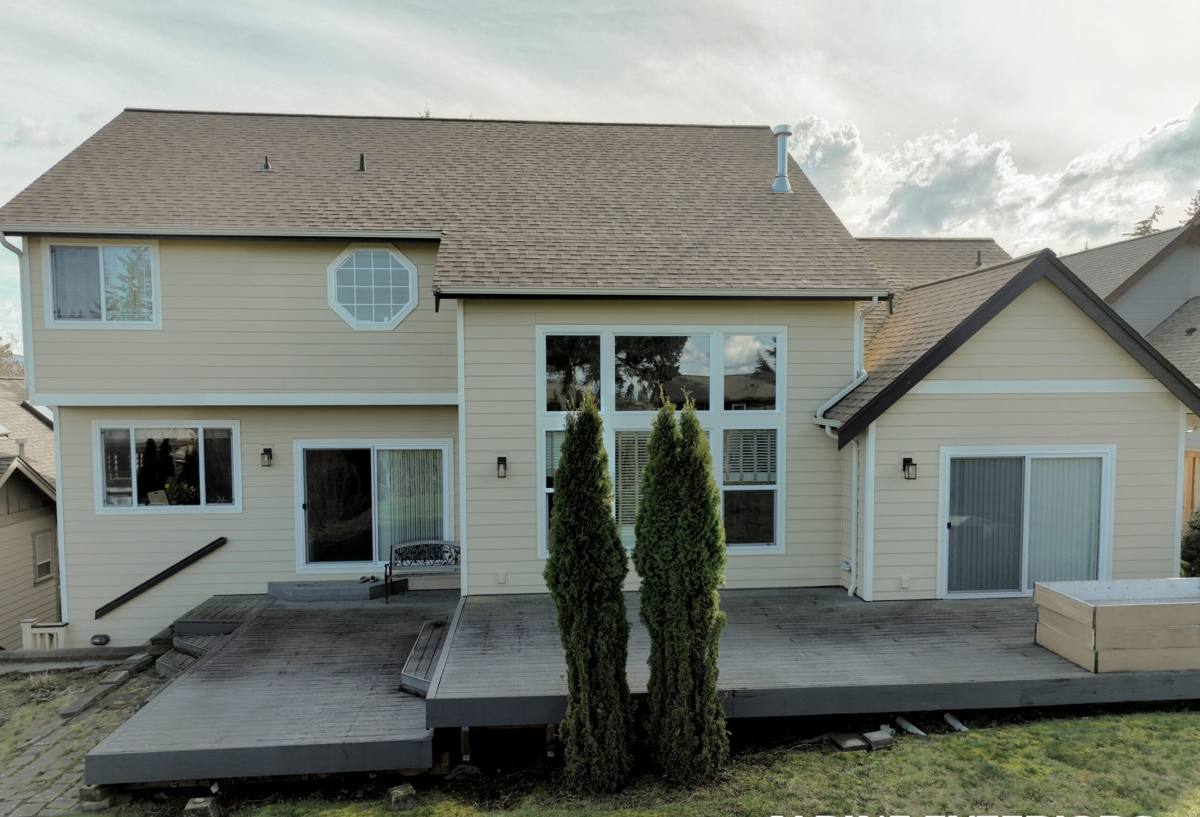
Signs a Kendall Home Needs Window Replacement
Because moisture problems in this region develop slowly, most homeowners don't notice a failing window until the damage has already spread into the wall. Here's what to check for, especially heading into another wet season:
- Fogging or a permanent haze between the panes — the sealed unit has failed and lost its insulating gas
- Soft or discolored wood on the interior sill or exterior trim
- Visible moss or dark streaking building up on the sill, casing, or brick mold
- Drafts you can feel at the frame edge, even with the window latched shut
- Difficulty opening, closing, or locking — frames swell and warp when they've absorbed moisture
- Condensation collecting on the inside of the glass regularly through fall and winter
- Paint that keeps failing on the trim no matter how often it's redone
Any one of these on its own might just need minor repair. Two or more together, especially on a window that's original to the house, usually means the assembly itself is compromised and replacement is the more honest fix.
What a Correct Window Replacement Job Actually Involves
Swapping in a new window is the easy part. The work that actually determines whether it holds up through a Whatcom County winter happens around the opening, not in the unit itself.
Removing the Old Window Without Guessing
Before anything new goes in, we pull the old unit and inspect the rough opening — sill, jack studs, header, and sheathing — for rot or hidden moisture. If a previous installation was sealed poorly, this is usually where we find it. Any damaged framing gets addressed before a new window goes anywhere near the opening.
Flashing and Water Management
This is the step that separates a window that lasts fifteen-plus years from one that starts leaking in three. Proper sill pan flashing, correctly lapped house wrap, and sealed integration with the water-resistive barrier are non-negotiable in a climate that sees this much driving rain. Sealant is a backup, not the primary defense — the flashing detail does the real work.
Setting, Shimming, and Insulating
The window has to be level, plumb, and square, then shimmed at the right points so it doesn't rack over time. The gap between the frame and rough opening gets insulated (typically low-expansion foam) to control both air leakage and condensation — overfilling with high-expansion foam can bow the frame, so this step matters more than it looks.
Exterior Trim and Final Sealing
Trim gets reset or replaced, caulked at the right joints (not every joint — some need to stay open to let moisture escape), and finished to match the home. A rushed trim-out is one of the most common reasons a technically good window still leaks a year later.
Choosing the Right Window for a Kendall Home
Frame material matters more in this climate than most homeowners assume, since it's constantly cycling between damp and dry. Here's how the common options actually compare for a Kendall installation:
| Frame Material | Moisture Behavior | Maintenance | Typical Fit |
|---|---|---|---|
| Vinyl | Won't rot or corrode; expands/contracts with temperature | Low — occasional cleaning | Most homes; best value for full-house replacement |
| Fiberglass | Very stable in wet/dry cycling, minimal expansion | Low | Homes wanting a stronger frame with less flex over time |
| Wood-clad | Good if the cladding and seals stay intact; wood core vulnerable if breached | Higher — watch cladding seams and sills | Homes prioritizing a wood interior look |
| Aluminum | Conducts cold, prone to condensation without a thermal break | Moderate | Limited use; we typically steer away from it for full residential replacements here |
We don't push one brand or material on every job. The right call depends on the specific opening, the home's exposure to wind-driven rain, and what the homeowner wants to maintain long-term. What we do insist on is glass and frame performance suited to a wet coastal-influenced climate — that's a standard we apply regardless of budget tier.
Glass Packages Worth Considering
Double-pane, low-E glass is the baseline we recommend for any Kendall replacement — the coating helps manage heat loss through the long, gray stretches of winter. Homes with more direct west or south exposure sometimes benefit from a slightly different low-E coating tuned for solar heat gain rather than pure insulation. Triple-pane is available and does add performance, but for most Kendall homes the jump in cost isn't matched by a proportional jump in comfort — we'll tell you honestly if we think it's worth it for your specific situation rather than defaulting to the upsell.
Our Window Replacement Process
- On-site assessment — we look at every window being considered, not just the ones you've flagged, and check framing condition while we're at it
- Honest recommendation — replace, repair, or leave alone; we're not incentivized to push more work than a home needs
- Written estimate — clear scope, material choices, and pricing with no vague allowances
- Scheduled installation — sequenced to limit how long any opening sits exposed to weather
- Flashing and framing correction — any rot or prior installation errors are fixed as part of the job, not treated as a change order surprise
- Final walkthrough — operation, sealing, and trim checked with you before we consider the job done
What Window Replacement Typically Costs
Pricing depends on window count, size, material, and how much framing repair is needed once we open the wall. Broad factors that move the number:
| Factor | Effect on Cost |
|---|---|
| Frame material (vinyl vs. fiberglass vs. wood-clad) | Vinyl is typically the most economical; wood-clad the most expensive |
| Hidden rot found during removal | Adds framing/sheathing repair before the new window can be set |
| Window size and style (single-hung vs. casement vs. large picture units) | Larger and operable multi-point-lock units cost more than basic fixed units |
| Number of windows done at once | Whole-house replacement typically has a better per-window cost than one-off swaps |
| Trim and siding integration | Matching existing trim or siding profiles adds labor |
We'd rather give you a real, itemized number after seeing the openings than a rough figure over the phone that doesn't hold up once we're on-site.
Why Hiring a Crew That Already Works Kendall Matters
A lot of window problems in this area trace back to installers who treated Kendall the same as a drier inland climate — using standard flashing details that don't account for how much wind-driven rain actually hits these homes through fall and winter. A crew that regularly works Whatcom County knows which elevations take the worst of the weather, how moss buildup on a sill accelerates rot if it's not addressed, and where builder-grade shortcuts tend to show up in homes of a certain era. That familiarity shows up in fewer callbacks, not in the sales pitch.
Keeping New Windows Performing Long-Term
A correctly installed window still needs some basic upkeep in this climate:
- Clear moss and debris off sills and tracks before it holds moisture against the frame
- Check exterior caulking annually, especially after a hard winter
- Keep weep holes on vinyl and fiberglass frames clear so water can drain out properly
- Watch interior sills each winter for early condensation — a sudden change can flag a seal issue
None of this is heavy maintenance, but skipping it is how a good installation slowly turns into a bad one.
If you're seeing drafts, fogged glass, or sticking frames on a Kendall property, we're glad to take a look and give you a straight answer on what's actually needed — no pressure, no upsell for its own sake. Fill out the form below for a free estimate.