 Lynden Siding
 Building a Deck in Custer That Actually Holds Up
Custer sits close enough to the water that a deck here deals with a different set of problems than one built further inland. The combination of salt-laden air off the Strait, long stretches of driving rain through fall and winter, and a moss season that can run five or six months out of the year means a deck built to a generic spec sheet will show its age fast. We build decks for this specific stretch of Whatcom County, and the choices we make on framing, fasteners, and decking material are shaped by what this climate actually does to wood and metal over time, not just what looks good on install day.
A deck is one of the few structures on a property that takes weather from every direction at once — sun overhead, rain from above, splash-back from below, and in Custer's case, a steady drift of salt air that settles into anything metal. Getting it right up front matters more here than in a lot of places, because the cost of getting it wrong shows up as soft framing, rusted hardware, and a slick, moss-covered surface within a few seasons.
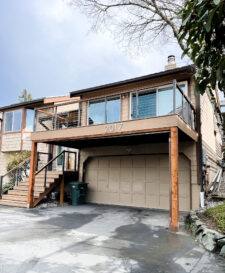
What Salt Air and Moss Season Do to an Improperly Built Deck
Two forces do most of the damage to decks in this part of Whatcom County, and they work on different parts of the structure.
Salt Air and Corrosion
Salt air accelerates corrosion on fasteners, brackets, and any exposed metal connectors. A deck built with standard hot-dipped galvanized hardware instead of coastal-rated stainless or heavier-coated fasteners can start showing rust streaks and weakening connections well before the wood itself is a problem. The failure is often invisible until it isn't — a ledger board connection or a joist hanger corroding from the inside doesn't announce itself the way surface rust does.
Moss, Algae, and Standing Moisture
A long moss season means anything that stays damp for extended periods becomes a growth surface. Decking boards laid without enough gap for airflow, framing without proper drainage below, and shaded areas under trees or on the north side of a house all become prime spots for moss and algae buildup. Beyond the slip hazard, sustained moisture against wood decking or framing is what drives rot, especially at butt joints, around fastener heads, and anywhere water can pool instead of shed.
Neither of these problems is dramatic in year one. They show up in year three or four as a deck that feels spongy in spots, hardware that's visibly rusting, or a surface that stays green and slick long after the rest of the yard has dried out.
Footings, Framing, and Ledger Attachment
The parts of a deck nobody sees are the parts that matter most for longevity, and they're also the parts most likely to get shortcut on a lower-quality build.
- Footings: Footings need to be sized and set to local frost depth requirements and bear on undisturbed or properly compacted soil — not just poured into whatever hole was convenient to dig.
- Ledger board attachment: Where the deck ties into the house is the single most common failure point on decks generally, and it's a bigger deal in a wet climate. Proper flashing behind and over the ledger keeps water from working its way into the house rim joist, which is a rot and structural problem, not just a deck problem.
- Joist spacing and hardware: Correct spacing for the decking material being used, plus corrosion-resistant joist hangers and structural screws rated for exterior and ground-contact use where applicable.
- Post-to-beam and beam-to-footing connections: These need mechanical connectors, not just fasteners, to meet current structural expectations and hold up under wind and load over time.
None of this is visible once the decking goes down, which is exactly why it's worth asking a contractor to walk through it before the boards cover it up.
Choosing Decking Material for a Custer Property
There's no single right answer on decking material — it depends on budget, how much upkeep you want to do, and how exposed the deck is to sun, shade, and moisture. Here's how the common options actually compare for a coastal Whatcom County property:
| Material | Upfront Cost | Maintenance | How It Handles This Climate |
|---|---|---|---|
| Pressure-treated pine | Lowest | Needs regular sealing/staining | Affordable and strong, but requires diligence — skipped maintenance shortens its life in a wet climate |
| Cedar | Mid | Periodic sealing to hold color and resist moisture | Naturally moisture- and insect-resistant, ages gracefully, but still needs upkeep against moss and graying |
| Composite decking | Higher | Low — occasional washing | Resists rot and moisture absorption well; still needs airflow underneath to discourage moss and mildew on the surface |
| PVC/capped composite | Highest | Lowest | Best moisture resistance of the group; a solid choice for shaded or heavily rain-exposed sections |
We'll walk through the honest trade-offs for your specific site — sun exposure, shade from trees, how close you are to the water, and how much maintenance you actually want to do — rather than push one material as a default.
Fasteners and Hardware: The Detail Most Decks Get Wrong
This is worth its own section because it's the detail that's easiest to shortcut and hardest to fix after the fact. In a coastal-influenced climate like Custer's, we use fasteners and structural hardware rated for the exposure — stainless steel or heavy-coated exterior-rated connectors rather than standard interior-grade or minimally coated options. The price difference between standard and coastal-rated hardware on a typical deck is small relative to the total project cost. The difference in how the deck performs after five winters of salt air and rain is not small.
Mixing metals matters too — using the wrong fastener with certain decking or flashing materials can accelerate corrosion through galvanic reaction. We match hardware to material intentionally, not by whatever's in the bin.
Drainage, Airflow, and Keeping Moss Off the Deck
Moss control starts with design, not chemicals applied after the fact. A few things make a real difference on a Custer property:
- Adequate gap between decking boards so water sheds through instead of sitting on the surface
- Enough clearance and airflow underneath the deck so the framing can actually dry out between rain events
- Grading and drainage below the deck so water doesn't pool under the structure
- Thoughtful placement and orientation where trees or the house cast heavy, near-permanent shade
- Material selection that accounts for how much sun a given section of the deck actually gets
A deck built with these details right needs far less scrubbing and far fewer moss treatments over its life than one that wasn't.
Permits and Inspections in Whatcom County
Most deck builds of meaningful size require a permit, and depending on height, attachment to the house, and other factors, an inspection process as well. We handle the permitting side of the job as part of the build — pulling the right permit, building to the structural requirements that will pass inspection, and not cutting corners that would need to be undone later. Skipping this step to save time up front is one of the more common ways homeowners end up with problems at resale or during insurance claims.
Our Process for a Custer Deck Build
1. On-Site Assessment
We look at sun exposure, drainage, existing structure if it's a rebuild or attachment to a house, and how the site is oriented relative to weather and shade.
2. Material and Design Conversation
An honest walk-through of decking and hardware options for your budget and how much maintenance you want to take on, based on what actually holds up in this climate rather than what's cheapest to quote.
3. Permitting
We handle the permit application and design to meet the structural and inspection requirements that apply.
4. Build
Footings, framing, flashing, and fastener choices are handled with the coastal exposure and moisture load in mind at every stage — not just the visible decking layer at the end.
5. Walkthrough
We go over basic care for whatever material was chosen, so you know what upkeep to expect and what's actually optional.
Why a Crew That Already Works Custer Matters
A deck built by a crew that hasn't worked this specific stretch of coastline before is more likely to default to generic specs — standard hardware, standard fastener spacing, standard assumptions about how much moisture the structure will see. A crew that already builds and repairs decks around Lynden and Custer has seen firsthand what salt air does to the wrong hardware and what a long moss season does to a deck without enough airflow underneath. That's not something you can fully compensate for with a manufacturer's spec sheet alone — it comes from working the material in this specific climate, repeatedly, and adjusting the build accordingly.
It also matters for permitting — knowing the local process and what inspectors are looking for saves time and avoids surprises partway through the build.
Get a Free Estimate for Your Custer Deck
If you're planning a new deck or replacing one that's showing its age, we're happy to come take a look and talk through what makes sense for your property — no pressure, no pushy upsell. Fill out the form below and we'll set up a time to walk the site with you.