 Lynden Siding
 Siding in Kendall Has to Handle a Different Kind of Weather Load
Kendall sits up against the foothills northeast of Lynden, and homes out here take a beating that's easy to underestimate if you're only comparing notes with someone closer to town. You've got the same Whatcom County moisture load as everywhere else in the valley, but Kendall adds more exposure to wind-driven rain off the higher ground, longer shaded stretches under tree cover that keep siding damp longer after a storm passes, and a moss and algae season that can run eight or nine months out of the year. Add in the salt-tinged marine air that reaches this far inland on a west wind, and you've got a combination that punishes any siding material that isn't dimensionally stable and properly sealed at every seam.
This is the environment James Hardie siding was engineered for. It isn't marketing — it's the reason we install nothing else. Fiber cement doesn't swell, cup, or delaminate the way wood-based products can when they take on repeated moisture cycles, and it gives us a manufactured, factory-controlled substrate to build a correct water-management system around. In a spot like Kendall, that consistency matters more than it does somewhere drier.
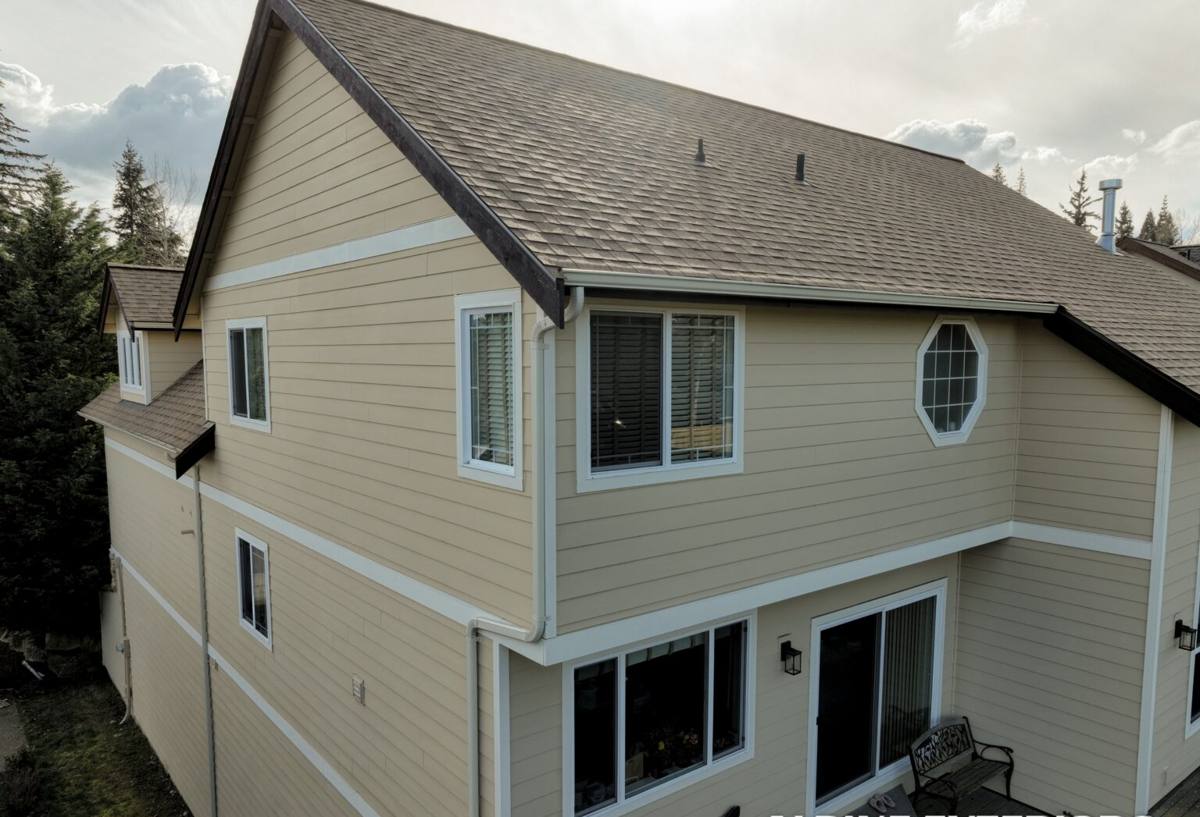
What Kendall's Climate Actually Does to a House
Moss and Algae Pressure
Anywhere with tree cover and persistent shade in Whatcom County grows moss on siding, roofing, and trim. On wood-based or poorly finished siding, moss and algae hold moisture directly against the substrate, and that's where rot and paint failure start. James Hardie's ColorPlus factory finish is baked on and far more resistant to the kind of surface breakdown that gives moss and mildew something to grip and feed on, and it holds up to periodic gentle cleaning without stripping down to bare substrate the way a field-applied paint job can.
Driving Rain and Wind Exposure
Kendall's proximity to higher terrain means storms often arrive with more horizontal force than they do lower in the valley. Wind-driven rain gets pushed sideways into wall assemblies, seams, and butt joints — anywhere water can find a gap, it will. This is a flashing and installation-detail problem as much as a material problem, which is why the install matters as much as the product.
Salt Air, Even This Far Inland
Homeowners are sometimes surprised that salt air is a factor this far from saltwater, but Whatcom County's proximity to Puget Sound and the Strait means airborne salt does travel with prevailing winds, especially during fall and winter storm systems. Salt-laden moisture accelerates corrosion on fasteners and trim and speeds up degradation of any coating that isn't built to handle it. James Hardie's factory finish and our use of corrosion-resistant fastening are both chosen with this in mind.
Why We Only Install James Hardie — Especially Out Here
We get asked fairly often why we don't offer LP SmartSide, vinyl, or cedar as alternatives. The honest answer is that in a climate like Kendall's, those products ask homeowners to take on maintenance burdens or moisture risks that James Hardie simply doesn't carry to the same degree.
- Vinyl can warp or become brittle with temperature swings and UV exposure over time, and it doesn't offer the same fire-resistance profile as fiber cement.
- Engineered wood siding (like LP SmartSide) performs well in a lot of climates, but any wood-based product is more sensitive to sustained moisture exposure at cut edges and seams than fiber cement is — and Kendall's moss season means sustained moisture exposure is the default, not the exception.
- Cedar and primed spruce look great on day one but require an ongoing repainting and sealing schedule that most homeowners underestimate, especially with the shaded, damp conditions common on wooded Kendall lots.
James Hardie fiber cement is non-combustible, dimensionally stable, and comes with a factory finish that's warrantied for decades rather than needing homeowner-applied maintenance every few years. That's the trade-off we made on purpose, and it's why it's the only product we put on houses.
What a Correct James Hardie Installation Actually Involves
The material is only half the equation. A huge share of siding failures we get called out to inspect — on any brand — trace back to installation shortcuts, not the product itself. On a Kendall job, here's what we treat as non-negotiable:
Water Management Behind the Siding
Correct weather-resistant barrier installation, properly lapped and taped house wrap, and rain-screen or drainage-gap detailing where the assembly calls for it. In a high-moisture pocket like Kendall, giving incidental water a way to drain and dry out behind the cladding is as important as keeping it out in the first place.
Flashing at Every Penetration
Windows, doors, hose bibs, light fixtures, and vent penetrations are the most common points of water intrusion on any home. Each one needs proper head flashing and integration with the weather barrier — not just caulk, which fails long before the siding does.
Fastening and Clearances to Spec
James Hardie publishes specific fastener types, spacing, and minimum clearances from grade, roofing, and decks. Skipping these — nailing too close to panel edges, using the wrong fastener for the substrate, or leaving insufficient ground clearance — voids warranty coverage and creates the exact wicking and moisture problems the product is designed to avoid.
Caulking and Joint Treatment
Butt joints and trim transitions need the right sealant, applied correctly, at the right stage of installation — not as an afterthought to hide a gap.
Our Process for a Kendall Job
- On-site assessment — we walk the exterior, check for existing moisture damage, moss buildup, and problem areas specific to the lot's shade and drainage pattern.
- Product and color selection — we help you choose the right James Hardie line and ColorPlus finish for the home's exposure and your style.
- Tear-off and substrate check — we remove the old siding and inspect sheathing for hidden rot or damage before anything new goes up, since covering a compromised substrate defeats the purpose of a new siding job.
- Weather barrier and flashing installation — this is the step that determines how the house performs in year ten, not just year one.
- Hardie installation to manufacturer spec — correct fastening, clearances, and joint treatment throughout.
- Final walkthrough — we go over the finished work with you before calling the job done.
Why Hiring a Crew That Already Works Kendall Matters
Kendall isn't a generic subdivision — it's a mix of older homes, larger wooded lots, and properties with varying sun and shade exposure that changes how each wall of the house weathers. A crew that's worked in the area knows which orientations tend to hold moss longer, where wind-driven rain typically causes the most wear, and how the local building department handles permitting for this part of unincorporated Whatcom County. That local familiarity translates into fewer surprises mid-project and a install that's actually built for the conditions your specific property faces, not a one-size-fits-all approach.
Cost Factors for a Kendall James Hardie Project
| Factor | Why It Affects Cost |
|---|---|
| Home size and wall complexity | More corners, gables, and dormers mean more cutting, flashing, and labor time |
| Existing siding removal | Tear-off of old wood or vinyl adds labor versus installing over new construction sheathing |
| Substrate condition | Hidden rot found during tear-off requires sheathing repair before siding can go on |
| Hardie product line | HardiePlank lap siding, HardiePanel, and HardieShingle carry different material and labor costs |
| Trim and accessory work | Fascia, soffit, and trim replacement alongside siding affects overall scope |
| Access and site conditions | Sloped or wooded lots, common in Kendall, can affect staging and scaffolding needs |
We don't quote broad numbers without seeing the house — every one of these factors shifts the estimate, and a proper quote comes from an actual site visit.
Signs Your Kendall Home May Already Need This Conversation
- Persistent moss or algae staining that returns quickly after cleaning
- Soft or spongy spots on wood siding, especially near the ground or under eaves
- Paint that's peeling, bubbling, or chalking heavily on one or two sides of the house
- Visible gaps, warping, or cupping in existing siding boards
- Rising energy bills that may point to a compromised weather barrier
- Siding that's original to a home built more than 20–25 years ago
If any of that sounds familiar, or you're just planning ahead for a Kendall property, we're happy to come take a look. Reach out for a free, no-pressure estimate — we'll walk the exterior with you, answer your questions honestly, and give you a straight read on what your home actually needs.