 Lynden Siding
 Blaine's Coastal Climate Is Hard on Siding
Blaine sits at the northern edge of Whatcom County, right up against the water and the Canadian border. That location gives homes here a different set of exterior problems than you'll find further inland. Salt-laden air off the Salish Sea works on metal fasteners and finishes year-round. Winter storms bring driving, wind-blown rain that doesn't just fall on a wall — it gets pushed sideways into every seam, joint, and trim gap. And the long stretch of grey, damp weather that defines a Whatcom County winter gives moss and algae months to colonize north-facing walls, shaded siding, and anywhere water sits instead of shedding.
None of this is unique to one house or one street — it's the baseline condition for exterior materials anywhere near this stretch of coastline. Siding that isn't built and installed for that reality tends to show it early: chalking finishes, rusted fastener heads bleeding through paint, soft spots where moisture got behind the cladding, and green-black staining that keeps coming back no matter how many times it's pressure washed off.
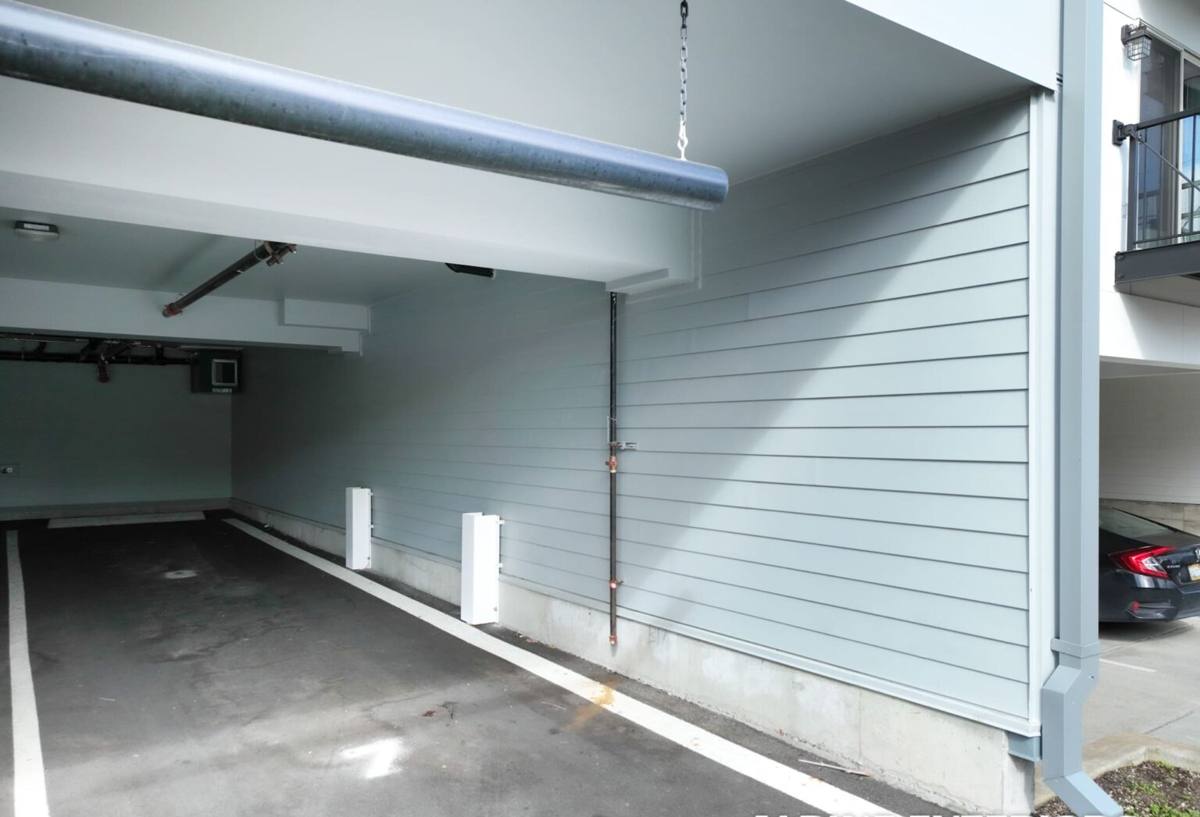
What Blaine Homes Actually Need From Their Siding
Given that climate, the material on the wall has a short list of real requirements, not marketing requirements:
- Dimensional stability — it can't swell, cup, or rot when it takes on repeated moisture exposure
- A factory-applied finish that resists salt air and UV fade rather than depending on field-applied paint
- Hardware and fasteners that hold up to a corrosive marine-influenced atmosphere
- A surface and installation detail that sheds wind-driven rain instead of trapping it
- Resistance to sustained dampness so moss and algae have less to grip onto
This is exactly the set of problems fiber cement siding was engineered to solve, which is why it's the only product we put on homes in this area.
Why We Install Only James Hardie Fiber Cement
We get asked fairly often why we don't offer vinyl, LP SmartSide, cedar, primed spruce, Cemplank, or Allura alongside Hardie. Each of those products has legitimate strengths — vinyl is inexpensive and low-maintenance in mild climates, engineered wood siding installs fast and takes paint well, cedar has a look some homeowners want that no composite fully replicates. But in a climate like Blaine's, each one carries a trade-off we're not willing to put our name behind: vinyl can warp and its seams give wind-driven rain a path in; engineered wood products rely on their outer coating staying intact, and any breach lets moisture into a wood-based substrate; cedar needs an ongoing maintenance commitment most homeowners don't keep up with once the first coat of stain fades.
James Hardie fiber cement is non-combustible, dimensionally stable in wet-dry cycling, and comes from the factory with a ColorPlus finish baked on rather than sprayed on-site — which matters directly here, since factory-cured finishes hold color and resist salt-air fade far longer than field-applied paint. Hardie also makes HZ5 product formulations specifically engineered for colder, wetter climate zones like the Pacific Northwest, and backs the material with a long transferable warranty that stays with the house if it sells. When it's installed to spec, it's the product we've seen perform best against exactly the conditions Blaine throws at a house.
What a Correct Fiber Cement Installation Actually Involves
Fiber cement is only as good as the installation behind it. The board itself resists moisture and salt air, but the assembly around it — flashing, clearances, fastening, sealing — is what actually keeps water out of the wall.
The details that matter most in a wet, salty climate
- A drainage plane or rainscreen behind the siding so any water that does get past the cladding has somewhere to go
- Proper head and kick-out flashing at every window, door, and roof-to-wall intersection
- Minimum ground clearance (typically 6 inches from grade, 2 inches from horizontal surfaces like decks and patios) so splash-back and standing water don't sit against the bottom edge
- Corrosion-resistant fasteners driven at the manufacturer's specified pattern and depth — not overdriven, not underdriven
- Factory-cut ends field-sealed or back-primed, since a raw cut edge is the one place the factory finish doesn't protect
- Joints staggered and caulked with a sealant rated for the exposure, not just whatever's on the truck
Common mistakes we see and correct
On tear-offs and repair calls in this area, the recurring failures are rarely the siding material itself — they're installation shortcuts. Overdriven nails that crack the board's fiber matrix. Missing kick-out flashing where a roof meets a wall, which sends roof runoff straight down behind the siding instead of out and away. Siding installed tight to a deck or grade with no clearance, which keeps the bottom course perpetually damp. And caulk used as a substitute for flashing rather than as a secondary seal — caulk fails, flashing sheds water permanently.
Our Process for a Blaine Siding Installation
- Assessment — we inspect existing siding, sheathing, and trim for moisture damage before quoting anything, since hidden rot changes the scope of the job
- Tear-off and sheathing check — old siding comes off and the sheathing underneath gets inspected and repaired as needed before anything new goes up
- Weather-resistive barrier — a new drainage plane goes on correctly lapped and taped, with flashing integrated at every penetration
- Hardie installation — installed to manufacturer fastening and clearance specs, not generic "close enough" spacing
- Trim, caulking, and touch-up finishing — factory-cut edges sealed, joints caulked, any field touch-up painted to match ColorPlus
- Final walkthrough — we go over clearances, flashing details, and care expectations with the homeowner before we consider the job done
James Hardie Product Lines We Use
| Product | Typical Use | Why It Fits Blaine |
|---|---|---|
| HardiePlank lap siding | Primary wall cladding | Most common profile; HZ5 formulation handles wet-dry cycling well |
| HardiePanel vertical siding | Accent walls, gable ends, modern facades | Fewer horizontal joints reduces water entry points on exposed elevations |
| HardieShingle siding | Accent/architectural detailing | Non-combustible alternative to cedar shingle look without the upkeep |
| HardieTrim boards | Corners, fascia, window/door trim | Matches the wall system's moisture performance instead of introducing a weaker material at the edges |
What It Costs
Every Blaine job is quoted after a walk-through, but the same handful of factors move the price on almost every siding project in this area:
| Cost Factor | Why It Matters |
|---|---|
| Home size and number of stories | More wall area and taller walls both add material and labor time |
| Removal of existing siding | Tear-off, disposal, and any sheathing repair found underneath add scope |
| Trim and architectural complexity | Dormers, multiple gables, and detailed trim work take more time than a simple rectangular wall |
| Moisture or rot damage discovered during tear-off | Rotted sheathing or framing has to be repaired before new siding can go on correctly |
| Site access and wind exposure | Homes closer to the water or on tighter lots can add setup and safety considerations |
Maintaining Fiber Cement in a Salt Air, Moss-Prone Climate
Fiber cement is low-maintenance compared to wood or engineered wood siding, but "low-maintenance" isn't "no-maintenance" — especially this close to the water. A short annual routine keeps it performing the way it's designed to:
- Rinse the exterior (garden hose pressure, not a pressure washer aimed at joints) once or twice a year to clear salt residue and organic buildup
- Check caulking around windows, doors, and trim annually and re-seal anywhere it's cracked or pulled away
- Clear gutters and downspouts before winter so overflow doesn't run down the wall face
- Trim back vegetation and tree cover that keeps a wall section shaded and damp, since that's where moss gets its foothold first
- Watch north-facing and shaded elevations for early moss or algae growth and address it before it spreads
- Have flashing and clearances checked periodically, since these — not the siding material — are usually where a moisture problem actually starts
Why Hiring a Crew That Already Works Blaine Matters
A lot of what separates a siding job that lasts twenty-plus years from one that fails in five isn't the material — it's whether the installer understands the specific conditions of the site. Crews who regularly work Blaine and the rest of Whatcom County already know which elevations take the worst wind-driven rain, where moss problems tend to start first, how to detail flashing for a wetter climate zone, and what Whatcom County permitting and inspection expect on a re-side. That local pattern recognition is the difference between a crew that installs siding correctly on paper and one that installs it correctly for this specific coastline.
If you're weighing a re-side in Blaine and want a straight answer on what your home actually needs, we're happy to walk the exterior with you, look at what's there now, and put together a free, no-pressure estimate.