 Lynden Siding
 Why Everson Roofs Wear Out Faster Than People Expect
Everson sits close enough to the Nooksack River bottomlands and the Whatcom County tree line that most homes here deal with three roofing stresses at once: near-constant damp shade from mature conifers, driving rain that comes sideways off wind out of the south and southwest, and enough marine air moving up from Bellingham Bay and the Salish Sea to keep metal fasteners and flashing working harder than they would inland. None of these alone is unusual for Western Washington. Together, on the same roof, for eight or nine wet months a year, they shorten the useful life of a poorly installed or poorly ventilated roof by years.
The most visible symptom is moss. Whatcom County's moss season effectively runs from October through May, and on north-facing slopes or roofs shaded by fir and cedar, it can be a near year-round presence. Moss itself isn't just cosmetic — it holds moisture against the roofing material, works into shingle tabs and shake gaps, and lifts edges just enough for wind-driven rain to get underneath. A roof that looks "mossy but fine" from the ground is often already losing granules or developing soft decking underneath.
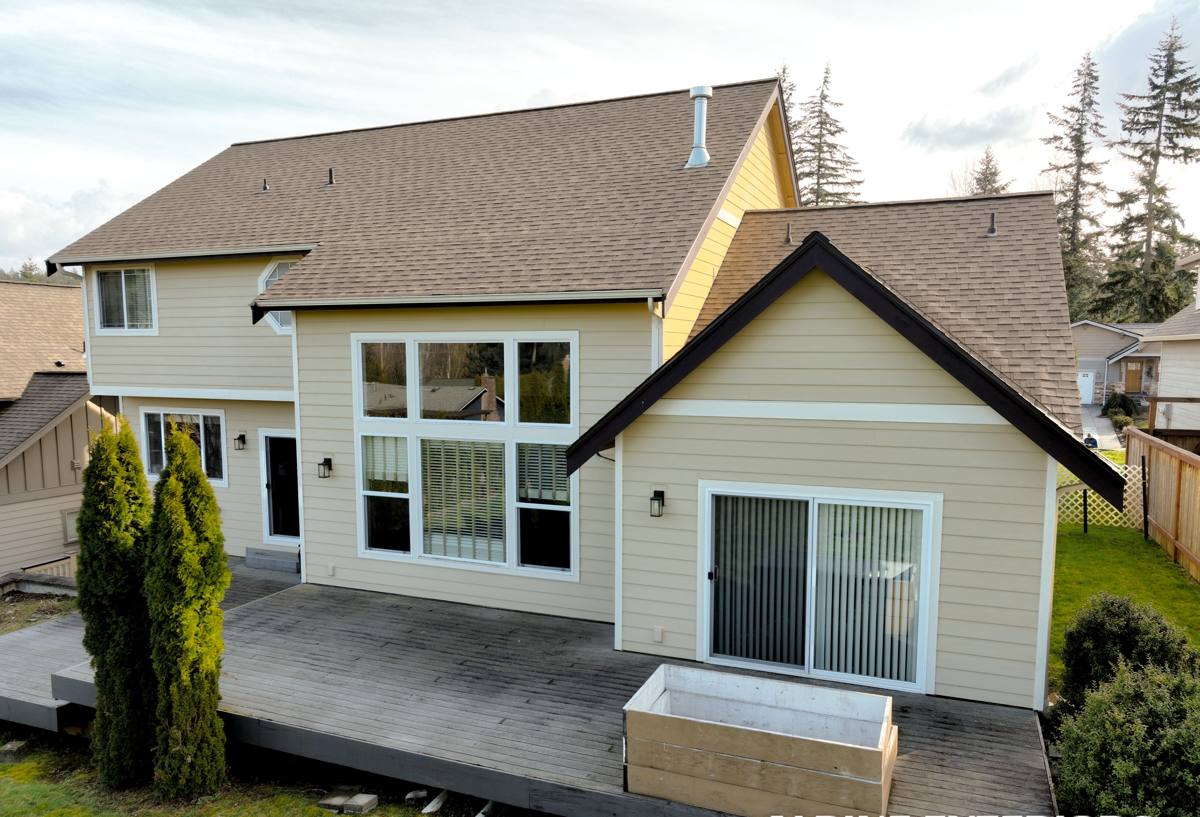
Signs a Home in Everson Needs a New Roof, Not Another Repair
Repairs make sense when a roof is otherwise sound and the problem is isolated — a cracked boot, a few lifted shingles after a windstorm, a flashing leak at a chimney. A full replacement is the honest answer when the damage is systemic or the roof is past the point where patching buys real time. Homeowners in Everson should watch for:
- Granule loss heavy enough to show bare asphalt mat, especially on south and west-facing slopes that catch the worst of the driving rain
- Moss or moss-stain coverage across more than a third of the roof, particularly if it's returned within a year or two of cleaning
- Soft or spongy decking felt through the roof surface, usually found near valleys, eaves, or old skylight cuts
- Daylight visible through the attic at ridge or hip lines
- Shingles curling, cupping, or cracking — a sign the asphalt has dried out and lost flexibility
- Rusted or failing flashing at chimneys, sidewalls, and roof-to-wall transitions
- A roof older than 20–25 years for composition shingle, or 40+ years for cedar shake, with no major re-roof on record
Any one of these can often wait for a scheduled repair. Three or more together, especially combined with visible interior staining on ceilings or in the attic, usually means the roof system as a whole is failing rather than one component.
What a Correctly Installed Roof Actually Involves
A new roof is not just stripping old shingles and nailing down new ones. In a climate like Whatcom County's, the parts most people never see are what determine whether the roof holds up through its full warranty life.
Tear-off and deck inspection
Full tear-off to bare decking lets us actually see the plywood or plank sheathing underneath — something you can't evaluate from the ground or even from inside the attic. Any decking that's delaminated, soft, or stained from long-term moisture gets replaced before anything new goes down. Roofing over bad decking is one of the most common corners cut in this trade, and it's the single fastest way to shorten a new roof's life.
Underlayment built for wet climates
Standard felt underlayment has its place, but for Everson's combination of driving rain and long wet seasons, we lean on synthetic underlayment and self-adhered membrane (ice-and-water shield) at the vulnerable spots: eaves, valleys, roof-to-wall intersections, and around every penetration. This is the layer that keeps a roof dry if wind-driven rain ever gets past the shingles themselves — which happens more often in coastal Whatcom County than in drier parts of the state.
Flashing done right
Flashing failures cause more leaks than worn-out shingles do. Step flashing at sidewalls, proper counter-flashing at chimneys, and correctly lapped valley metal are all details that take longer to do correctly and are easy to shortcut. We flash to last the life of the roof, not just to pass a quick visual check.
Ventilation that actually balances
See the section below — this is important enough to cover on its own.
Roofing Material Options for Everson Homes
There's no single "best" roofing material — the right choice depends on the home's roof pitch, tree cover, budget, and how much moss and moisture exposure the specific site sees. Here's how the common options compare for this climate:
| Material | Typical Lifespan Here | Moss Resistance | Maintenance Burden |
|---|---|---|---|
| Standard asphalt composition shingle | 18–25 years | Low without treatment; algae-resistant (AR) shingles help | Periodic moss/moss-stain treatment recommended |
| Architectural / laminate shingle | 25–30 years | Moderate, especially with AR granules | Lower than standard 3-tab, still benefits from cleaning |
| Standing seam metal | 40–50+ years | High — moss struggles to hold on smooth metal | Low; occasional fastener and sealant checks |
| Cedar shake | 25–35 years with upkeep | Low — shake is naturally moss-prone in shade | High; needs regular cleaning and treatment |
Most Everson homeowners land on architectural asphalt shingle with algae-resistant granules as the best balance of cost and moss resistance, or standing seam metal when the budget allows and the homeowner wants to largely stop thinking about moss for decades. We don't install cedar shake as a first recommendation in heavily shaded lots here — not because shake is a bad product, but because the maintenance commitment it demands in a wet, shaded climate is more than most homeowners realistically keep up with, and a neglected shake roof fails faster than almost any other option.
Ventilation and Moisture: The Part Most Re-Roofs Get Wrong
A roof that's watertight on top but poorly ventilated underneath will still fail early in this climate. Warm, moist air from the living space rises into the attic; if it can't escape through balanced intake (soffit) and exhaust (ridge or roof vents), it condenses against the underside of the decking. Over a few wet Whatcom County winters, that trapped moisture rots decking from the inside, exactly the kind of damage that gets found only during a tear-off — often after it's already spread.
Correct ventilation means matching intake to exhaust, not just adding vents wherever they're convenient. On a re-roof, this is the point where we can fix decades of an under-ventilated attic at the same time we're already up there, instead of leaving the homeowner to discover the problem the hard way.
Our Installation Process, Start to Finish
- On-site inspection and estimate. We walk the roof (weather permitting) and the attic, check decking condition where visible, and note ventilation, flashing points, and any moss or moisture damage. No pressure, no same-day-signature tactics.
- Written scope and material selection. You get a clear breakdown of what's included — tear-off, decking replacement if needed, underlayment type, flashing work, ventilation changes, and material choice — before anything is scheduled.
- Scheduling around weather windows. In Whatcom County, timing a tear-off around a stretch of dry weather matters more than in drier regions. We plan around forecasts and keep the roof dried in if conditions turn.
- Tear-off and deck repair. Old roofing comes off down to the deck; any compromised sheathing is replaced and inspected before covering anything up.
- Underlayment, flashing, and ventilation installed. This is the layer that does the real long-term work, as covered above.
- New roofing material installed to manufacturer spec. Correct nailing patterns, exposure, and fastening are what keep a warranty valid and a roof performing through wind events.
- Cleanup and final walkthrough. Magnetic sweep for stray fasteners, debris haul-off, and a walkthrough so you know what was done and what to expect going forward.
What a New Roof Typically Costs — and What Drives the Price
Exact pricing depends on roof size, pitch, layers to remove, decking condition, and material choice, so we won't quote a number without seeing the roof. What we can tell you honestly is what moves the price up or down:
| Cost Factor | Why It Matters |
|---|---|
| Roof pitch and complexity | Steep, cut-up rooflines with multiple valleys and dormers take longer and need more flashing detail than a simple gable |
| Number of existing layers | Multiple old layers mean more tear-off labor and disposal, and a mandatory full strip in most cases |
| Decking condition | Rot or soft sheathing found during tear-off adds material and labor that couldn't be priced sight-unseen |
| Material choice | Standard shingle, architectural shingle, and metal each carry different material and labor costs |
| Access and tree cover | Roofs shaded by mature trees often need branch clearance or extra protection for equipment and material staging |
Why a Crew That Already Works Everson Matters
Roofing licenses and manufacturer certifications are the baseline — they don't tell you whether a crew understands how a specific neighborhood's tree cover, drainage, and wind exposure behave. A crew that regularly works in and around Lynden and Everson already knows which lots hold moss the longest, which older subdivisions tend to have under-ventilated attics from their original build era, and how local wind patterns off the valley affect flashing and edge details. That familiarity shows up in fewer surprises during tear-off and fewer callbacks after the fact.
It also matters for response time. A local crew can get back out for a warranty check, a post-storm look, or a question about maintenance without a multi-hour drive eating into the visit. When you're hiring anyone to work on your home, ask how much of their current work is actually in your area — not just the broader region on their website.
After the Install: Keeping a New Roof Performing in This Climate
A correctly installed roof still needs basic upkeep in a climate this wet and shaded. A short annual checklist:
- Clear gutters and downspouts each fall before the heavy rain sets in — clogged gutters back water up under eave flashing
- Have moss growth treated or gently removed before it establishes heavily, rather than after
- Trim back overhanging branches to reduce shade, debris buildup, and physical abrasion on the roofing surface
- Check attic ventilation isn't blocked by insulation or storage after any attic work
- Have flashing points (chimneys, skylights, sidewalls) visually checked every couple of years, especially after a bad windstorm
None of this replaces a good installation — it just protects the investment once it's in place.
If your Everson home's roof is showing its age, or you just want an honest read on whether repair or replacement makes more sense, we're happy to take a look. Fill out the form below for a free, no-pressure estimate from a crew that works this area regularly.