 Lynden Siding
 Custer's Siding Takes a Specific Kind of Punishment
Custer sits close enough to the water that homes here deal with a mix of weather most inland Whatcom County properties don't see as often: salt-laden air drifting in off the strait, wind-driven rain that hits siding at an angle instead of falling straight down, and long stretches of gray, damp months where surfaces rarely get a chance to fully dry out. That combination is hard on exterior materials. Salt air accelerates corrosion on fasteners and trim metal. Driving rain finds its way into seams, laps, and butt joints that would stay dry in a calmer climate. And the extended moss season common to this part of Washington means anything that traps moisture — a cracked panel, a failed caulk joint, a spot where paint has let go — becomes a foothold for organic growth that keeps the moisture problem going long after the rain stops.
None of this means Custer homes need exotic materials or unusual construction. It means the ordinary wear that shows up on any siding job shows up faster and matters more here, and a repair that doesn't account for local conditions tends to fail again within a season or two.
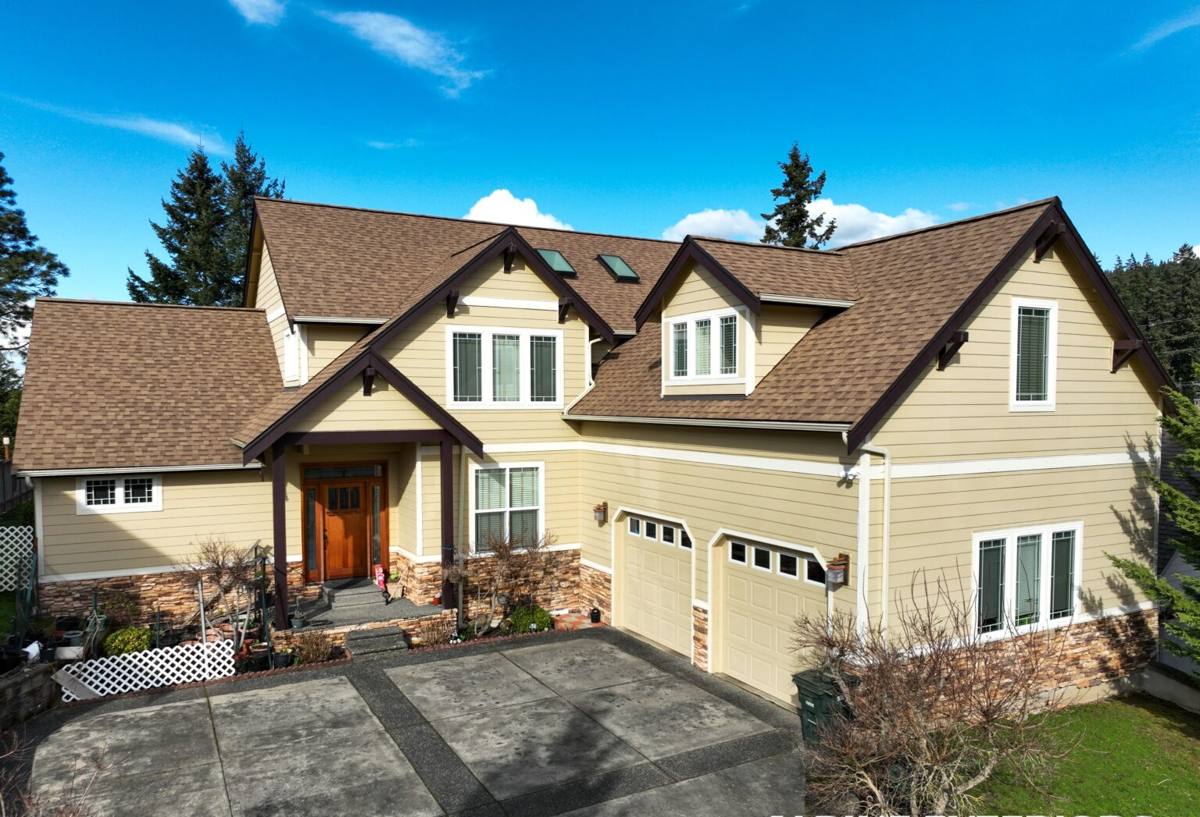
Signs Your Siding Needs Attention
Most siding repairs start small and stay small if they're caught early. The problem is that a lot of early warning signs look cosmetic until you look closer. Here's what we tell Custer homeowners to watch for:
- Soft or spongy spots when you press on the siding, especially near the bottom courses or under window sills
- Paint that's cracking, peeling, or bubbling in a pattern rather than evenly across the wall
- Visible moss, algae, or dark streaking that keeps coming back after cleaning
- Gaps opening up at butt joints, corners, or where siding meets trim
- Panels that have warped, cupped, or pulled away slightly from the wall
- A musty smell near exterior walls inside the home, which often points to moisture already past the siding
- Fastener heads that have rusted, popped, or streaked the siding below them with rust stains
Any one of these on its own might be minor. Several showing up in the same area, or damage that's spreading year over year, usually means water has been getting behind the siding for a while — and that's a different repair than patching a single cracked panel.
What a Correct Repair Actually Involves
Finding the Real Cause, Not Just the Visible Damage
The cracked or stained panel you can see is almost never the whole story. Before we touch anything, we're looking for how water got in: a failed kick-out flashing, a caulk joint that gave up years ago, a nail popped just enough to open a path, or siding that was installed too tight to trim and never had room to move. Replacing the damaged piece without fixing the entry point just buys you a shorter second failure.
Checking What's Behind the Siding
Once panels come off, we check the house wrap or building paper, the sheathing underneath, and the framing for signs of rot or sustained moisture. In a climate that stays wet as long as ours does, it's common to find that the visible siding damage is smaller than what's happening behind it. This is the step that separates a repair that lasts from one that just covers the symptom.
Matching Material, Not Guessing
Fiber cement siding varies by manufacturer, plank profile, and factory finish batch. A patch that's close but not matched shows as a visible seam and, worse, can behave differently in moisture and temperature than the surrounding panels. On repairs, we match to the existing product where possible, and where a full section needs replacing, we use the same James Hardie profile and finish system the rest of the house is built with — never a mixed-material patch.
Rebuilding the Flashing and Sealant Details
This is where most repairs succeed or fail. Correct flashing above windows, doors, and at horizontal joints — combined with the right sealant in the right places, not caulk smeared over every gap — is what actually keeps driving rain out. We rebuild these details to spec rather than resealing over old, failed material.
Repair vs. Replace: How We Decide
Not every damaged section needs a full re-side, and not every problem is fixable with a patch. The table below covers the factors we weigh on a Custer repair call.
| Factor | Leans Toward Repair | Leans Toward Replacement |
|---|---|---|
| Extent of damage | Isolated to one or two areas | Spread across multiple walls or elevations |
| Sheathing condition | Dry, sound wood behind the siding | Rot or persistent moisture in the sheathing |
| Age of existing siding | Under 15–20 years, still structurally sound | Nearing or past expected service life |
| Cause of failure | A specific, fixable defect (one bad flashing, one impact spot) | Systemic issue — original installation flaws throughout |
| Cosmetic match | Product and color still available or close enough to blend | Discontinued color/profile with no realistic match |
Honest repair recommendations save homeowners money. We'll tell you straight when a patch makes sense and when it doesn't — a repair we know won't hold isn't a repair worth doing.
Why We Only Work With James Hardie Fiber Cement
When a repair calls for new material, we use James Hardie fiber cement exclusively — the same standard we install on every full re-side. We don't stock or install vinyl, LP SmartSide, or other fiber cement brands, and that matters on a repair job specifically because mixing materials on one house creates long-term problems: different expansion rates, different moisture behavior, and finishes that age at different speeds side by side.
Fiber cement doesn't absorb water the way engineered wood products can, which matters in a climate where surfaces stay damp for extended stretches. It's non-combustible, it holds paint and factory finish far longer than wood-based sidings, and Hardie's ColorPlus finish is baked on at the factory rather than field-applied, so a color-matched repair panel actually matches — it isn't a guess with a paint sprayer. Vinyl, by comparison, becomes brittle with age and UV exposure and is difficult to patch invisibly once a section has faded. We standardized on Hardie because it's the product we're willing to warranty and stand behind on repair work, not just new installs.
Our Repair Process
- On-site inspection — we look at the damaged area and the surrounding siding, not just the spot you called about, since related issues often sit nearby.
- Diagnosis — we identify the actual moisture entry point or mechanical cause before quoting anything.
- Written scope — you get a clear explanation of what's being repaired, why, and what it will cost, before work starts.
- Removal and inspection behind the siding — checking sheathing and house wrap condition.
- Repair of underlying issues — flashing, sealant, or sheathing repair as needed, not skipped to save time.
- Installation of matched James Hardie material — cut, fastened, and finished to manufacturer spec.
- Final check — confirming the repair sheds water correctly and blends with the surrounding siding.
Why Local Experience in Custer Matters
A crew that regularly works this part of Whatcom County knows which details tend to fail first out here — where salt air chews through fasteners faster, where driving rain hits certain exposures hardest, and how much moss buildup is normal versus a sign of a bigger moisture problem. That's not something you can fully account for from a general specification sheet. It shows up in small decisions: which fastener material to use, how tight to set reveals so the siding can move with seasonal humidity, and which flashing details need extra attention on a wall that takes weather straight off the water. A crew that's done this work up and down the Lynden and Custer area brings that judgment to your repair instead of treating it like a generic job.
After the Repair: Keeping Moss and Moisture From Coming Back
A correct repair solves the immediate problem, but Custer's climate keeps working on your siding year-round. A few habits go a long way:
- Rinse siding gently once or twice a year to clear early moss and algae growth before it takes hold
- Trim back vegetation and tree cover that keeps sections of the house shaded and slow to dry
- Check and refresh sealant at trim joints every few years rather than waiting for a gap to open
- Keep gutters clear so overflow isn't running down the siding face during heavy rain
- Walk the exterior after any major windstorm to catch new damage early, while it's still a repair and not a replacement
If you're seeing damage, staining, or recurring moss on your Custer home's siding, we're happy to take a look and give you a straight answer on what it needs — a small patch, a section repair, or something more. Reach out for a free, no-pressure estimate and we'll walk the exterior with you and explain exactly what we find.