 Lynden Siding
 Board and batten siding has a long history in Whatcom County. The vertical-plank-and-strip look shows up on old farmhouses, barns, and newer builds throughout Laurel and the surrounding Lynden countryside, and it's still one of the most requested siding profiles we install. It's a clean, strong look — but it's also a profile that punishes poor material choices and sloppy installation faster than lap siding does, especially in this climate. This page covers what board and batten actually needs to hold up in Laurel, and how we build it.
Why Board & Batten Suits Laurel Homes
Laurel sits in the working farmland and low-density residential stretch around Lynden, where a lot of homes were built with a rural or agricultural character in mind — gable barns, shop buildings, farmhouse-style residences. Board and batten fits that architecture naturally. It also reads well on modern builds when used as an accent alongside lap siding, which is a common combination we see requested on newer Whatcom County construction.
Beyond looks, the vertical lines of board and batten do something practical: they shed water down the face of the wall rather than collecting it on a horizontal ledge the way some other profiles can. That matters here. Whatcom County gets a long, wet stretch from fall through spring, and Laurel's low, open terrain means driving rain off the Nooksack Valley and Puget Sound air masses hits walls at an angle more often than it falls straight down. A vertical profile handles that better than a lot of alternatives, provided the material behind it can take the moisture load.
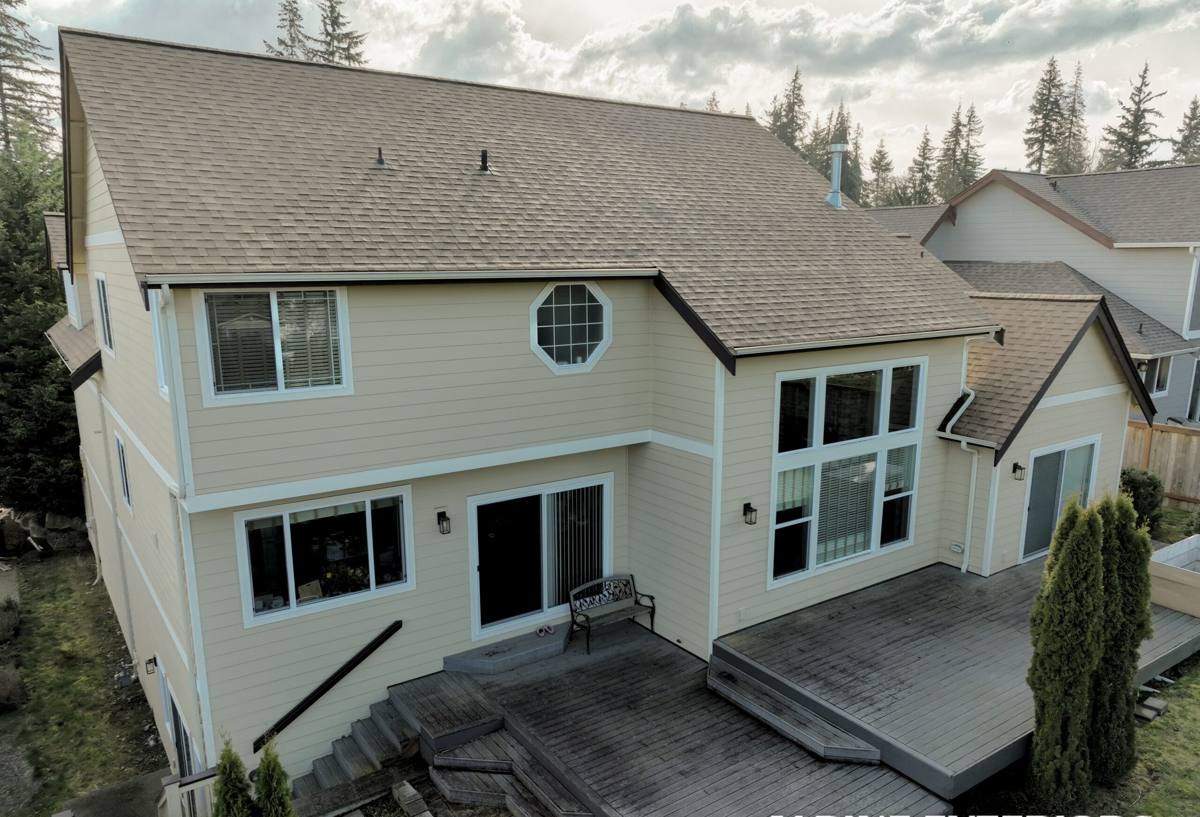
What This Climate Actually Does to Siding
Three things wear down exterior siding in this part of Whatcom County faster than in drier climates:
- Salt-influenced air. Proximity to the Salish Sea and Puget Sound means the air carries more salt and moisture than an inland climate would, which accelerates corrosion of fasteners and finish breakdown on lower-grade materials.
- Driving rain. Storms coming off the water don't just fall — they push sideways into wall assemblies, working into seams, laps, and joints that aren't detailed correctly.
- A long moss season. Shaded walls, north faces, and anything near mature trees or fence lines stay damp for months at a time. Moss and algae don't just look bad — they hold moisture against the siding surface, which is exactly the condition that causes swelling, delamination, and paint failure on wood-based and composite products.
Board and batten, because of its exposed vertical battens and narrow reveal, has more linear joint length per square foot than wide lap siding. Every one of those joints is a place water can get behind the material if the product or the installation isn't right. That's the core issue we're solving for on every board and batten job in Laurel.
Why We Only Install It in James Hardie Fiber Cement
We don't offer board and batten in vinyl, LP SmartSide, cedar, or primed spruce. That's not a marketing line — it's a standard we hold because of what we've seen this profile do in wet coastal climates over time.
Wood-based and composite battens
Cedar and primed spruce board and batten look excellent when new, but the battens are thin, exposed on multiple faces, and sit directly in the path of driving rain. Wood absorbs moisture at the end grain and along any check or crack in the finish, and in a climate with this much sustained dampness, that moisture doesn't get a long enough dry window between storms. The result over years is cupping, split battens, and paint that needs recoating far sooner than homeowners expect. Engineered wood products like LP SmartSide use resin-treated strand board, which resists some of that but is still an organic substrate — if the factory edge seal or field-cut edges aren't treated correctly, the same swelling risk applies, just delayed.
Vinyl board and batten
Vinyl board and batten is affordable and low-maintenance in the sense that it doesn't need repainting, but it's a thin extruded plastic profile with real limitations here. It expands and contracts significantly with temperature swings, which stresses the fastening system over time, and it can become brittle in sustained cold snaps. It also won't take direct fastening the way fiber cement does — it hangs on a track system that's more forgiving of a rushed install and less forgiving of high wind.
James Hardie fiber cement
James Hardie board and batten is fiber cement — sand, cement, and cellulose fiber, cured into a dense, dimensionally stable board. It doesn't absorb water the way wood does, it's non-combustible, and it holds paint and factory finish far longer than wood-based alternatives because the substrate itself isn't the thing failing. Hardie's HZ5 product line is engineered specifically for climates with sustained moisture exposure — which describes Whatcom County well — and the ColorPlus factory finish is baked on and warranted separately from the substrate, so you're not relying on field-applied paint to be the only thing standing between the board and the weather. It's the one material we've found that holds its shape, its finish, and its joints correctly through a full Pacific Northwest wet season after wet season.
What a Correct Board & Batten Installation Involves
Board and batten is more installation-sensitive than standard lap siding, and most of the failures we get called out to fix on other contractors' work trace back to a handful of details getting skipped.
Water-resistive barrier and rainscreen
Every board and batten wall we build starts with a correctly lapped weather-resistive barrier and, in most cases, a furring strip or engineered rainscreen gap behind the siding. That gap lets any moisture that does get past the battens drain and dry instead of sitting against the sheathing. On a profile with this much joint length, skipping the rainscreen is one of the most common corners cut in this trade.
Fastening pattern
James Hardie specifies exact fastener spacing, edge distance, and fastener type for board and batten assemblies, and those specs change depending on whether the boards are blind-nailed or face-nailed and where the battens land relative to studs. Fastening off the manufacturer's pattern is one of the fastest ways to void a warranty and one of the most common causes of boards working loose in high wind.
Joint and seam treatment
Butt joints, inside corners, and the transition where board and batten meets a different siding profile or trim all need to be flashed and sealed correctly — not just caulked and hoped for. In a climate with this much driving rain, a joint that relies on caulk alone as its only water defense is a callback waiting to happen.
Batten spacing and reveal
Batten spacing is a design decision, but it also has to respect Hardie's minimum board overlap and expansion gap requirements. Getting this wrong either looks off or creates gaps that let wind-driven rain track further into the wall than it should.
Our Process on a Laurel Board & Batten Project
| Step | What Happens |
|---|---|
| Site walk | We inspect existing siding, sheathing, and trim condition, and check for moss, trapped moisture, or rot before quoting anything |
| Detailed estimate | Written scope covering tear-off (if needed), house wrap, rainscreen, fastening plan, and James Hardie board and batten with your chosen ColorPlus finish |
| Prep and moisture check | Any water-damaged sheathing gets addressed before new siding goes up — covering it over is not an option we offer |
| Installation | Battens and boards installed to Hardie's fastening and clearance specs, with flashing at every penetration and joint |
| Final walkthrough | We walk the job with you, check reveals and finish, and confirm warranty registration |
Why a Crew That Already Works Laurel Matters
Laurel isn't a large commercial district — it's a residential and semi-rural pocket near Lynden, and jobs here tend to be spread across acreage lots, older farmhouses, and newer infill homes rather than tightly packed subdivisions. A crew that already works this area knows the practical stuff that doesn't show up in a spec sheet: how exposed a given wall orientation typically is to the prevailing weather, what moss and algae buildup usually looks like on homes that have gone a few years without attention, and how the county's inspection and permitting process runs for exterior work. That local familiarity shortens the guesswork on every estimate we write for this neighborhood.
Signs Your Current Siding Needs Attention
- Battens or boards that have visibly cupped, bowed, or separated from the wall
- Persistent moss or algae staining that comes back within a season of cleaning
- Soft or spongy spots when you press on the siding near the base of the wall
- Paint that's peeling or alligatoring rather than just fading
- Visible gaps at butt joints or corners where daylight or drafts get through
- Rising utility bills that may point to moisture-compromised insulation behind the siding
If any of these sound familiar, it's worth having the wall assembly looked at, not just the surface — by the time siding shows these signs, there's often moisture history behind it that needs to be addressed before new material goes up.
Cost Factors on a Board & Batten Job
Every project is different, but the main variables that move the price on a board and batten job in this area are worth understanding before you get quotes:
| Factor | Why It Matters |
|---|---|
| Existing siding removal | Tear-off and disposal add labor, and hidden sheathing damage found underneath can add scope |
| Wall complexity | Gables, dormers, and multiple wall planes take more cutting and fitting than a simple rectangular wall |
| Batten spacing/design | Tighter batten spacing means more material and more labor hours per square foot |
| Rainscreen inclusion | Adding a proper drainage gap is additional labor but is the right call in this climate |
| Trim and flashing detail | Corners, window and door surrounds, and transitions to other materials add time to do correctly |
We'd rather walk your specific home and give you real numbers than throw out a broad estimate that doesn't reflect your walls, your exposure, or your existing condition.
If you're considering board and batten siding for a home in Laurel, we're happy to come take a look and walk you through what your specific walls need. There's no pressure and no cost to get a written estimate — just a straight assessment from a crew that installs this profile, in this climate, on a regular basis.