 Lynden Siding
 Why Storm Damage Repair Works Differently in Blaine
Blaine sits right on Drayton Harbor and Semiahmoo Bay, at the northwest corner of Whatcom County, which puts local roofs in a different weather lane than homes even a few miles inland. Storms here don't just drop rain — they push it sideways off the water, and the air carrying it is loaded with salt. A roof repair that would hold up fine in a drier, inland climate can fail early in Blaine if it isn't built for these specific conditions. That's the gap we focus on closing: not just patching what a storm broke, but repairing it in a way that accounts for what the next storm, and the one after that, will do to the same spot.
The Coastal Factor
Homes within a mile or two of the water take a steady dose of salt-laden air, even on calm days. Salt accelerates corrosion on exposed metal — flashing, fasteners, gutter hardware, vent boots with metal collars. After a storm loosens or exposes any of that hardware, the clock on corrosion starts running faster than it would on an inland roof. A repair that leaves standard fasteners or bare metal exposed to that air is a repair that's inviting a second problem within a few years.
Wind and Driving Rain
Whatcom County also gets outflow wind events — cold, dense air spilling down out of the Fraser Valley to the north — on top of the normal Pacific frontal systems that roll through fall and winter. These winds don't need to be extreme to cause damage; sustained, gusty wind combined with driving rain is very good at finding the one lifted shingle tab, the one soft spot in old flashing sealant, or the one nail that backed out, and turning it into a leak. Roofs here need repairs that are built to shed wind-driven rain, not just rain falling straight down.
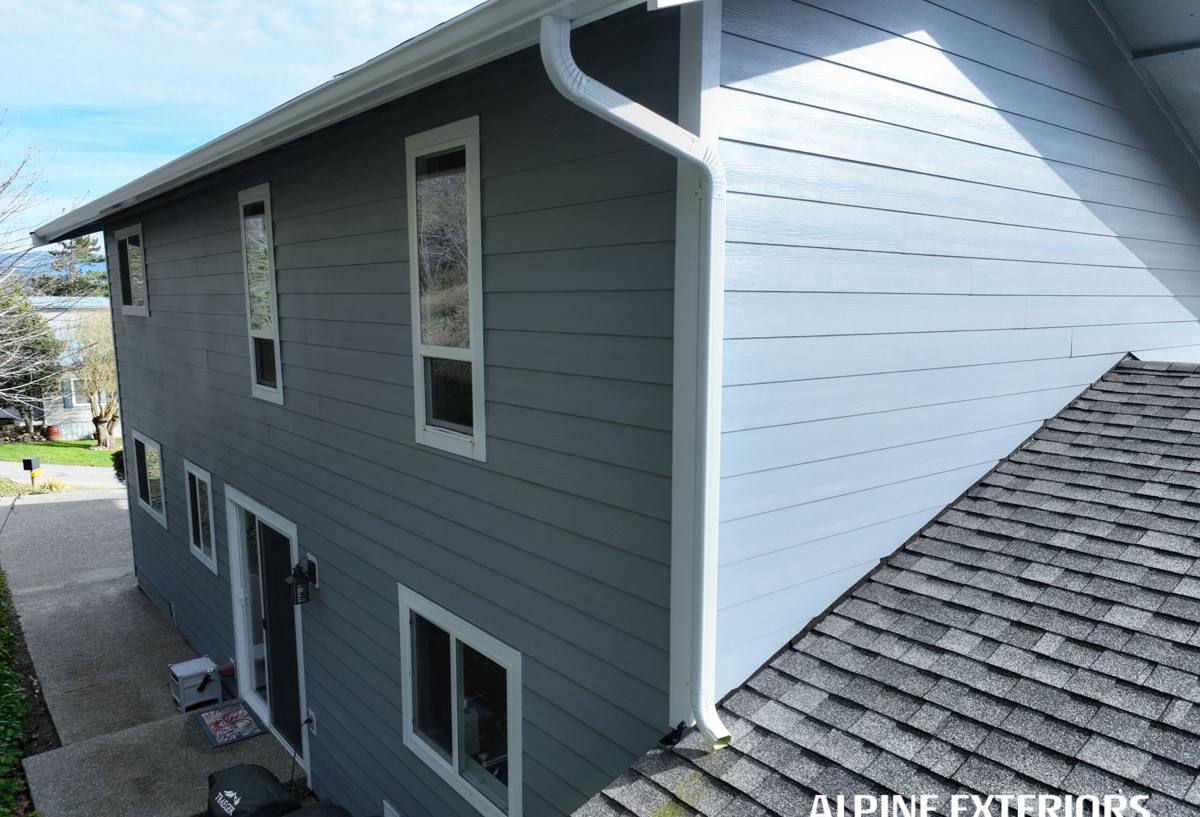
What Actually Counts as Storm Damage
Storm damage isn't always a dramatic hole in the roof. Most of what we get called out for in Blaine falls into a handful of categories:
- Wind-lifted or torn shingle tabs, especially along ridges, edges, and valleys where wind uplift is strongest
- Granule loss on asphalt shingles from wind-driven rain and debris, which thins the shingle's protective layer
- Flashing pulled loose or bent at chimneys, skylights, and roof-to-wall transitions
- Damaged or dislodged vent boots and pipe collars, a common source of slow leaks after wind events
- Limb strikes and impact damage from trees, which are common on wooded Whatcom County lots
- Gutter and downspout damage that redirects water onto fascia and siding instead of away from the house
Some of this is obvious from the ground. A lot of it isn't — a lifted tab or a bent flashing edge can sit quietly for months, letting water in a little at a time, until it shows up as a stain on an interior ceiling.
Why Moss Season Makes Storm Damage Worse
Whatcom County's moss season runs long — the combination of shade, moisture, and mild temperatures from fall through spring gives moss a lot of time to establish itself on north-facing slopes and shaded sections of roof. Moss holds water against the shingle surface far longer than the shingle was designed to handle, which softens the mat underneath and works up under tabs and around fasteners over time. A roof with moss already established is a roof that's weaker going into storm season, because the wind doesn't have to work as hard to lift a tab that's already lifted slightly by moss growth underneath it.
This is why we always check for moss and its effects during a storm damage inspection, even when the homeowner only called about a specific leak. Repairing the storm damage without addressing the moss that weakened that section in the first place is a repair that's likely to need doing again.
What a Correct Repair Actually Involves
A storm damage repair that's done right is more than swapping out the shingles that are visibly missing. Here's what we check on every storm call in Blaine:
Decking Condition
Before any new material goes down, we check the roof decking underneath the damaged area for soft spots or water staining. Replacing shingles over decking that's already saturated or beginning to rot just seals the problem in — it needs to come out and be replaced with sound plywood or OSB first.
Underlayment and Flashing Detail
Storm damage often exposes or compromises the underlayment — the water-resistant barrier beneath the shingles. In a coastal, high-rain area like Blaine, we pay close attention to how flashing is integrated at valleys, chimneys, and wall transitions, since these are the spots where wind-driven rain finds its way in even when the shingles themselves look fine.
Material Matching
Where we can match the existing shingle color, style, and exposure, we do — a patch job that looks obviously different from the rest of the roof is a sign of a repair done in a hurry. Where an exact match isn't available (common on older roofs), we talk through the options honestly rather than pretending a mismatch won't show.
Fastener and Hardware Choice
Given the salt air near the water, we use corrosion-resistant fasteners and flashing on repairs in and around Blaine rather than defaulting to standard hardware. It costs a little more up front and it's the difference between a repair that lasts and one that starts rusting at the nail heads within a couple of winters.
Patch Repair, Section Replacement, or Full Re-Roof?
Not every storm-damaged roof needs the same scope of work. The right call depends on the age of the roof, how widespread the damage is, and what condition the rest of the roof is in.
| Approach | Best For | Typical Cost Range | Key Consideration |
|---|---|---|---|
| Spot patch repair | Isolated damage on a roof under 10-15 years old in otherwise good shape | Roughly $400–$1,200 | Only makes sense if the surrounding material is still sound |
| Section replacement | Damage concentrated on one slope or area, older roof still with useful life left | Roughly $1,500–$5,000 | Material and color matching gets harder the older the roof |
| Full roof replacement | Widespread damage, roof near end of its service life, or repeated storm calls to the same roof | Roughly $9,000–$20,000+ depending on size and material | Often the more economical choice long-term if the roof is already old |
These are broad ranges, not quotes — actual cost depends on roof size, pitch, material, and access. We'll give you a specific number after we've actually looked at the roof, not before.
Insurance and Storm Damage Claims
Many storm damage repairs in Blaine are covered in whole or part by homeowners insurance, but coverage depends on your policy and the cause of the damage. A few general things worth knowing:
- Document damage with photos as soon as it's safely possible, before any temporary repairs are made
- Most policies want damage reported within a specific window after the storm — check your policy or ask your agent
- An inspection report from a roofing contractor is different from an insurance adjuster's assessment, and having both often works in your favor
- Temporary measures like tarping to stop active leaks are usually reasonable and often reimbursable, but keep records of what was done
We're not insurance agents and won't pretend to be — for coverage specifics, your policy and your agent are the authority. What we can do is give you a clear, honest written assessment of the damage and the repair needed, which is what most adjusters ask for anyway.
How Our Process Works
When you call us about storm damage in Blaine, here's what happens:
- We schedule an inspection, usually within a few days — sooner if there's an active leak
- We get on the roof (weather permitting) and check not just the obvious damage but the surrounding area, decking, flashing, and any moss or wear that may have contributed
- We give you a written explanation of what we found, in plain language, along with photos where useful
- We lay out the repair options honestly — patch, section, or full replacement — and what each one costs and doesn't fix
- Once you approve the work, we schedule it, do the repair to the standard described above, and clean up the site fully before we leave
If there's an active leak, we'll talk about temporary protection — tarping the area — as a separate, faster step while the full repair gets scheduled.
Signs You Should Get a Storm Damage Inspection
After any significant wind or rain event in the Blaine area, it's worth a look — from the ground, safely — for these signs:
- Shingle pieces or granules in gutters, downspouts, or on the ground around the house
- Visibly lifted, curled, or missing shingle tabs, especially near ridges and edges
- New or worsening water stains on ceilings or upper interior walls
- Sagging or dented gutters, or downspouts pulled away from the house
- Daylight visible through the roof deck from inside the attic
- A musty smell in upper rooms or the attic after a storm, which can indicate hidden moisture
Any one of these is a reasonable reason to get a professional look, even if nothing seems urgent yet. Storm damage that sits unaddressed through a Whatcom County winter tends to get worse, not better.
Why a Crew That Already Works Blaine Matters
Storm damage work rewards local familiarity in ways that aren't always obvious. A crew that regularly works the Blaine area already knows which roof styles and ages are common in the neighborhoods here, how the coastal exposure and outflow winds tend to concentrate damage on certain slopes, and what the local moss and moisture patterns typically do to a roof over time. That local knowledge shortens the inspection, sharpens the diagnosis, and means fewer surprises once repair work is underway. It also means a faster response — when a storm rolls through the county, contractors who are already local and already scheduled in the area can usually get to an active leak sooner than a crew traveling in from further away.
Whatcom County's building requirements and typical construction practices also don't always match what you'd find in other parts of the state or country. A local crew is working within a framework it already understands, rather than adapting on the fly.
If a recent storm has left you with a leak, missing shingles, or just a nagging feeling something's not right up there, we're happy to take a look. Reach out for a free, no-pressure estimate using the form below.