 Lynden Siding
 Why Siding Fails Faster Here Than in Most Places
Aldergrove sits right at the edge of the Fraser Valley, just across the line from Lynden, and it gets the worst of a few overlapping weather patterns at once. Moist Pacific air pushes inland and stalls against the foothills, driving rain comes in sideways for days at a time in the fall and winter, and the damp never really lets up long enough for wood or wood-based siding to fully dry out between soakings. Add in the trace salt carried on the marine air that moves up the Strait and through the valley, and you've got a slow, steady combination working against every exterior wall on the house.
None of that is dramatic on its own. It's the cumulative effect that gets homeowners: caulk joints that dry out and crack a year or two early, paint film that fails faster than the can promised, and a moss season that stretches from October well into spring. Siding that isn't built for this specific mix of moisture and biological growth doesn't fail all at once — it fails a little every year until a homeowner realizes the wall behind it has been wet for a long time.
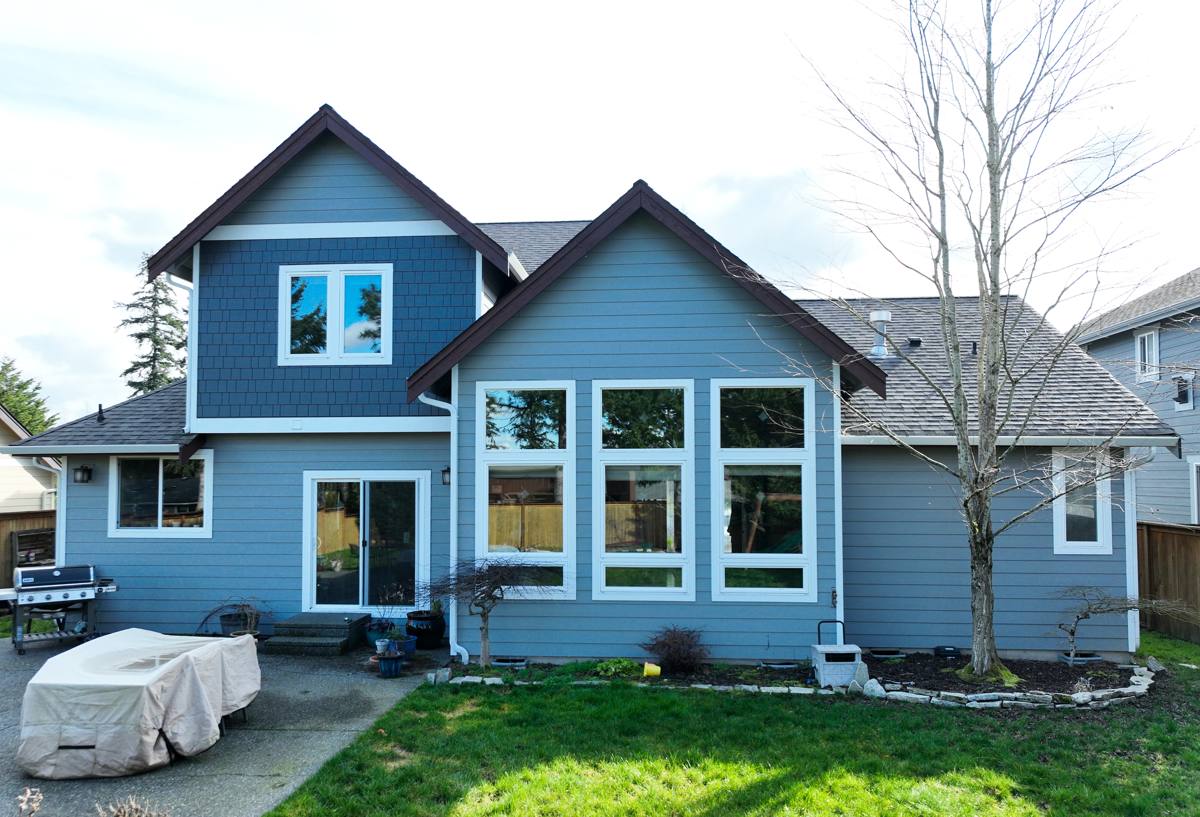
What the Local Climate Actually Does to a Wall
Driving rain and wind-driven moisture
Rain that falls straight down is easy to shed. Rain that's pushed sideways by wind finds every lap joint, every trim gap, and every fastener hole that isn't sealed or flashed correctly. Homes on more exposed lots — open yards, corner lots, anything without windbreaks — take this the hardest, and it's usually the north and west-facing walls that show wear first.
Moss, algae, and constant dampness
A long moss season means siding stays damp for extended stretches, especially on shaded walls under trees or on the north side of the house. Moss and algae don't just look bad — they hold moisture against the surface, which accelerates rot in wood products and breaks down paint and caulk faster than dry conditions would.
Salt-tinged air and material fatigue
Even well inland from the coast, this region's marine air carries enough salt to matter over a couple of decades. It's not going to rust through a wall in a season, but it does contribute to the slow breakdown of lesser caulks, fasteners, and finishes — one more reason material choice and installation detail matter more here than they would in a drier, inland climate.
Signs Your Siding Has Reached the End of Its Useful Life
Most siding doesn't announce that it's failing — it shows small signs for a while before anything looks obviously wrong. Homeowners in Aldergrove and the surrounding area should watch for:
- Soft or spongy spots when you press on the siding, especially near the bottom courses and around window and door trim
- Paint that's peeling, bubbling, or needs repainting more often than every 7-8 years
- Visible cracking, warping, or delamination in the panels themselves
- Persistent moss or dark streaking that comes right back within a season of cleaning
- Gaps opening up at seams, corners, or where siding meets trim
- A musty smell or visible staining on interior walls that share an exterior wall with problem siding
- Fastener heads showing through the surface or backing out over time
One or two of these on their own might mean a repair. Several at once, especially combined with soft spots, usually means the water has already gotten behind the material and a full replacement is the honest answer rather than another round of caulk and paint.
What a Correct Siding Replacement Actually Involves
Replacing siding is not just pulling off old panels and nailing up new ones. In a climate that pushes this much moisture at a wall, the parts you never see again after the job is done matter as much as the finished look.
Tear-off and inspection
Every old course comes off so the sheathing underneath can actually be looked at — not guessed at. Any water damage, soft sheathing, or rot found at this stage needs to be repaired before anything new goes up. Skipping this step is the single most common shortcut that leads to a callback a few years later.
Weather-resistive barrier and flashing
A correctly lapped weather-resistive barrier, properly integrated window and door flashing, and flashing at every horizontal transition (roof lines, deck ledgers, trim bands) are what actually keep wind-driven rain from reaching the sheathing. The siding itself is the second line of defense, not the first.
Proper clearances and fastening
Siding needs the right clearance from grade, roofing, and decks so water has somewhere to go instead of wicking up into the material. Fastener type, spacing, and depth all affect how the panels perform over 20-plus years, not just how they look on installation day.
Caulking and joint treatment
Joints and butt seams need the right sealant, applied correctly, in the places the manufacturer actually specifies — not everywhere, and not nowhere. Over-caulking traps moisture just as badly as under-caulking lets it in.
Why We Install Only James Hardie Fiber Cement
We don't install vinyl, LP SmartSide, Cemplank, Allura, primed spruce, or cedar. That's a deliberate standard, not a lack of options. In a climate defined by driving rain, salt-tinged air, and a moss season that lasts half the year, the material has to hold up to sustained moisture exposure without becoming a maintenance project of its own.
James Hardie fiber cement is engineered specifically for climates like this one. It's non-combustible, it doesn't swell or rot the way wood-based products can when they take on repeated moisture, and its ColorPlus factory finish is baked on under controlled conditions rather than field-applied — which means far less repainting over the life of the siding. Hardie also builds its HZ5 product line specifically for the moisture and temperature swings common to the Pacific Northwest, so what goes on an Aldergrove-area home is matched to the climate it has to survive, not a generic national spec.
We're not going to pretend other products don't have their place — vinyl is inexpensive and low-maintenance in mild climates, engineered wood has a warmer look some homeowners prefer, and cedar has genuine curb appeal. But we've made a business decision to stand behind one material because we've seen what holds up here and what doesn't, and we'd rather do one thing well than offer five options and let a homeowner gamble on the wrong one for this climate.
Serving Aldergrove From Just Across the Line in Lynden
Aldergrove sits close enough to Lynden that it's a natural part of our service area, even though it's across the international border in the Township of Langley. That proximity matters in a practical way: we're not driving in from Seattle or Vancouver for a one-off job, we're already working this corridor regularly, and we understand the weather pattern on both sides of the line because it's the same weather pattern.
Working across the border does add a few logistics that a purely local job wouldn't have — material staging, scheduling around border crossing times, and confirming permitting requirements with the homeowner's local municipality before work starts, since permit processes on the Canadian side differ from what's required on the US side. We handle that coordination as part of quoting the job, and we'd rather walk through exactly what's needed for your specific property up front than have it become a surprise mid-project.
How Our Process Works, Start to Finish
- On-site assessment: we walk the whole exterior, not just the obviously bad sections, and check for hidden moisture damage behind trim, at penetrations, and at grade.
- Written estimate: a clear scope covering tear-off, sheathing repair allowances, flashing details, the Hardie product line and color, and a realistic timeline.
- Scheduling around weather: given how much rain this area gets, we plan tear-off and dry-in in stretches where we can keep the wall protected, not just whenever it's next on the calendar.
- Tear-off and sheathing repair: old material comes off, damage gets fixed and documented before it's covered up.
- Weather barrier and flashing installation: the part of the job that determines how the wall performs for the next 30 years.
- Hardie siding installation: installed to the manufacturer's fastening, clearance, and joint-treatment specifications — not a generalized approach.
- Final walkthrough: we go over the finished work with the homeowner before calling the job done.
What Drives the Cost of a Siding Replacement
Every home is different, but the same handful of factors move the price up or down on nearly every siding job in this area:
| Factor | Why It Matters |
|---|---|
| House size and wall complexity | More square footage and more corners, dormers, and trim details mean more labor and material |
| Condition of the sheathing underneath | Hidden rot or water damage found during tear-off adds repair work that can't be quoted sight-unseen |
| Siding profile and Hardie product line | Lap, shingle, and panel styles carry different material and labor costs; HZ5 vs. standard lines can vary in price |
| Trim and accessory scope | Replacing trim, fascia, and soffit alongside siding costs more up front but avoids mismatched materials aging at different rates |
| Access and site conditions | Steep lots, tight clearances, or two-story sections take more time and equipment than a simple single-story wall |
| Cross-border logistics | Material staging and scheduling for Aldergrove-area jobs factor into timeline, though this rarely changes the core installation cost |
We'd rather give you a real number based on an actual walk-through than a ballpark that doesn't hold up once the old siding comes off and the sheathing is exposed.
What to Look For in a Contractor Before You Hire
Siding replacement is one of those projects where the quality of the installer matters as much as the quality of the material — a great product installed wrong will fail early, and a good installer working with the wrong product for this climate still leaves you with a maintenance headache. Before you hire anyone for a job in Aldergrove or the surrounding area, it's worth asking:
- Do you have experience with this specific climate — driving rain, salt air, and long moss seasons — not just siding in general?
- Will you inspect and repair the sheathing before installing new siding, and how is that priced?
- What weather-resistive barrier and flashing details do you use, and can you explain why?
- Are you familiar with permitting requirements on both sides of the border if the property is in a Canadian municipality?
- What's covered under warranty — material, labor, or both — and for how long?
- Can you walk me through why you recommend this specific product for my home?
A contractor who can answer these clearly, without hedging, is one who's actually thought through the job rather than treating it as a standard swap.
Living With Your New Siding Through Moss Season
Even the right material benefits from basic upkeep in this climate. A soft wash once a year knocks back moss and algae before it gets established, keeping gutters and downspouts clear prevents water from sheeting down walls in concentrated streams, and trimming back vegetation that shades siding for long stretches helps it dry out between rain events. None of this is heavy maintenance — it's the kind of once-a-year attention that keeps a properly installed Hardie exterior looking and performing the way it should for decades, rather than needing early intervention because moisture had a chance to sit against the wall unnoticed.
If your siding in the Aldergrove area is showing its age, or you just want an honest read on what shape it's in, we're happy to take a look and put together a straightforward, no-pressure estimate using the form below.