 Lynden Siding
 Asphalt Shingle Roofing for Aldergrove, BC
Aldergrove sits just north of the Canada-US border, close enough to Lynden that it's practically an extension of the same weather system we build roofs for every day. The Fraser Valley funnels the same marine air and Pacific storm systems that move through Whatcom County, which means Aldergrove roofs deal with the same core problems: sustained wind-driven rain through fall and winter, salt-influenced air moving inland off the Strait of Georgia, and mild, damp conditions that give moss a long growing season on any roof plane that doesn't get much direct sun.
We're based in Lynden, Washington, and asphalt shingle roofing is one of the services we install and repair most often on that side of the line as well as this one. This page is specifically about asphalt shingle roofs for Aldergrove homes — what the climate does to them, what a correct installation actually involves, and how we handle a job that starts with a border crossing instead of a short drive across town.
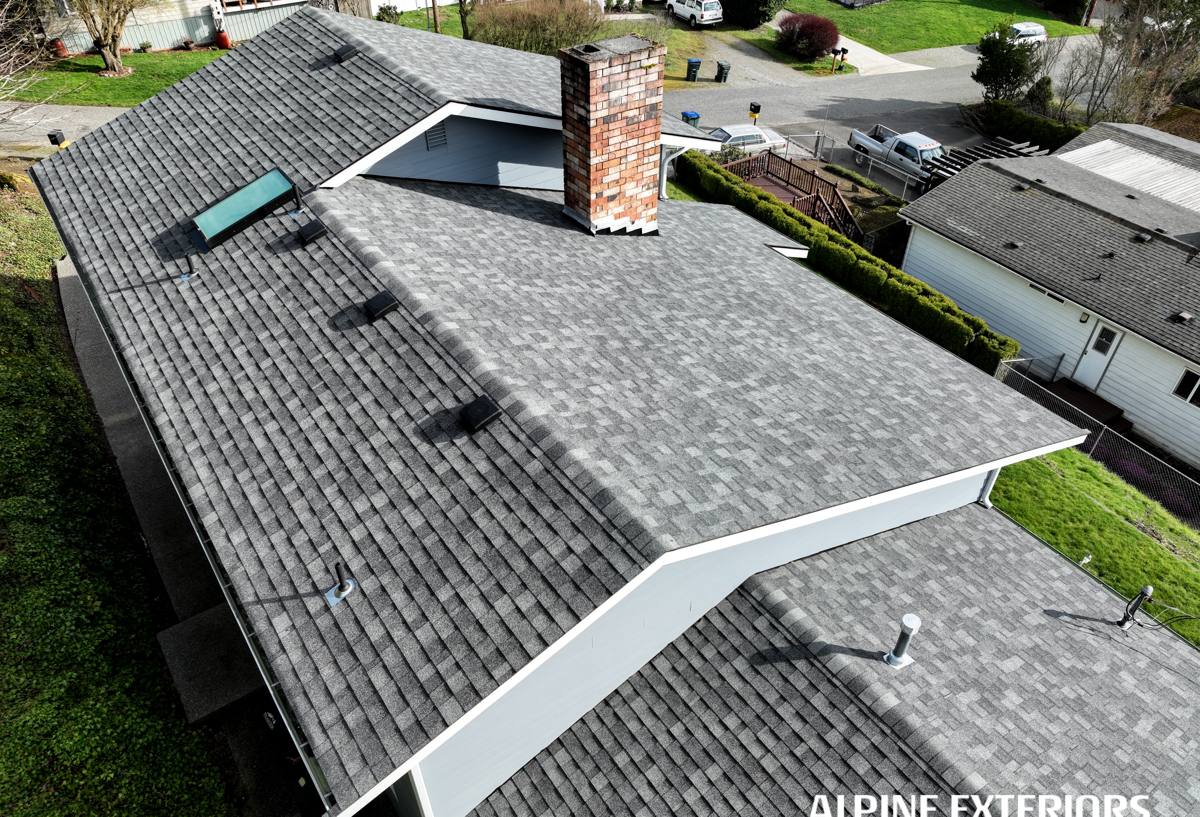
What Border-Country Weather Does to an Asphalt Shingle Roof
Wind-Driven Rain
Rain in this part of the Fraser Valley rarely falls straight down. Storms push in off the water and drive rain sideways into roof valleys, around vent pipes and chimneys, and up under shingle edges and flashing that isn't sealed and lapped correctly. A roof that would hold up fine under calm, straight-down rainfall can still leak here if the flashing details and underlayment weren't installed with that sideways load in mind.
Salt-Influenced Marine Air
Aldergrove isn't directly on the water, but marine air still moves inland across this stretch of the valley and reaches roofs here over time. That air carries enough salt to accelerate corrosion on fasteners, flashing, and any lower-grade metal components on a roof. It's a slower effect than you'd see on a waterfront roof, but it's real, and it's a reason to choose corrosion-resistant hardware rather than whatever's cheapest.
A Long Moss Season
Mild temperatures and consistent moisture give moss and algae a growing season that can run most of the year on shaded, north-facing roof planes. Once moss establishes itself, it holds water against the shingle surface and works into the granule layer and shingle edges, which shortens the roof's useful life if it's left unchecked. Trees around many Aldergrove properties add shade that keeps roof sections damp longer than an open, sun-exposed lot would.
Why Asphalt Shingles Still Make Sense in This Climate
Asphalt shingles aren't the flashiest roofing material, but installed correctly, with the right grade of shingle and the underlying details done right, they hold up well against everything described above. The key is not treating "asphalt shingle" as a single product — the difference between a basic shingle and a properly specified one matters a lot in a climate this wet.
| Shingle Type | Moss & Moisture Behavior | Wind Rating | Realistic Lifespan Here |
|---|---|---|---|
| Standard 3-tab | Thinner profile, more prone to edge lift and moss intrusion over time | Lower, typically 60-70 mph rated | 15-20 years |
| Architectural / laminated | Thicker, better sealing; moss-resistant granule options available | Higher, commonly 110-130 mph rated | 25-30 years |
| Premium/designer laminate | Heaviest profile, best moss and algae resistance among asphalt options | Highest among asphalt products | 30+ years with proper install |
For most Aldergrove homes we recommend architectural shingles with algae-resistant granules as the baseline, and reserve standard 3-tab for budget-driven jobs where the homeowner understands the shorter service life they're trading for the lower upfront cost. We'll walk through the real trade-offs for your specific roof rather than defaulting to whichever product is easiest to sell.
What a Correct Asphalt Shingle Installation Involves
Most shingle roof failures in this climate don't start with the shingles themselves — they start with shortcuts underneath them that don't show up until years later. On every job, that means:
- Underlayment rated for sustained moisture exposure, not the bare minimum required by code
- Ice-and-water shield at eaves, valleys, and any low-slope transitions where water and debris collect
- Properly lapped and sealed flashing at every valley, chimney, skylight, and roof-to-wall transition
- Attic and roof deck ventilation that lets moisture escape rather than get trapped under the shingles
- Corrosion-resistant fasteners and metal components suited to a consistently damp, marine-influenced climate
- Correct nailing pattern and shingle exposure for the specific product's wind rating
None of these steps add much to the overall cost of a job relative to the shingles themselves, but skipping any one of them is how a twenty-five-year roof turns into a fifteen-year roof with a leak nobody can trace back to its actual source.
Signs an Aldergrove Roof Needs Attention
- Moss buildup on shaded or north-facing slopes that returns quickly after cleaning
- Granules collecting in gutters or piling up at the base of downspouts
- Curling, cupping, cracked, or missing shingles, especially after a windstorm
- Water staining on interior ceilings near exterior walls, chimneys, or skylights
- Daylight visible through the roof deck when viewed from inside the attic
- Soft spots or noticeable sagging anywhere along the roofline
- Flashing that looks lifted, rusted, or missing sealant
Any one of these is worth a professional look before another wet season passes. Caught early, most of these are a repair. Left alone, several of them add up to a full tear-off sooner than the roof's rated life would suggest.
Repair or Full Replacement?
We don't default to recommending a full replacement just because a homeowner calls about a leak. We look at the roof's age, how much surface area is affected, whether the deck underneath has moisture damage, and how many repairs it's already had. A localized leak on an otherwise sound, reasonably young roof is usually a straightforward repair. A roof nearing the end of its rated life, with moss-related wear spread across multiple slopes or a deck showing soft spots from long-term moisture, is more honestly addressed with a replacement than another round of patchwork that won't hold through the next wet season. We'll explain what we actually find on the roof and why, and give you the honest trade-offs instead of steering toward whichever option pays better.
Why a Crew That Already Works Aldergrove Matters
A shingle roof job that starts with a border crossing still needs to run like any other local job — on schedule, with the right materials on the truck, and without surprises showing up mid-install. Working this area regularly means we already understand how a border-adjacent property differs from a job ten miles further into either country: the specific mix of open, wind-exposed lots and tree-sheltered ones that shows up around Aldergrove, how moss behaves differently on each, and which flashing and ventilation details are worth the extra time so you're not dealing with a callback two winters later. It also means we've already worked out the logistics of quoting, scheduling, and completing a cross-border job cleanly, so that part isn't something you have to manage yourself.
Our Process, Start to Finish
- Inspection and estimate — we look at the full roof, not just the section you called about, and document what we find with a straightforward written quote.
- Material selection — we go over shingle grade, color, and any upgrades like ice-and-water shield extent or ventilation improvements, based on your roof's actual sun and shade exposure.
- Tear-off and deck check — old roofing comes off down to the deck, and we flag any rot or soft spots before covering them back up.
- Underlayment, flashing, and shingle install — done in that order, with attention to every valley, penetration, and roof-to-wall transition, not just the open field areas.
- Final walkthrough — we go over the finished roof with you and answer any questions before we consider the job done.
Beyond the Roof
Roofing is the service most Aldergrove calls start with, but the same climate that wears on a roof wears on the rest of a home's exterior too. We also handle siding, windows, and decks, and if a roof inspection turns up moisture damage at a wall-to-roof transition or aging trim nearby, we can address it as part of the same conversation instead of sending you to find a second contractor for a problem that's really one connected issue.
If your Aldergrove home needs a roof inspection, a repair, or you're weighing a full asphalt shingle replacement, we're glad to take a look and give you a straightforward, honest read on what it actually needs. Reach out using the form below for a free, no-pressure estimate.