 Lynden Siding
 Deck Replacement in Acme: Built for This Corner of Whatcom County
Acme sits up against the foothills east of Lynden, and that location changes what a deck has to survive. You get more rain shadow relief from the Sound than coastal Whatcom towns get, but you also get long stretches of damp, shaded ground, cooler overnight temperatures that hold moisture longer into the morning, and tree cover that drops needles, leaves, and pollen onto deck boards year-round. Add in the driving rain that comes through the valley during fall and winter storms, and the moss season that can run from October into April, and you have a climate that is genuinely hard on wood and hard on fasteners. A deck that was built without that in mind ages fast — soft spots, black staining, popped nails, and boards that cup or crown within a few seasons.
We replace decks for homeowners in and around Acme regularly, and the pattern is almost always the same: the original deck was built to a reasonable standard for a dry climate, not this one. Replacing it correctly means addressing drainage, ventilation, and material choice together — not just swapping old boards for new ones on the same frame.
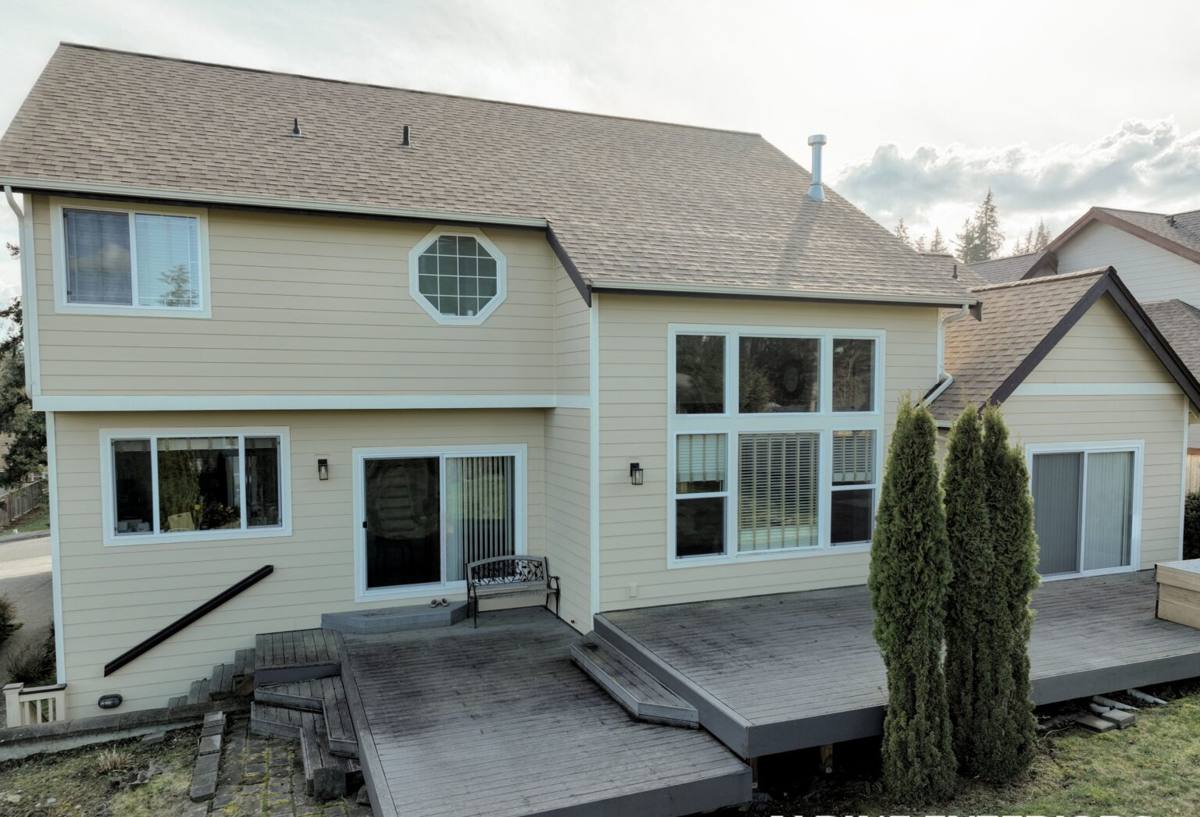
What Acme's Climate Actually Does to a Deck
Moisture That Doesn't Leave
Between tree canopy and the valley's humidity, decks in and around Acme often stay damp longer after a rain than decks out in open sun closer to town. That extra dry-time window is exactly what allows rot to start in ledger boards, joists, and the underside of decking — areas that never fully see sunlight.
Moss and Algae
A long moss season isn't just a maintenance annoyance. Moss holds water against the wood surface, and on composite or wood decking it creates a slick, slowly rotting layer that traps moisture at the board level instead of letting it shed. Left alone over a couple of winters, that moisture retention accelerates decay in wood decking and can stain and degrade the surface of lower-grade composite.
Salt Air and Fasteners
Whatcom County's proximity to the Sound means even inland areas like Acme get some airborne salt influence, especially with the region's frequent onshore weather systems. Combined with constant dampness, that's a corrosion accelerant for standard fasteners. Decks built with non-coated screws or nails often show rust streaking and fastener failure well before the decking itself is worn out.
Freeze-Thaw Cycling
Whatcom County doesn't get deep, sustained freezes most winters, but it does get repeated freeze-thaw swings — cold nights followed by wet, above-freezing days. That cycling works on any water that's already trapped in a joint, a fastener hole, or a poorly sealed ledger connection, widening small problems into bigger ones over a few seasons.
Signs Your Acme Deck Needs Replacing, Not Just Repairing
- Soft, spongy, or bouncy spots anywhere in the decking or framing
- Boards that are cupping, splitting, or separating at the ends
- Visible rot or dark staining at the ledger board where the deck meets the house
- Rust streaks running from fastener heads down the board surface
- Persistent moss or algae that returns within weeks of cleaning
- Railings or posts that flex or feel loose when you lean on them
- Gaps opening up between decking boards beyond normal seasonal movement
- A deck more than 15-20 years old that has never had the substructure inspected
Any one of these on its own might be a repair. Several at once, or rot at structural connection points, usually means the frame has been absorbing moisture for years and a repair will only mask the problem for a season or two.
What a Correct Deck Replacement Involves
Tear-Out and Inspection
We remove the old decking, railings, and as much of the substructure as needed to see what's actually happening underneath. This is where we find the real story — ledger board condition, joist rot, post base decay, and whether the original footings were sized and set correctly. You can't price or plan a replacement honestly without this step.
Ledger Board and Flashing
The ledger board — where the deck attaches to the house — is the single most common failure point we see on older decks in this area, because it's constantly exposed to whatever water runs off the house and roof above it. A correct replacement includes proper flashing between the ledger and the siding or sheathing, so water is directed away from that connection instead of sitting against it.
Framing for Local Conditions
We frame with moisture and airflow in mind: adequate spacing for ventilation under the deck, joist tape or flashing on top of framing members to shed water before it soaks into the wood, and corrosion-resistant structural hardware throughout. In a climate with this much sustained dampness, the hardware and fastener choice matters as much as the lumber grade.
Decking Material
This is where homeowners have real choices, and where the tradeoffs are worth understanding rather than guessing at.
| Material | How It Handles This Climate | Maintenance | Typical Lifespan Here |
|---|---|---|---|
| Pressure-treated wood | Affordable, but needs consistent sealing to resist the moss/moisture cycle | Annual cleaning, resealing every 1-3 years | 10-15 years with upkeep |
| Cedar | Naturally more rot- and insect-resistant, but still needs sealing against constant dampness | Sealing every 1-2 years, moss removal | 12-18 years with upkeep |
| Composite decking | Resists rot and moisture absorption well; some lower-grade products can still stain from moss/algae | Periodic washing, no sealing needed | 20-30 years depending on product |
| PVC/capped composite | Best resistance to moisture, staining, and moss buildup; fully sealed surface | Occasional washing | 25-30+ years |
We don't push one material on every homeowner. A shaded, moisture-heavy lot in Acme is a very different situation than an open, sunny yard closer to Lynden proper, and the right material depends on your site, your budget, and how much upkeep you actually want to do. What we won't do is install a decking product where the manufacturer's own warranty excludes the kind of standing moisture and shade exposure common on wooded lots here — that's a setup for a callback in a few years, and we'd rather tell you that up front.
Railings, Stairs, and Fasteners
Replacement is also the right time to address railings and stairs, since they take the same moisture exposure as the decking and are a safety item if they've loosened. We use corrosion-resistant fasteners and hardware throughout — stainless or coated structural screws, not standard exterior screws that will streak and weaken over a damp Whatcom County winter. Post bases get set with proper standoff from the deck surface so water doesn't pool against the wood.
Our Process for Acme Deck Replacements
- On-site assessment — we look at the existing deck, the ledger connection, the framing where accessible, and your site conditions (shade, drainage, tree cover)
- Honest scope and estimate — you get a clear breakdown of what's being replaced, what materials are being used, and why
- Permitting — deck replacements of most sizes require a permit; we handle that coordination so it's not on you
- Tear-out — full removal of old decking and any compromised framing, with the site protected
- Rebuild — new or reinforced framing, proper ledger flashing, correct fastener and hardware selection
- Decking and railing installation — installed to the manufacturer's specifications, which matters for both performance and warranty coverage
- Final walkthrough — we go over the finished deck with you before we consider the job done
Why Local Experience with Acme Properties Matters
A crew that hasn't worked this specific area can underestimate how much shade, tree debris, and sustained moisture a lot near Acme actually gets compared to more open parts of Lynden or Whatcom County. We've seen what happens when decks here are built or repaired to a generic standard — the ledger rots first, the moss comes back within a month of cleaning, and the fasteners rust out before the boards do. Building for the conditions this area actually has, instead of the conditions a spec sheet assumes, is the difference between a deck that needs attention every year and one that doesn't.
What Deck Replacement Typically Costs
Cost depends heavily on deck size, framing condition, material choice, and whether stairs or multiple levels are involved. As a general range, homeowners in this area typically see pressure-treated rebuilds land at the lower end of the spectrum, cedar in the middle, and composite or PVC decking toward the higher end due to material cost — though composite and PVC often even out over time with lower maintenance spending. We'll give you specific numbers once we've actually seen your deck and site conditions; broad estimates without an inspection aren't worth much in a climate this variable.
If your deck near Acme is showing its age, or you just want an honest opinion on whether it's a repair or a full replacement, we're happy to take a look. The estimate is free, there's no pressure, and you'll get a straight answer about what your deck actually needs — just fill out the form below.