 Lynden Siding
 Why Board & Batten Suits Acme Homes
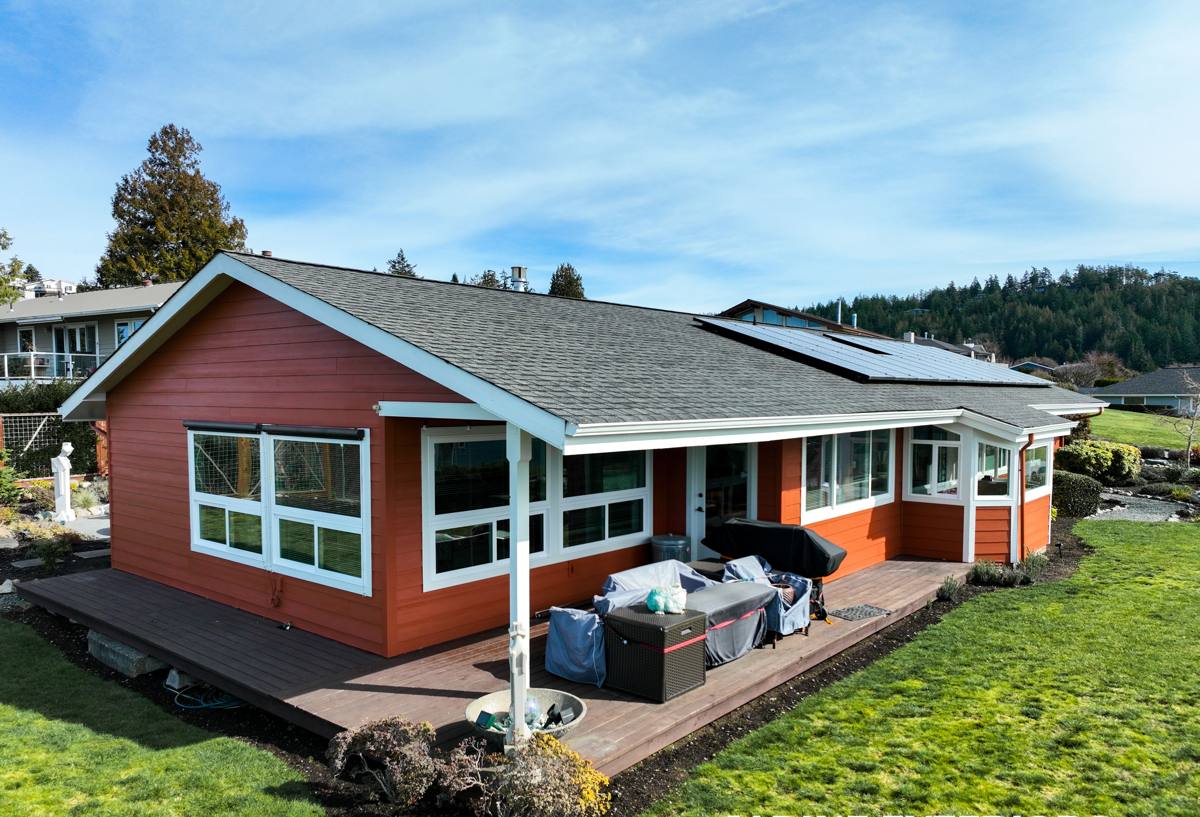
Acme sits in the wooded, foothill country east of Lynden, and the homes out here run the gamut from older farmhouses to newer builds on larger wooded lots. Board and batten siding — wide flat boards with narrower battens covering the seams — reads well on both. It gives a farmhouse a clean, traditional look and gives a newer build a more modern, cabin-style profile without looking out of place next to the trees and pasture that define this part of Whatcom County.
It's also a style choice, not just an aesthetic one. The strong vertical lines hide minor wall irregularities better than lap siding does, and on homes with gable ends, dormers, or mixed rooflines, board and batten can visually tie those different wall planes together in a way that horizontal siding sometimes can't.
What Acme's Climate Actually Does to Siding
Whatcom County doesn't get the driest treatment from the Pacific, and Acme's setting makes it worse in specific ways. Long stretches of tree canopy and hillside shade mean many homes here don't get the direct sun exposure that dries out siding quickly after a storm. Combine that with our long wet season and driving rain that comes in sideways during winter fronts, and you get siding that stays damp longer than it would on an open, sunny lot. That's exactly the environment moss and algae like, and it's exactly the environment where a poorly detailed siding job starts failing years before it should.
Vertical siding behaves differently than horizontal lap siding in this kind of climate. Water runs down the face of the boards and battens rather than resting on overlapping horizontal shadow lines, which can actually be an advantage — but only if the assembly behind the siding is built to let that water go somewhere and let the wall breathe. A board and batten wall that traps moisture behind it will rot from the inside before it ever looks bad from the street.
Moss Season Is Longer Here Than People Expect
On shaded lots, moss and algae growth can start earlier in the fall and hang on later into spring than it would on a home with full sun exposure. That's not just a cosmetic issue — moss holds moisture against the siding surface, and on the wrong material that moisture retention accelerates deterioration. Fiber cement handles this dramatically better than wood-based products because it doesn't feed the organism the way cellulose-based sidings can, and it doesn't swell or soften when moss sits on it through a wet winter.
What a Correct Board & Batten Installation Actually Requires
Board and batten looks simple — flat boards, battens over the seams — but it's one of the less forgiving siding profiles to install correctly, especially in a wet, shaded climate like Acme's. Most of what separates a job that lasts thirty years from one that needs rework in five happens behind the siding, not on the surface.
A Real Drainage Plane and Rainscreen Gap
Board and batten should never be fastened directly against the house wrap with no gap. A drainage plane and a ventilated rainscreen gap — typically vertical furring strips — let any water that gets past the siding drain down and out, and let air movement dry the wall assembly between rain events. Skip this step and you're building a moisture trap directly against the sheathing, which in a climate with as much sustained damp weather as ours is a slow-motion problem.
Fastening That Accounts for Board Movement
Boards and battens need to be fastened into solid framing with the correct fastener spacing and pattern, with enough clearance built in for the material's normal expansion and contraction. Battens fastened too tightly or spaced incorrectly over the underlying boards can pull loose or crack caulk joints within a few seasons, especially with the freeze-thaw swings and heavy seasonal rain we get.
Flashing, Trim, and Ground Clearance
Every horizontal transition — window and door heads, the base of the wall, roof-to-wall intersections — needs proper flashing, not just caulk. And the bottom edge of the siding needs real clearance from grade, decking, and soil. On wooded and rural lots like many in Acme, it's common to find siding installed too close to the ground or butted against landscaping, which holds moisture right at the most vulnerable part of the wall.
Board & Batten vs. Other Profiles for a Shaded, Wet Lot
Every siding profile can be made to work in this climate, but they don't all carry the same risk or maintenance load on a lot like the ones common in Acme.
| Factor | Board & Batten (Fiber Cement) | Lap Siding (Fiber Cement) | Panel Siding |
|---|---|---|---|
| How it handles driving rain | Sheds water vertically; depends entirely on correct rainscreen and flashing detail | Overlapping courses shed water by design, more forgiving of minor detail gaps | Large flat surface; joints and seams are the main risk points |
| Moss and algae resistance (shaded lots) | Excellent on fiber cement; vertical orientation sheds debris better than horizontal ledges | Excellent on fiber cement; horizontal ledges can collect more debris and moss | Excellent on fiber cement; large flat field can hold surface moisture longer |
| Installation sensitivity | Higher — batten spacing, fastening, and drainage gap all matter | Moderate — well-understood overlap system | Moderate — mainly seam and joint detailing |
| Style fit for farmhouse/cabin-style homes | Strong — the classic look for this setting | Good, more traditional/neutral look | Good for modern styling, less traditional |
| Long-term maintenance | Low, if installed with a rainscreen and correct flashing | Low | Low |
The takeaway isn't that board and batten is riskier as a material — it's fiber cement either way, and fiber cement is fiber cement. The risk is entirely in how it's installed. A board and batten wall built without a drainage gap will underperform a well-installed lap siding wall every time, climate be damned.
How We Approach a Board & Batten Project in Acme
- Site and wall assessment. We look at sun exposure, tree cover, grade clearance, and the condition of the existing wall assembly before we talk about materials.
- Removal and sheathing check. Old siding comes off and we inspect the sheathing underneath for any moisture damage that needs addressing before new siding goes on — this is the point where hidden problems get found and fixed, not covered up.
- Weather-resistive barrier and rainscreen. A proper house wrap goes on first, followed by vertical furring to create the drainage and ventilation gap board and batten needs in a climate this wet.
- Board and batten installation. Hardie panel boards go up first, fastened into framing at the correct spacing, followed by the battens over each seam with the clearance needed for material movement.
- Flashing and trim. Windows, doors, corners, and the base of the wall get flashed and trimmed to shed water away from the structure, not just sealed over with caulk.
- Final finish check. We check joints, fastener patterns, and clearances before calling the job done — not just how it looks from the driveway.
Signs Your Current Siding Is Already Losing to the Climate
- Dark green or black staining that keeps returning within a season or two of cleaning
- Soft or spongy spots when you press on boards, especially near the bottom of the wall
- Visible gaps opening up at batten joints or around trim
- Peeling or bubbling paint, particularly on shaded or north-facing walls
- Siding sitting close to grade, decking, or landscaping with little to no visible clearance
- Moss buildup that's thick enough to hold moisture rather than just discoloring the surface
Any one of these on its own might just mean a cleaning or repaint. Several of them together, especially on a shaded lot, usually mean the wall assembly behind the siding has been holding moisture for a while.
Why We Install Only James Hardie for This Style
Board and batten is available in wood, engineered wood, vinyl, and fiber cement, and we've made the decision to install James Hardie fiber cement exclusively, in this style and every other. For a climate like ours, the reasoning is straightforward: fiber cement doesn't feed moss and algae the way wood-based products can, it doesn't swell, cup, or delaminate when it stays damp for extended stretches, and it holds a factory-applied ColorPlus finish that's engineered to resist the fading and moisture intrusion that plain paint on site-finished siding struggles with over time.
Hardie's HZ product lines are also climate-engineered for regions like the Pacific Northwest, which matters more than it sounds like it should — a product built and tested for a dry climate doesn't necessarily perform the same way under our rainfall totals and humidity. Hardie backs the material with a strong, transferable warranty, but that warranty is only as good as the installation underneath it, which is why we treat the rainscreen, flashing, and fastening details as non-negotiable rather than optional upgrades.
Why Hiring a Crew That Already Works in Acme Matters
Acme isn't a dense subdivision — it's larger wooded lots, more tree cover, more variation in grade and drainage from one property to the next, and often older wells and septic systems that affect where equipment and materials can go during a project. A crew that already works this area knows what to expect before they show up: which parts of a lot are going to stay shaded and damp longer, how far siding needs to sit off grade given the terrain, and how Whatcom County's permitting and inspection process actually works in practice rather than just on paper.
That local familiarity shows up in small decisions throughout a project — where to add extra flashing, how much drainage gap to build in on a heavily shaded wall, how to sequence work around a wet forecast — that don't show up on a materials list but make the difference in how the siding performs ten and twenty years out.
If you're weighing board and batten siding for a home in Acme, we're happy to take a look and give you a straight assessment of what your walls need — no pressure, no upsell, just an honest estimate.