 Lynden Siding
 Why Decks in Abbotsford and Lynden Wear Out Faster Than People Expect
A deck in this part of the Pacific Northwest lives a harder life than most homeowners realize. Between Abbotsford, BC and Lynden, WA, you're dealing with a marine-influenced climate that stays damp for most of the year, punctuated by driving rain events that push moisture into every joint, fastener hole, and board gap. Add a long moss and algae season — often six months or more where surfaces rarely fully dry out — and even a well-built deck starts showing stress within a decade. Homes closer to open water or exposed to prevailing wind also pick up salt-laden air that accelerates corrosion on fasteners, brackets, and any exposed metal hardware.
None of that means decks here are doomed. It means repair work has to account for moisture cycling and slow-drying conditions, not just cosmetic wear. A repair that looks fine the day it's finished but doesn't address how water moves through the structure will fail again — usually in the same spot, usually within a season or two.
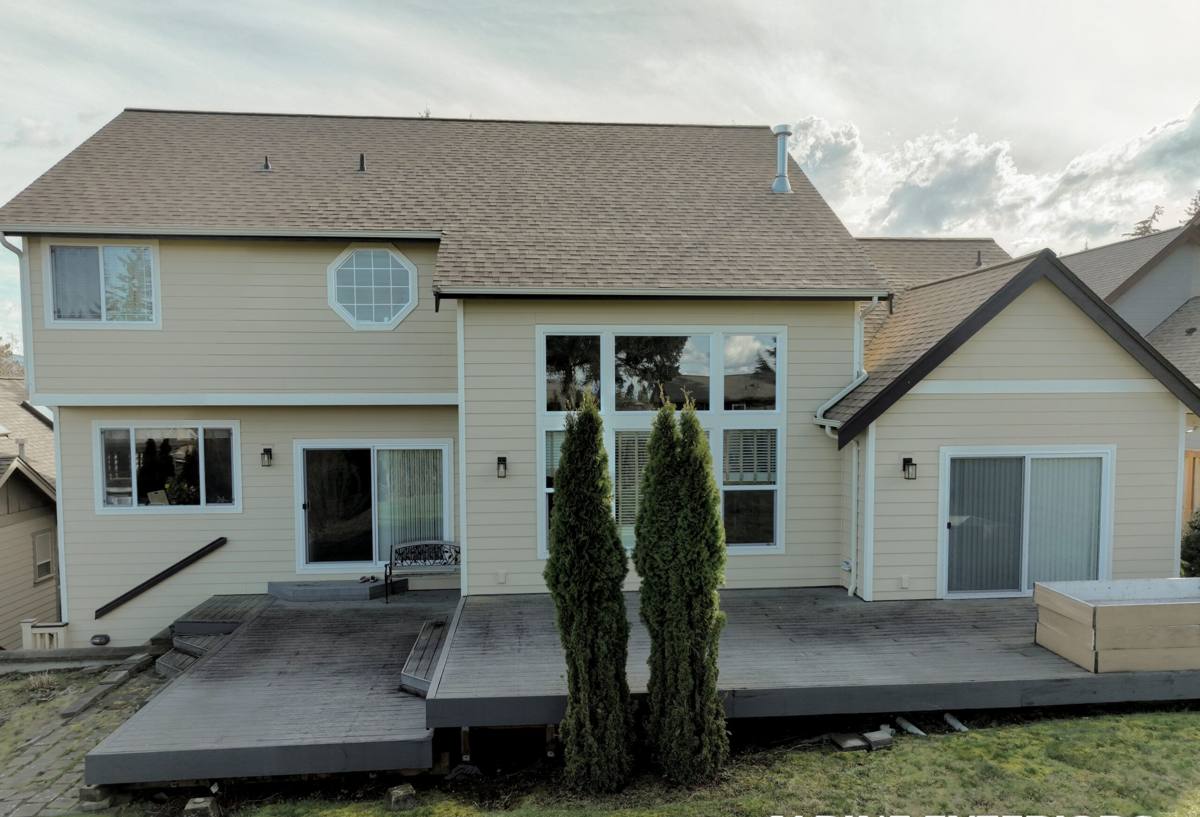
Signs Your Deck Needs Repair, Not Just a Cleaning
A lot of deck problems get mistaken for "just needs a wash and some sealant." Some do. Others are early signs of structural trouble that a pressure wash will only mask. Here's what we actually look for:
- Soft, spongy, or springy spots underfoot — usually rot in the joists or decking below
- Boards that have cupped, split lengthwise, or pulled away from fasteners
- Persistent black or green staining that comes back within weeks of cleaning
- Rust streaks bleeding from screws, nails, or joist hangers
- A railing or guardrail that flexes or wiggles when you lean on it
- Gaps or separation where the deck ledger board meets the house
- Visible daylight or water staining underneath where the deck meets the siding or foundation
- Stair stringers that feel uneven, bouncy, or show cracking at the notches
If you're seeing more than one or two of these, it's worth having someone look at the framing, not just the surface boards.
What a Correct Deck Repair Actually Involves
Structural Inspection First
Before any board gets pulled or replaced, a proper repair starts underneath. That means checking the ledger board attachment to the house, the condition of the joists and beams, post bases, and any hardware holding it together. Surface rot is often a symptom — the actual cause is usually a flashing gap, a missing vapor barrier behind the ledger, or fasteners that have corroded enough to lose their grip.
Ledger Board and Flashing
The ledger board — where the deck bolts to the house — is the single most common failure point we find in this region, and it's also the least visible from a casual walk-around. Without proper flashing to shed water away from the house wall, moisture tracks behind the ledger for years before it shows up as visible rot or a sagging deck edge. Any repair that doesn't correct the flashing detail is a temporary fix at best.
Framing, Joists, and Fasteners
Damaged joists get sistered (reinforced alongside a new piece of lumber) or fully replaced depending on how far the rot has spread. We also look hard at fastener condition — older galvanized nails and screws corrode faster than people expect in a damp coastal climate, and a deck can look structurally fine while its connections are quietly failing.
Decking Surface and Guardrails
Once the structure underneath is sound, surface boards, stair treads, and guardrails get addressed. Guardrail repair matters more than it gets credit for — a loose or rotted rail post is a safety issue, not a cosmetic one, and it's one of the first things we test on every inspection.
Deck Materials We Commonly Repair
What a repair should look like depends heavily on what the deck was originally built with. Older decks in this area are a mix of pressure-treated lumber, cedar, and — on newer builds — composite decking. Each behaves differently once moisture gets involved.
| Material | How It Behaves in This Climate | Typical Repair Approach |
|---|---|---|
| Pressure-treated lumber | Resists rot reasonably well but is vulnerable at cut ends, fastener holes, and anywhere the treatment has worn through | Sister or replace affected framing; reseal cut ends; upgrade to corrosion-resistant fasteners |
| Cedar | Naturally rot-resistant early on, but softens and checks (cracks) once finish coatings fail and moisture sits in the grain | Selective board replacement matched to existing spacing; refinish with a breathable sealant |
| Composite decking | Doesn't rot, but can trap moisture against framing below if ventilation is poor, and older composite can fade or flake | Address framing/ventilation first; replace failed boards; check hidden fastener clips |
| Older mixed-material decks | Common on homes that have had prior patch repairs; often the weakest link is where two materials or two eras of work meet | Full structural check before any surface work; standardize hardware and flashing details |
Repair or Replace? The Honest Cost Factors
Not every deck problem needs a full rebuild, and not every deck is worth saving as-is. We'd rather tell you honestly which side of that line your deck falls on than sell you more work than you need.
| Factor | Leans Toward Repair | Leans Toward Full Replacement |
|---|---|---|
| Deck age | Under 15-20 years, built to a reasonable original standard | Original construction is 25+ years old or was never built to current attachment standards |
| Extent of rot found | Isolated to one or two joists, a section of decking, or the guardrail | Rot found at multiple structural points or spreading through the ledger connection |
| Ledger/flashing condition | Attachment is sound; flashing can be corrected without full teardown | Ledger is failing or was never properly flashed to begin with |
| Footings and posts | Footings are sized and set correctly, just need post or base hardware work | Footings are undersized, frost-heaved, or not code-compliant for the deck's span |
| Your timeline and budget | You want to extend usable life a number of years affordably | You're planning to stay long-term and want it solved once |
Our Deck Repair Process
- Free on-site inspection. We get underneath the deck, not just look at the surface, and check ledger, framing, posts, and fasteners.
- Diagnose the cause, not just the symptom. If a board is rotting, we find out why — usually a moisture path — before deciding what to replace.
- Written scope and straightforward pricing. You get a clear explanation of what's structural, what's cosmetic, and what your realistic options are.
- Repair work. Framing and flashing corrections first, then surface materials, stairs, and guardrails.
- Walkthrough and cleanup. We show you what was done and why, and leave the site clean.
Maintenance That Extends a Repaired Deck's Life
A good repair buys you years, but this climate will keep testing it. A short list of upkeep habits makes a real difference between a repair that lasts five years and one that lasts fifteen:
- Clear leaves and debris from between boards before the wet season sets in — trapped organic matter holds moisture and feeds moss
- Keep gutters and downspouts near the deck clear so runoff isn't dumping directly onto it
- Reseal or refinish wood decking on the schedule the product actually needs, not just when it looks faded
- Check guardrail posts for movement at least once a year
- Look underneath periodically for new staining, especially near the ledger board
- Avoid stacking planters, firewood, or storage bins directly on deck boards for extended periods — they trap moisture underneath
Permits, Codes, and Working Across the Border
Abbotsford, BC and Lynden, WA sit close enough together that we regularly field questions from homeowners on both sides of the border, but the two sides fall under different building jurisdictions with their own permit requirements and guardrail/structural standards. We work within whatever local code applies to your property — that's part of scoping the job correctly rather than assuming one set of rules covers both. If a repair touches structural framing, footings, or guardrail height, it's worth confirming upfront whether a permit is required in your jurisdiction; we'll tell you plainly if we think yours does.
Why a Crew That Already Works This Area Matters
Deck repair done by someone unfamiliar with Fraser Valley and Whatcom County conditions tends to under-plan for moisture. A crew based somewhere drier might reach for the same fasteners, sealants, or flashing details they'd use in a low-rainfall region, and those choices don't hold up here. Working regularly in Abbotsford, BC and Lynden means we're not guessing at how long a driving rain event lasts, how late into the year moss keeps growing, or how salt air near open water eats through unprotected hardware. It also means we've seen how earlier repairs — done right or done wrong — actually hold up over years, not just at the final walkthrough.
If your deck has soft spots, a wobbly rail, staining you can't get rid of, or you just want an honest read on whether it needs repair or replacement, we're glad to come take a look. The estimate is free, there's no pressure attached to it, and you'll get a straight answer about what your deck actually needs — use the form below to get started.