 Lynden Siding
 Wiser Lake's Climate Is Harder on Siding Than Most Homeowners Realize
Wiser Lake sits in a part of Whatcom County where the weather doesn't do siding any favors. The marine air moving inland off the Salish Sea carries a faint but persistent salt content, the fall and winter storm pattern brings driving, wind-pushed rain rather than gentle vertical rain, and the combination of shade, moisture, and mild temperatures around the lake gives moss and algae months at a time to establish themselves on any surface that stays damp. None of this is exotic weather. It's just relentless, and siding around Wiser Lake spends more days per year in a damp, humid state than siding does in drier parts of the state.
That matters because most siding failures aren't caused by one dramatic storm. They're caused by years of moisture sitting where it shouldn't, wind-driven rain finding a seam that was never sealed correctly, or a north-facing wall that never fully dries out between rain events. A siding product and installation that would hold up fine in a drier inland climate can start showing problems here in half the time.
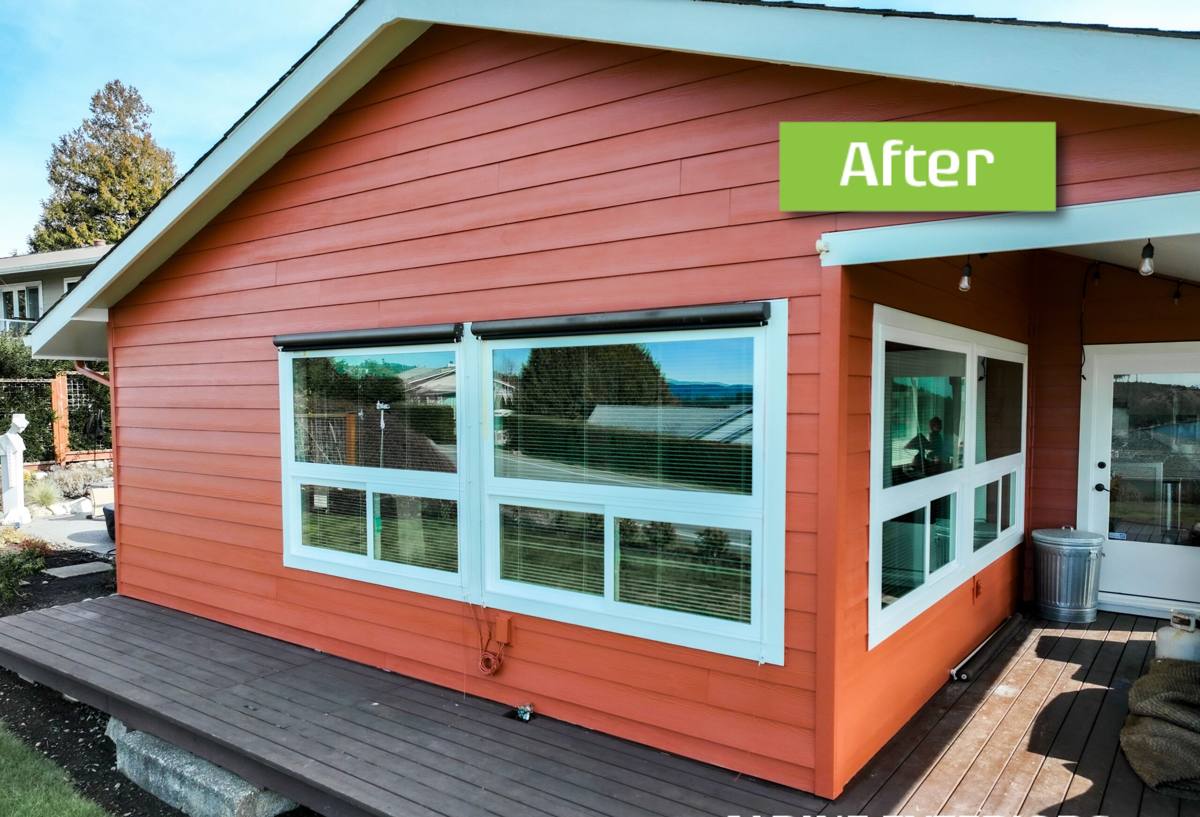
What Wiser Lake Homes Actually Need From Their Siding
Given that climate profile, siding on a Wiser Lake home needs to do three things well, not just one:
- Shed water fast. The siding profile and the flashing behind it need to move wind-driven rain back out and away from the wall assembly, not just resist it on the surface.
- Resist moss and algae growth without constant maintenance. A finish that stays cleaner longer means less pressure-washing, less scrubbing, and less chance of someone damaging the siding trying to clean it.
- Hold its shape and finish through repeated wet-dry cycling. Materials that swell, warp, or delaminate when they take on moisture will eventually show it at the seams and corners, even if the surface looks fine from the street.
This is the lens we use on every Wiser Lake project: not "what siding looks good today," but "what siding is still doing its job in fifteen years given exactly what this property sits in."
Why We Only Install James Hardie Fiber Cement
We standardized on James Hardie fiber cement siding for every home we work on, including around Wiser Lake, and we don't install vinyl, LP SmartSide, cedar, primed spruce, or other fiber cement brands. That's not a marketing position — it's a decision based on what holds up under the conditions described above.
Fiber cement is dimensionally stable. It doesn't expand and contract with moisture the way wood-based products do, which matters a lot in a climate that never really dries out for long. It's also non-combustible, which is a real advantage independent of climate. James Hardie backs its siding with a factory-applied ColorPlus finish that's baked on and warranted against fading and peeling, so the color layer isn't something applied on-site that depends on weather conditions during installation, and it isn't something a homeowner needs to repaint on a schedule.
James Hardie also engineers different product lines for different climate zones (its HZ5 line, for example, is built for the moisture and freeze-thaw exposure typical of the Pacific Northwest), which means the product going on a Wiser Lake wall was designed with weather like this in mind, not adapted after the fact.
How James Hardie Compares on the Points That Matter Here
| Factor | Why It Matters at Wiser Lake | James Hardie's Approach |
|---|---|---|
| Moisture cycling | Long wet season, humid lake air, slow drying | Fiber cement doesn't swell or rot; dimensionally stable wet or dry |
| Moss and algae | Shaded, damp walls encourage growth | Dense factory finish sheds growth better than porous or wood-based surfaces |
| Salt-tinged marine air | Accelerates corrosion and finish breakdown over time | Non-combustible cement composition with factory finish rated for exterior exposure |
| Wind-driven rain | Pushes water sideways into seams, not just down | Correct lap, flashing, and joint treatment stop intrusion at the install level |
| Long-term color | UV plus damp cycling fades painted surfaces faster | ColorPlus factory finish with its own fade warranty, separate from paint |
What a Correct James Hardie Installation Involves
The product is only half the story. James Hardie siding installed without attention to detail can still let water in, and a lot of the siding problems we see on older homes near the lake trace back to installation shortcuts, not the material itself. A correct install includes:
Water Management Behind the Siding
- A weather-resistant barrier installed and lapped correctly, shingle-style, so water is directed down and out at every layer
- Flashing at every window, door, and roof-to-wall intersection, with kick-out flashing where a roofline meets a wall to keep water from running behind the siding
- A rainscreen gap where conditions call for it, so any moisture that does get behind the cladding has somewhere to drain and air to dry
- A proper weep path at the base of the wall so trapped water has an exit instead of pooling against the framing
Fastening and Fit
- Manufacturer-specified nailing patterns and fastener types, not whatever is fastest for the crew
- Correct plank overlap and gapping at butt joints, sized for the specific product line being installed
- Sealant only where James Hardie's own instructions call for it — over-caulking joints that are supposed to allow drainage traps moisture instead of shedding it
- Field-cut edges primed or sealed per spec so raw cut ends aren't left exposed to the weather
Every one of those details is spelled out in James Hardie's own installation guidelines, and every one of them is easy to skip on a job that's being rushed. On a home near Wiser Lake, skipping any of them shortens the timeline to a callback.
Our Process for a Wiser Lake Siding Project
- On-site assessment. We look at existing siding condition, wall exposure (which sides take the worst wind-driven rain), any trapped moisture or rot at trim and corners, and the home's specific shade and drainage pattern around the lake.
- Product and profile selection. We walk through the relevant James Hardie lines and profiles (lap siding, panel, shingle-style) for the home's style and exposure, and explain the trade-offs plainly rather than pushing a single option.
- Tear-off and inspection. Removing the old siding is when hidden problems show up — soft sheathing, missing flashing, old moisture damage. We address what's found before anything new goes up, rather than covering it.
- Water barrier and flashing installation. This is the step that determines whether the siding actually performs, and it's the step that's invisible once the job is finished — which is exactly why we don't shortcut it.
- Siding installation to manufacturer spec. Correct fastening, spacing, and sealant placement, following James Hardie's published requirements for the product and climate zone.
- Final walk-through. We review the finished work with the homeowner and go over basic care so the siding performs the way it's designed to for its full warranty life.
Cost Factors on a Wiser Lake Home
We don't quote firm numbers without seeing the property, but the main variables that move the price on a typical Wiser Lake siding project are:
| Factor | Why It Affects Cost |
|---|---|
| Home size and wall area | More square footage means more material and labor, straightforwardly |
| Existing siding removal and disposal | Tear-off adds labor time and disposal cost versus installing over prepared sheathing |
| Hidden moisture or rot repair | Damaged sheathing or framing found during tear-off has to be repaired before new siding goes on |
| Trim, corners, and architectural detail | More corners, windows, and rooflines mean more flashing and cutting labor |
| Siding profile chosen | Lap siding, panel systems, and shingle-style products differ in material and labor cost |
| Site access | Lakefront or wooded lots with tighter access can add setup and staging time |
Why It Matters That We Already Work Around Wiser Lake
A crew that's worked this specific area knows which walls take the worst of the wind-driven rain off the lake, which lots hold shade and moisture longer into the day, and where moss tends to establish first on a typical roofline and wall junction. That's not something you can fully account for from a general climate zone chart — it comes from having done the work here before.
Local experience also means we're familiar with Whatcom County's permitting expectations and the realistic timeline for scheduling around the wetter months, so a project doesn't stall out mid-tear-off when a home has its weather barrier temporarily exposed. That timing detail matters more here than it does in a drier climate, because an exposed wall assembly during a heavy rain stretch is a real risk, not a theoretical one.
What to Ask Any Siding Contractor Working Near the Lake
- Do you follow James Hardie's published installation instructions for flashing and fastening, and can you explain what that involves?
- How do you handle kick-out flashing at roof-to-wall intersections?
- What's your plan if you find moisture damage or soft sheathing once the old siding is off?
- Do you install a rainscreen or drainage gap, and under what conditions?
- Can you walk me through why you'd recommend one Hardie profile over another for this specific home?
If a contractor can't answer those clearly, that's worth knowing before the tear-off starts, not after.
Ready to Talk About Your Wiser Lake Home?
If your siding is showing moss, staining, soft spots, or you're just planning ahead of the next wet season, we're happy to take a look and walk you through what your home specifically needs. Reach out for a free, no-pressure estimate using the form below.