 Lynden Siding
 Birch Bay Roofs Work Harder Than Most
Birch Bay sits right where Whatcom County meets the water, and that location changes what a roof has to survive. Homes a few miles inland in Lynden deal with plenty of rain, but Birch Bay roofs also take on salt-laden air off the water, wind-driven rain that hits shingles sideways instead of straight down, and a moss season that runs longer than most homeowners expect. None of that is exotic or unusual for the area — it's just the baseline. The problem is that a lot of roofing work done here is installed the same way it would be twenty or forty miles inland, using details that hold up fine in a drier, calmer spot but wear out faster on a shoreline-adjacent home.
A correctly installed roof in Birch Bay isn't a different product so much as a different set of decisions: which fasteners resist corrosion, where extra underlayment goes, how flashing is lapped, and how much attention ventilation gets. Skipping any one of those doesn't usually cause a visible problem in year one. It shows up in year eight or ten as a leak, premature granule loss, or moss that keeps coming back no matter how many times it's cleaned off.
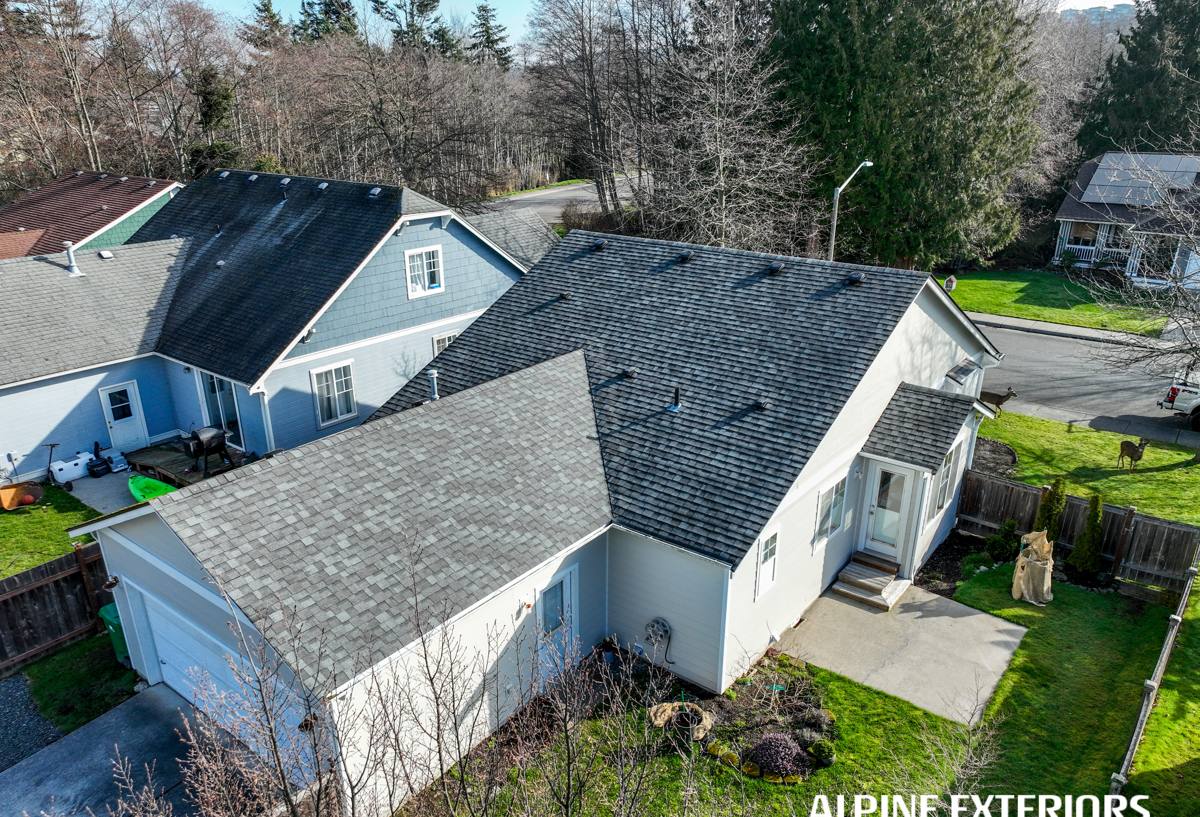
What the Climate Actually Does to a Roof Here
Salt Air and Metal Components
Salt in the air accelerates corrosion on anything metal — nails, flashing, vent boots, drip edge. Standard electro-galvanized fasteners can start to bleed rust stains through shingles years before the shingle itself is worn out. This is one of the most common early-failure signs we see on homes close to the water: rust streaking around nail heads or flashing edges while the shingles around them still look fine.
Driving Rain and Wind
Wind off the water pushes rain up and sideways under roof edges, into valleys, and around anything that penetrates the roof deck — vent pipes, chimneys, skylights. A roof that would be watertight in a calm inland yard can leak in Birch Bay if the underlayment and flashing weren't installed with that wind-driven water in mind.
Moss, Shade, and Moisture
The combination of tree cover, marine humidity, and mild winters gives moss a long growing window here — often close to year-round. Moss holds moisture against the roof surface, works its way under shingle tabs, and lifts them over time. It also traps organic debris in valleys and at eaves, which is where a lot of hidden leaks actually start.
What a Correct Installation Includes
None of this is complicated or unusual in the roofing trade — it's standard best practice. The difference in a coastal Whatcom County job is which details get treated as optional and which don't.
- Corrosion-resistant fasteners and flashing (stainless or heavier-coated options) in place of standard-grade hardware
- Ice-and-water shield membrane at eaves, valleys, and around every roof penetration, not just where code minimums require it
- Properly lapped step flashing and counterflashing at any wall or chimney intersection, sealed against wind-driven rain from multiple directions
- Balanced intake and exhaust ventilation so the attic isn't holding moisture that later shows up as rot or mold in the decking
- Valley and eave detailing sized for actual rainfall volume, not just the code minimum
- A roof deck that's inspected and repaired before anything new goes down, not just covered over
Comparing Roofing Materials for a Birch Bay Home
There's no single "correct" material for every house — it depends on your roof's slope, sun exposure, budget, and how much moss and maintenance you're willing to manage. Here's how the common options actually compare for this specific climate.
| Material | How It Handles Salt Air & Rain | Moss Resistance | Typical Lifespan Here | General Cost Position |
|---|---|---|---|---|
| Architectural asphalt shingle | Good, with corrosion-resistant fasteners and flashing | Moderate — benefits from zinc/copper strips or periodic cleaning | 20–30 years | Lower to mid |
| Standing seam metal | Excellent when properly coated and grounded against galvanic corrosion | High — sheds debris, little surface for moss to grip | 40–50+ years | Higher |
| Basic 3-tab asphalt shingle | Fair — thinner profile is more sensitive to wind uplift | Lower — flatter surface holds moisture longer | 15–20 years | Lowest |
| Cedar shake | Requires diligent maintenance in marine humidity | Low without regular treatment — moss and moisture are its main enemies | Highly maintenance-dependent | Higher |
Our general standard is architectural shingle or standing seam metal for most Birch Bay homes, matched to the roof's exposure and the homeowner's budget and maintenance appetite. We'll walk through the honest trade-offs for your specific roof rather than push one product across the board.
Our New Roof Installation Process
1. Inspection and Estimate
We start by walking the roof and attic, not just eyeballing it from the ground. We're checking deck condition, ventilation, flashing points, and how the current roof has actually failed — that tells us what to do differently on the replacement.
2. Tear-Off and Deck Inspection
Full tear-off to the deck, every time. Roofing over an existing layer hides problems and shortens the life of the new roof. Once the deck is exposed, we inspect for soft spots, rot, or delamination and replace any bad sections before anything new goes down.
3. Underlayment and Water Protection
Ice-and-water shield goes at eaves, valleys, and penetrations, with synthetic underlayment across the rest of the deck. This is the layer that actually keeps the house dry if wind ever drives rain under the shingles — it matters more here than in drier parts of the state.
4. Flashing and Penetrations
New flashing at every wall intersection, chimney, and vent — we don't reuse old flashing on a new roof. This is one of the most common places we find prior leaks traced back to, and it's cheap insurance to replace it now rather than patch it later.
5. Roofing Material Installation
Installed to manufacturer spec for nailing pattern, exposure, and fastener type, with corrosion-resistant hardware given the coastal exposure.
6. Ventilation Check
We confirm intake at the eaves and exhaust at the ridge are balanced for your attic's size. This step gets skipped more often than it should, and it's a major factor in both moss regrowth and long-term deck health.
7. Cleanup and Final Walk-Through
Magnetic sweep for stray nails, full site cleanup, and a walk-through so you know what was done and what to watch for going forward.
Ventilation: The Half of the Job You Can't See
A lot of roof problems that look like a bad roofing job are actually ventilation problems. When an attic can't breathe properly, moisture builds up underneath the roof deck. Over time that moisture feeds rot from below, and it also keeps the underside of the roof cooler and damper than it should be — which, combined with our shaded, humid marine air, is exactly the condition moss likes. We size and balance ventilation as part of every new roof install, not as an upsell add-on, because a beautiful new roof on top of a poorly ventilated attic is a roof that ages faster than it should.
Signs a Birch Bay Roof Needs Replacing, Not Just Repair
Not every issue means a full replacement — plenty of problems are legitimate repairs. But some signs point toward a roof that's past the point where patching makes sense.
- Granule loss heavy enough that you're finding shingle grit in gutters regularly
- Multiple soft or spongy spots when walked on, suggesting deck damage under the surface
- Rust staining spreading from multiple fastener or flashing points, not just one isolated spot
- Moss regrowth within months of cleaning, especially on north-facing or heavily shaded slopes
- Daylight visible through the attic decking, or damp insulation after a windy rain event
- Shingles that are curling, cupping, or losing their seal in multiple areas rather than just at one edge
- A roof already at or past its expected lifespan with more than one of the issues above showing up together
Why It Matters That We Already Work in Birch Bay
Roofing work here isn't fundamentally different from roofing anywhere in the Pacific Northwest — good practices are good practices. But a crew that's already worked a number of Birch Bay roofs has a feel for which slopes and orientations hold moss longest, which fastener grades actually hold up long-term this close to the water, and how local wind exposure tends to drive rain compared to a more sheltered lot a few miles inland toward Lynden. That's the kind of knowledge that comes from doing the work here repeatedly, not from a general roofing checklist. We're a Whatcom County crew — this area is our regular service territory, not a one-off drive-out job.
Warranty and Maintenance After Installation
Manufacturer warranties cover material defects, and workmanship coverage on our end covers the installation itself — we'll walk you through exactly what's covered and for how long before you sign anything. After that, the biggest thing you can do for a coastal roof is keep an eye on moss and debris buildup, especially in valleys, and have it checked periodically rather than waiting for a visible leak. A five-minute look from the ground after a big windstorm is worth doing, too — loose or missing shingles are much cheaper to fix before the next heavy rain finds the gap.
What to Ask Before You Hire Anyone for This Job
- Are you doing a full tear-off to the deck, or roofing over the existing layer?
- What fastener and flashing grade are you using, and is it upgraded for coastal exposure?
- Will you inspect and balance attic ventilation as part of the job?
- What does the workmanship warranty cover, and for how long?
- Have you worked on other roofs in Birch Bay or similar shoreline-adjacent areas?
If you're weighing a roof replacement in Birch Bay, we're happy to take a look and give you a straight read on what your roof actually needs — no pressure, no inflated urgency. Use the form below to request a free estimate.