 Lynden Siding
 Laurel's Climate Is Harder on Siding Than Most Homeowners Realize
Laurel sits inside a stretch of Whatcom County that gets more weather exposure than its quiet, tree-lined streets let on. Salt-tinged air drifting in off the Sound, long stretches of driving rain that comes in sideways rather than straight down, and a moss season that can run from October through April all put steady pressure on exterior siding. None of this is dramatic on any single day. It's the accumulation — years of damp air, cycles of wet and dry, and shaded north walls that never fully bake off — that separates siding systems that hold up from siding systems that don't.
Homeowners in this part of Lynden often don't notice a problem until it's already behind the wall: soft trim, a musty smell in a closet on an exterior wall, or moss creeping up from the bottom courses of siding. A siding product and installation method chosen for a drier climate, or installed without this area's rain and moss exposure in mind, tends to show its weaknesses here faster than it would somewhere else in the country.
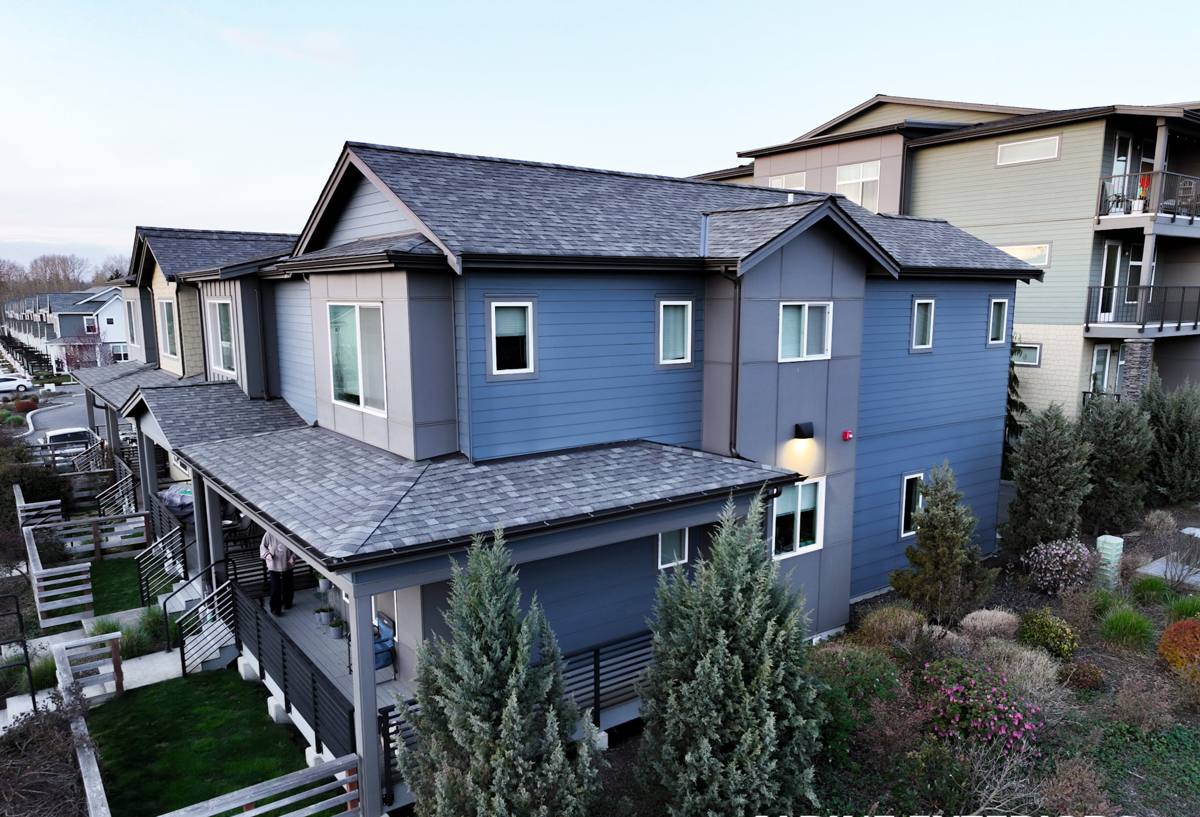
What Fiber Cement Siding Actually Is
Fiber cement is a manufactured siding material made from cement, sand, and cellulose fiber, cured into dense, dimensionally stable boards and panels. It's heavier and more rigid than vinyl, doesn't rot the way solid wood or primed spruce can, and it's non-combustible — it won't ignite or contribute fuel to a fire the way wood-based products can. It's manufactured to hold a factory-applied finish and to keep its shape through swings in temperature and moisture far better than wood products, which move with humidity, or vinyl, which can warp in heat.
Why We Install Only James Hardie
Fiber cement is a category, not a single product, and the manufacturing quality behind it varies. We install James Hardie exclusively — not LP SmartSide, not vinyl, not Cemplank or Allura, not primed spruce or cedar — because it's the fiber cement system we trust to hold up under this region's rain and moss exposure without turning into a maintenance project. Hardie's ColorPlus factory finish is baked on and warrantied against fading and peeling in a way field-applied paint jobs on wood or engineered wood siding aren't. Hardie's HZ product line is also climate-engineered for wet regions like ours, with moisture and cold-crack performance in mind. LP SmartSide, cedar, and primed spruce are wood-based products at their core: well-made, but wood-based siding depends on an intact factory or field finish to keep moisture out, and any breach — a cut edge, a missed caulk joint, a woodpecker hole — gives water a path into the substrate itself. Vinyl avoids that specific failure mode but brings its own trade-offs: it expands and contracts significantly with temperature, it can crack in cold snaps, and it doesn't hold paint if a homeowner ever wants to change the color. We standardized on Hardie because, installed correctly, it holds its finish, resists moisture intrusion at the board level, and comes with a strong transferable warranty — and because we'd rather install one product very well than several products adequately.
How Fiber Cement Holds Up Against Laurel's Weather
Against salt air, fiber cement doesn't corrode the way metal trim or fasteners can, and it doesn't absorb salt-laden moisture into its fibers the way wood does. Against driving rain, a dense fiber cement board sheds water at the surface rather than wicking it into the material — but only if the water is also being managed correctly behind the siding, which is an installation issue as much as a product one. Against moss, a factory-cured, ColorPlus-finished surface gives algae and moss spores less to grip than raw or lightly primed wood, and it holds up to occasional soft washing without the finish degrading the way field paint can. None of that means fiber cement is maintenance-free — it means the material itself isn't the weak point, so the parts of the job that are still weak points (flashing, sealant, ground clearance, water management) matter even more.
What a Correct Installation Involves in This Climate
Moisture Management Behind the Siding
A weather-resistive barrier goes on the sheathing before any siding, and every seam, window, and door opening gets flashed so water is directed out and down, never trapped behind the cladding. In a climate that gets as much sustained rain as Whatcom County, we also pay close attention to whether a wall assembly benefits from a rainscreen gap — a small air space behind the siding that lets any moisture that does get past the surface dry out instead of sitting against the sheathing.
Fastening and Clearances
Hardie siding has specific nailing patterns, fastener types, and minimum clearances from grade, roofing, and decks that are in the manufacturer's installation guide for a reason — they're what keep the warranty valid and keep water from wicking up into the bottom edge of the siding. Skipping these details is one of the most common ways a fiber cement job underperforms even though the material itself is right.
Caulking and Sealing Done Right
Joints, butt seams, and penetrations (hose bibs, vents, light fixtures) need the right sealant, applied correctly, not just a bead run down every visible seam. Over-caulking can trap moisture as easily as under-caulking lets it in, and we install with the goal of keeping the wall assembly able to dry out on its own.
James Hardie Product Lines That Make Sense Here
Most Laurel homes are well suited to HardiePlank lap siding, which gives the traditional horizontal look most buyers expect in this part of Lynden while carrying Hardie's full moisture and finish performance. HardiePanel vertical siding works well for accent walls, gables, or a more modern look, and HardieShingle gives a staggered, shake-style appearance for homes that want that texture without the maintenance of real cedar shingle. All of these are available in Hardie's HZ5 climate-engineered formulation, built specifically for regions with sustained moisture exposure like the Pacific Northwest, and finished with ColorPlus Technology — a factory-applied, baked-on finish backed by its own finish warranty, which holds color and resists the kind of chalking and fading you'll eventually see on field-painted siding exposed to this much rain and gray-sky UV cycling.
Comparing Siding Materials and What Drives Cost
Material Comparison
| Factor | James Hardie Fiber Cement | Vinyl | Cedar / Primed Wood | Engineered Wood (LP SmartSide) |
|---|---|---|---|---|
| Moisture resistance | High — cement-based, doesn't absorb and swell | Good at the surface, but seams can let water behind panels | Depends entirely on finish being intact | Wood-strand core depends on finish and edge sealing |
| Moss / algae resistance | Strong with ColorPlus finish | Moderate; can stain over time | Low without regular treatment | Moderate; finish-dependent |
| Fire performance | Non-combustible | Combustible, can melt/deform | Combustible | Combustible |
| Finish longevity | Factory ColorPlus, long warranty | Color molded in, can fade/chalk | Field paint/stain, needs recoating | Field or factory finish, needs monitoring |
| Typical lifespan when installed to spec | Multiple decades | Decades, but earlier warping/fading in harsh sun or cold | Shorter without diligent upkeep | Shorter if moisture reaches the core |
What Drives Cost on a Project Like This
| Cost Factor | Why It Matters |
|---|---|
| Home size and number of stories | More square footage and taller walls mean more material and labor, plus added staging for upper stories |
| Condition of existing sheathing and trim | Hidden rot found during tear-off has to be repaired before new siding goes on |
| Siding profile chosen | Lap, panel, and shingle styles differ in material and labor time |
| Trim and detail work | Corner boards, window trim, and fascia detailing add time relative to a plain box wall |
| Site access | Tight side yards, fencing, or landscaping close to the walls slow down tear-off and staging |
We give real numbers after walking the actual house — broad guesses on Whatcom County homes without seeing the wall condition and layout tend to be wrong in both directions.
Our Process for a Laurel Installation
- Walk the exterior and assess the existing siding, trim, and any visible moisture damage or ventilation issues
- Remove old siding and inspect sheathing, repairing or replacing any compromised wood before moving forward
- Install or verify the weather-resistive barrier and flash all windows, doors, and penetrations
- Add a rainscreen gap where the wall assembly calls for it, to let the wall dry properly
- Install James Hardie siding to manufacturer nailing patterns, fastener specs, and clearance requirements
- Finish trim, corners, and joints, and seal with the correct sealant at the correct locations
- Walk the finished job with the homeowner and go over basic care for the new siding
Maintenance in a Moss-Prone, High-Rainfall Climate
- Clean gutters at least twice a year so overflow doesn't run down the siding face
- Keep shrubs and trees trimmed back from walls to let air circulate and surfaces dry between rains
- Soft wash siding when moss or algae appear rather than pressure washing, which can force water behind joints
- Check caulking at trim, seams, and penetrations once a year and touch up before winter rains set in
- Maintain proper ground clearance — mulch, soil, or hardscaping shouldn't be piled up against the bottom of the siding
- Inspect flashing above windows, doors, and any wall-mounted fixtures for gaps or corrosion
Why Local Experience in Laurel and Lynden Matters
A crew that already works this part of Whatcom County has seen how the same siding install performs on a shaded north wall near the tree line versus an open, wind-exposed elevation, and adjusts detailing accordingly. They're familiar with the permitting and inspection expectations for exterior work in the area, and they've already made the mistakes — on other jobs, not yours — that come from underestimating how much rain and moss exposure a wall assembly here actually sees. That local track record matters more with fiber cement than with some other materials, because Hardie's performance and warranty both depend on installation being done to spec, not just on the product being good.
If you're weighing a siding project on a Laurel home, we're glad to come out, look at the actual walls, and give you a straight answer on what it would take — no pressure, no obligation, just a clear picture of the work and the cost.